

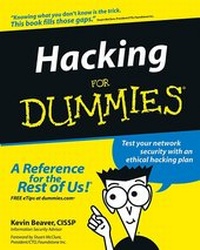
Hacking For Dummies
1st Edition
Published on 30. April 2004
Book
Paperback/Softback
378 pages
978-0-7645-5784-2 (ISBN)
Description
Not intended for malicious hackers, this book discusses hacking methods and penetration testing techniques that are non-destructive in nature and explores the malicious hacker's mindset, helps the reader develop an ethical hacking plan, and covers eleven typical hack attacks and how to counteract them. Finally, it takes the reader through reporting vulnerabilities to upper management, managing security changes, automating the ethical hacking process, and training end users not to be victims of social engineering.
Reviews / Votes
"...a good read...a price well--worth paying, because such works are invaluable..." (InfoSecurity News Magazine, August 2004) "...an excellent aide..." (PC Home, August 2004) "...should be of interest to both ethical and malicious hackers..." (Publishing News, 22 nd March 2004)More details
Edition
1., Aufl.
Language
English
Place of publication
Foster City
United States
Publishing group
John Wiley & Sons Inc
Target group
College/higher education
Professional and scholarly
Illustrations
Illustrations
Dimensions
Height: 23.4 cm
Width: 18.7 cm
Weight
539 gr
ISBN-13
978-0-7645-5784-2 (9780764557842)
Schweitzer Classification
Other editions
New editions
Kevin Beaver
Hacking For Dummies
Book
10/2006
2nd Edition
Wiley
€19.90
Article exhausted; check for reprint
Persons
Kevin Beaver is a consultant who specializes in security assessments and incident response. He is a regular columnist and expert advisor for SearchSecurity.com and SearchMobileComputing.com.
Content
Foreword. Introduction. Part I: Building the Foundation for Ethical Hacking. Chapter 1: Introduction to Ethical Hacking. Chapter 2: Cracking the Hacker Mindset. Chapter 3: Developing Your Ethical Hacking Plan. Chapter 4: Hacking Methodology. Part II: Putting Ethical Hacking in Motion. Chapter 5: Social Engineering. Chapter 6: Physical Security. Chapter 7: Passwords. Part III: Network Hacking. Chapter 8: War Dialing. Chapter 9: Network Infrastructure. Chapter 10: Wireless LANs. Part IV: Operating System Hacking. Chapter 11: Windows. Chapter 12: Linux. Chapter 13: Novell NetWare. Part V: Application Hacking. Chapter 14: Malware. Chapter 15: Messaging Systems. Chapter 16: Web Applications. Part VI: Ethical Hacking Aftermath. Chapter 17: Reporting Your Results. Chapter 18: Plugging Security Holes. Chapter 19: Managing Security Changes. Part VII: The Part of Tens. Chapter 20: Ten Tips for Getting Upper Management Buy--In. Chapter 21: Ten Deadly Mistakes. Part VIII: Appendixes. Appendix A: Tools and Resources. Appendix B: About the Book Web Site. Index.