

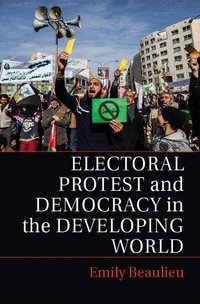
Electoral Protest and Democracy in the Developing World
Published on 10. March 2014
Book
Hardback
238 pages
978-1-107-03968-1 (ISBN)
Description
This book shows that the third wave of democracy has been accompanied by a worldwide wave of opposition-initiated, election-related protests. Such electoral protests result from a failure on the part of incumbent and opposition elites in the developing world to negotiate acceptable terms of electoral conduct, and their consequences for democracy depend on the context in which they occur. Where election boycotts receive international support, they increase the probability of democratic reform, but where support is primarily domestic, there is a higher probability of authoritarian backsliding. Based on an extensive new data set covering nearly thirty years of electoral protest and election-related reform in the developing world, this book explores the causes of different types of electoral protest and their consequences for democracy. Statistical analysis and case studies provide readers with a complete picture of the dynamics surrounding developing world elections, protest, and democratization.
Reviews / Votes
'In this book, Beaulieu proposes and tests an important new theory of why authoritarian leaders agree to hold more or less competitive elections, and why such processes sometimes descend into protests and reversals. It is a story of problems for incumbents to make credible commitments and of information deficits leading to 'bargaining failures' in transition processes. With a carefully designed study involving rigorous quantitative analyses as well as a wealth of qualitative case analyses, Beaulieu makes an inspiring and significant contribution to the study of the role of elections in competitive electoral regimes.' Staffan I. Lindberg, University of Gothenburg 'What happens, in the absence of strong institutions, when opposition and incumbents fail to agree on the acceptable conduct of an election? In this incisive and deeply researched study, Beaulieu highlights the role of protest in advancing opposition demands for fairer elections and identifies the conditions under which it succeeds in convincing incumbents to enact democratic reforms. A must-read for students of democratization and contentious politics alike.' Frederic C. Schaffer, University of Massachusetts, Amherst 'Beaulieu's book presents original data on multiparty elections in 118 developing countries over three decades, from 1975 to 2006. It examines two facets of electoral protest: boycotts of the election, and demonstrations following the vote.' Michael Biggs, MobilizationMore details
Language
English
Place of publication
Cambridge
United Kingdom
Target group
Professional and scholarly
College/higher education
Illustrations
8 Tables, unspecified; 1 Halftones, unspecified; 5 Line drawings, unspecified
Dimensions
Height: 235 mm
Width: 157 mm
Thickness: 19 mm
Weight
552 gr
ISBN-13
978-1-107-03968-1 (9781107039681)
Copyright in bibliographic data and cover images is held by Nielsen Book Services Limited or by the publishers or by their respective licensors: all rights reserved.
Schweitzer Classification
Other editions
Additional editions
Emily Beaulieu
Electoral Protest and Democracy in the Developing World
E-Book
03/2014
1st Edition
Cambridge University Press
€20.49
Available for download
Emily Beaulieu
Electoral Protest and Democracy in the Developing World
Book
03/2014
Cambridge University Press
€37.50
Shipment within 15-20 days
Emily Beaulieu
Electoral Protest and Democracy in the Developing World
E-Book
03/2014
Cambridge University Press
€19.49
Available for download
Person
Emily Beaulieu is an Assistant Professor of Political Science at the University of Kentucky. She has also published work on political economy and democracy in outlets such as International Organization and Comparative Political Studies. She is working on several projects on political violence, and recently received a TESS grant to study the impact of partisanship and political polarization on perceptions of election fraud. She received her PhD from the University of California, San Diego.
Content
1. Introduction; 2. Elite bargaining and developing world elections; 3. Causes of electoral protest; 4. Election day and its aftermath; 5. Democratic consequences of electoral protest; 6. Conclusion; Appendix A. Data and robustness; Appendix B. Boycotts; Appendix C. Demonstrations; Appendix D. Reforms.