

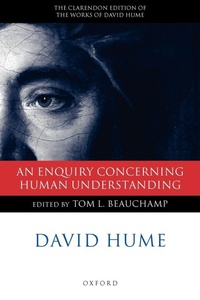
David Hume: An Enquiry concerning Human Understanding
A Critical Edition
Published on 13. April 2006
Book
Paperback/Softback
454 pages
978-0-19-926634-0 (ISBN)
Description
about Hume: David Hume (1711-1776) is one of the greatest of philosophers. Today he probably ranks highest of all British philosophers in terms of influence and philosophical standing. His philosophical work ranges across morals, the mind, metaphysics, epistemology, and aesthetics; he had broad interests not only in philosophy as it is now conceived but in history, politics, economics, religion, and the arts. He was a master of English prose.
about the Clarendon Hume Edition:
The Clarendon Hume will include all of his works except his History of England and minor historical writings; it will be the only thorough critical edition, and will provide a far more extensive scholarly treatment than any previous editions. This edition (which has been in preparation since the 1970s) offers authoritative annotation, bibliographical information, and indexes, and draws upon the major advances in textual scholarship that have been made since the publication of earlier editions--advances both in the understanding of editorial principle and practice and in knowledge of the history of Hume's own texts.
General Editors: Professors T. L. Beauchamp (Georgetown University, USA), D. F. Norton (McGill University, Canada), M. A. Stewart (University of Lancaster, England).
The Edition will comprise:
Vols. 1 and 2: A Treatise of Human Nature, edited by D. F. Norton
Vol. 3: An Enquiry concerning Human Understanding, edited by T. L. Beauchamp
Vol. 4: An Enquiry concerning the Principles of Morals, edited by T. L. Beauchamp
Vol. 5: The Natural History of Religion and the Dissertation on the Passions
Vols. 6 and 7: Essays
Vol. 8: Dialogues concerning Natural Religion and other posthumous publications, edited by M. A. Stewart
about the Clarendon Hume Edition:
The Clarendon Hume will include all of his works except his History of England and minor historical writings; it will be the only thorough critical edition, and will provide a far more extensive scholarly treatment than any previous editions. This edition (which has been in preparation since the 1970s) offers authoritative annotation, bibliographical information, and indexes, and draws upon the major advances in textual scholarship that have been made since the publication of earlier editions--advances both in the understanding of editorial principle and practice and in knowledge of the history of Hume's own texts.
General Editors: Professors T. L. Beauchamp (Georgetown University, USA), D. F. Norton (McGill University, Canada), M. A. Stewart (University of Lancaster, England).
The Edition will comprise:
Vols. 1 and 2: A Treatise of Human Nature, edited by D. F. Norton
Vol. 3: An Enquiry concerning Human Understanding, edited by T. L. Beauchamp
Vol. 4: An Enquiry concerning the Principles of Morals, edited by T. L. Beauchamp
Vol. 5: The Natural History of Religion and the Dissertation on the Passions
Vols. 6 and 7: Essays
Vol. 8: Dialogues concerning Natural Religion and other posthumous publications, edited by M. A. Stewart
Reviews / Votes
Tom Beauchamp has produced two excellent editions, which will remain the standard editions of both Enquiries for years to come. An enormous amount of research has gone into this edition. . . Tom Beauchamp [has given] thirty years of devotion to the writings of Hume brought to . . . a splendid conclusion, . . . Beauchamp has attended to "the extreme Accuracy of Style" that Hume demanded and has produced reliable texts of the two enquires, edited to the highest standards. * O. M. Brack, Eighteenth-Century Scotland *More details
Series
Language
English
Place of publication
Oxford
United Kingdom
Target group
Professional and scholarly
Dimensions
Height: 234 mm
Width: 156 mm
Thickness: 25 mm
Weight
685 gr
ISBN-13
978-0-19-926634-0 (9780199266340)
Copyright in bibliographic data and cover images is held by Nielsen Book Services Limited or by the publishers or by their respective licensors: all rights reserved.
Schweitzer Classification
Other editions
Additional editions
Book
10/2000
Oxford University Press
€237.10
Shipment within 15-20 days
Person
David Hume (/hjüm/; born David Home; 7 May 1711 NS (26 April 1711 OS) - 25 August 1776)[9] was a Scottish Enlightenment philosopher, historian, economist, and essayist, who is best known today for his highly influential system of philosophical empiricism, scepticism, and naturalism.[1] Beginning with A Treatise of Human Nature (1739-40), Hume strove to create a naturalistic science of man that examined the psychological basis of human nature. Hume argued against the existence of innate ideas, positing that all human knowledge derives solely from experience. This places him with Francis Bacon, Thomas Hobbes, John Locke, and George Berkeley, as a British Empiricist.[10]
Hume argued that inductive reasoning and belief in causality cannot be justified rationally; instead, they result from custom and mental habit. We never actually perceive that one event causes another, but only experience the "constant conjunction" of events. This problem of induction means that to draw any causal inferences from past experience it is necessary to presuppose that the future will resemble the past, a presupposition which cannot itself be grounded in prior experience.[11]
An opponent of philosophical rationalists, Hume held that passions rather than reason govern human behaviour, famously proclaiming that "Reason is, and ought only to be the slave of the passions".[10] Hume was also a sentimentalist who held that ethics are based on emotion or sentiment rather than abstract moral principle. He maintained an early commitment to naturalistic explanations of moral phenomena, and is usually taken to have first clearly expounded the is-ought problem, or the idea that a statement of fact alone can never give rise to a normative conclusion of what ought to be done.[12]
Hume also denied that humans have an actual conception of the self, positing that we experience only a bundle of sensations, and that the self is nothing more than this bundle of causally-connected perceptions. Hume's compatibilist theory of free will takes causal determinism as fully compatible with human freedom.[13] His views on philosophy of religion, including his rejection of miracles and the argument from design for God's existence, were especially controversial for their time.
Hume influenced utilitarianism, logical positivism, the philosophy of science, early analytic philosophy, cognitive science, theology, and many other fields and thinkers. Immanuel Kant credited Hume as the inspiration who had awakened him from his "dogmatic slumbers".
Content
Introduction: A History of the Enquiry Concerning Human Understanding ; AN ENQUIRY CONCERNING HUMAN UNDERSTANDING ; Editor's Annotations ; Glossary ; Appendices ; References ; Hume's Index ; Editor's Index