

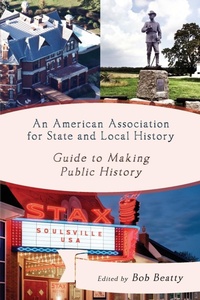
An American Association for State and Local History Guide to Making Public History
Published on 27. October 2017
Book
Paperback/Softback
260 pages
978-1-4422-6414-4 (ISBN)
Description
Gain insight into history organizations of all shapes and sizes in this book, which addresses the opportunities and challenges of public historians' work through the prism of the past, present, and future of our communities and institutions, as well as the public history field itself. Featuring essays from some of the leading thinkers in the profession, this book not only looks at major themes as they relate to historians' work but also inspires creativity in how they approach their work in an institutional and personal sense.
The themes themselves are important, but even more important are the articles (presented here as chapters) that amplify the overarching themes. Chapters discuss in-depth and through real-world examples, the work of history organizations. They specifically focus on the challenges and opportunities that are important to any nonprofit (or small business)-entrepreneurship, change, transformation, possibility/opportunity, partnerships-but also those unique to history organizations, leverage the asset of history to: explore place, commemorate the past (and therefore better understand the present), demonstrate how it is people who make history, and discern how to use the past to chart the future.
Together, An American Association for State and Local History Guide to Making Public History provides a roadmap of the national discussions the field of history museums and organizations is having regarding its present and the future.
The themes themselves are important, but even more important are the articles (presented here as chapters) that amplify the overarching themes. Chapters discuss in-depth and through real-world examples, the work of history organizations. They specifically focus on the challenges and opportunities that are important to any nonprofit (or small business)-entrepreneurship, change, transformation, possibility/opportunity, partnerships-but also those unique to history organizations, leverage the asset of history to: explore place, commemorate the past (and therefore better understand the present), demonstrate how it is people who make history, and discern how to use the past to chart the future.
Together, An American Association for State and Local History Guide to Making Public History provides a roadmap of the national discussions the field of history museums and organizations is having regarding its present and the future.
Reviews / Votes
[The book] presents America's (public) history organizations as more lively and relevant than ever, pressing challenges notwithstanding. Bob's Guide to Making Public History is a wide-ranging book, bringing together essays by important thinkers from between 2008-2017 on topics such as entrepreneurship, change management, relevance, partnerships, etc. Key themes in the book include financial and institutional stability, change and transformation, collections, diversity and inclusion, and the relevance of the history field as a whole. Each essay is introduced by Bob, who adds invaluable context and additional sources.... Fortunately, the book is full of promising case studies of public history organizations that have tried to become relevant and sustainable again.... Some chapters transcend the level of a guidebook and give directions on another level, most notably Edward T. Linenthal's reflections on commemoration and David A. Janssen's story about the rebirth of Detroit.... Instead, the image of the sector Bob's book paints is one of a sector that feels a strong need to play an important, relevant role in society, and one that feels empowered and enabled to do so. This confidence is rooted in research and best practice. For me, this is the great strength of the book. It covers a formative period for many history (and other cultural heritage) organizations and by looking at many case studies at the same time, manages to give a convincing roadmap of possible futures for all of us. * The Museum of the Future * The honest self-reflection of the editor and contributors in regards to their successes and failures in public history is enlightening. This book creates a positive, supportive and empathetic dialogue with its audience, which will resonate with practicing public historians. It will help those practicing public history to understand that failure is a natural part of the process of doing public history, turning issues and challenges into opportunities and catalysts for change. AASHL Guide to Making Public History encourages public historians to be honest and to trust each other; to collaborate, to be less competitive, and to strive through shared passion and experiences to be more inclusive and relevant. * The Public Historian * Beatty repurposes for fresh use ten sweeping essays written by wise colleagues. What emerges is a handy guide to what public history institutions have been doing over the past decade and a map to where the field is headed. His supporting chapters re-angle, poke, highlight, and elaborate upon the core essays producing a new work of distilled insight. -- John Dichtl, president and CEO, American Association for State and Local History A must for every public historian's library. Under Bob Beatty's masterful guidance, leading scholars and practitioners tackle key issues faced by the 21st century public historian: community engagement, reciprocal partnerships, inclusive approaches and narratives, and keeping history at the forefront of contemporary debates and dialogues. Here is a useful volume with common-sense, tested solutions plus new questions about the practice and sustainability of the public history field. -- Carroll Van West, director, Middle Tennessee State University Center for Historic PreservationMore details
Series
Language
English
Place of publication
United States
Publishing group
Bloomsbury Publishing Plc
Target group
Professional and scholarly
Illustrations
39 b/w photos; 6 tables; 2 textboxes
Dimensions
Height: 229 mm
Width: 152 mm
Thickness: 16 mm
Weight
430 gr
ISBN-13
978-1-4422-6414-4 (9781442264144)
Copyright in bibliographic data and cover images is held by Nielsen Book Services Limited or by the publishers or by their respective licensors: all rights reserved.
Schweitzer Classification
Other editions
Additional editions
E-Book
10/2017
1st Edition
Rowman & Littlefield Publishers
€44.99
Available for download
Person
Bob Beatty is founder and president of The Lyndhurst Group, a history, museum, and nonprofit consulting firm providing community-focused engagement strategies for institutional planning, organizational assessments, and interpretive direction. From 2007-2017 Bob served in a variety of capacities at the American Association for State & Local History, the only comprehensive national organization dedicated to state and local history, most recently as chief of engagement.
Content
Foreword - Cinnamon Catlin-Legutko
Introduction
Chapter 1 The Only Thing that is Constant is Change
Chapter 2 The Winds of Opportunity - Barbara Franco and Laura B. Roberts
Chapter 3 Discovering the Power of Transformation
Chapter 4 Understanding Change and Transformation in History Organizations - Candace Tangorra Matelic
Chapter 5 Making History a Twenty-First-Century Enterprise
Chapter 6 Entrepreneurship in History Organizations - John W. Durel
Chapter 7 A Twenty-First Century Renaissance
Chapter 8 The Spirit of Rebirth - David A. Janssen
Chapter 9 The Power of Possibility
Chapter 10 It's Possible - Kent Whitworth and Scott Alvey
Chapter 11 The Whole is Greater
Chapter 12 Greater than the Sum of Our Parts - Erin Carlson Mast
Chapter 13 Crossroads: Exploring the Vibrant Connections Between People and Place
Chapter 14 Explorations in Place and Time: A Personal Journey - David A. Donath
Chapter 15 Turning Points: Ordinary People, Extraordinary Change
Chapter 16 What Kind of Ordinary Will You Be? - Max A. van Balgooy
Chapter 17 Commemoration: The Promise of Remembrance and New Beginnings
Chapter 18 Public History and the Challenges of Commemoration
Edward T. Linenthal
Chapter 19 Inclusion is Active
Chapter 20 I AM History: Embracing Inclusion in Social and Political Climates - Dina A. Bailey
Chapter 21 Epilogue Moving History from Nice to Essential - John R. Dichtl
Introduction
Chapter 1 The Only Thing that is Constant is Change
Chapter 2 The Winds of Opportunity - Barbara Franco and Laura B. Roberts
Chapter 3 Discovering the Power of Transformation
Chapter 4 Understanding Change and Transformation in History Organizations - Candace Tangorra Matelic
Chapter 5 Making History a Twenty-First-Century Enterprise
Chapter 6 Entrepreneurship in History Organizations - John W. Durel
Chapter 7 A Twenty-First Century Renaissance
Chapter 8 The Spirit of Rebirth - David A. Janssen
Chapter 9 The Power of Possibility
Chapter 10 It's Possible - Kent Whitworth and Scott Alvey
Chapter 11 The Whole is Greater
Chapter 12 Greater than the Sum of Our Parts - Erin Carlson Mast
Chapter 13 Crossroads: Exploring the Vibrant Connections Between People and Place
Chapter 14 Explorations in Place and Time: A Personal Journey - David A. Donath
Chapter 15 Turning Points: Ordinary People, Extraordinary Change
Chapter 16 What Kind of Ordinary Will You Be? - Max A. van Balgooy
Chapter 17 Commemoration: The Promise of Remembrance and New Beginnings
Chapter 18 Public History and the Challenges of Commemoration
Edward T. Linenthal
Chapter 19 Inclusion is Active
Chapter 20 I AM History: Embracing Inclusion in Social and Political Climates - Dina A. Bailey
Chapter 21 Epilogue Moving History from Nice to Essential - John R. Dichtl