


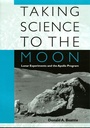
Taking Science to the Moon
Lunar Experiments and the Apollo Program
Published on 30. August 2001
Book
Hardback
352 pages
978-0-8018-6599-2 (ISBN)
Description
How did science get aboard the Apollo rockets, and what did scientists do with the space allotted to them? This volume describes, from the perspective of NASA headquarters, the struggles that took place to include science payloads and lunar exploration as part of the Apollo program. Author Donald A. Beattie - who served at NASA from 1963 to 1973 in several management positions and finally as programme manager, Apollo Lunar Surface Experiments - supplies a detailed, insider's view of the events leading up to the acceptance of science activities on all the Apollo missions. Beattie tells this story within the context of what we knew about the moon in the 1960s, the ongoing programmes that looked ahead to the first successful landing, and the objections that had to be overcome within NASA's entrenched engineering culture. Beattie concentrates on activities directly related to science, including behind-the-scenes controversies. He also discusses the important contributions of some of the lesser-known participants and contractors, who he says played a much larger role than previous books on the programme have acknowledged.
The book provides the early history of on-site lunar experiments, raising important questions about a shift in NASA policy which led to some of the most dramatic planetary-science developments of our time.
The book provides the early history of on-site lunar experiments, raising important questions about a shift in NASA policy which led to some of the most dramatic planetary-science developments of our time.
Reviews / Votes
Taking Science to the Moon transports the reader behind NASAs facade, and into the 1960s' politics, planning sessions, turf battles, camaraderie, and jealousies of the world's major space agency. An absorbing, insightful, and revealing critical history of what eventually turned out to be a hugely successful scientific endeavor.-David W. Hughes, The Observatory Comprehensive yet thoroughly readable, it will hold great appeal for rocket enthusiasts, providing as it does a behind-the-scenes look at one of the greatest adventures in history.
-Publishers Weekly We get valuable insights into how committees worked and into the struggles for scientific payload space on lunar landers, and into how geological objectives were devised. We also discover how fears of contamination from lunar organisms led to the creation of an elaborate quarantine facility for the first men on the moon. This is a fascinating book.
-Martin Heath, Astronomy Now This is a very detailed yet clearly written and interesting account of the tremendous effort involved in getting the greatest science return from the Apollo program, starting with having it included in the first place.
-Steven Simon, Journal of Geology
More details
Series
Language
English
Place of publication
Baltimore, MD
United States
Target group
College/higher education
Professional and scholarly
Illustrations
37 s/w Photographien bzw. Rasterbilder, 5 s/w Zeichnungen
5 Line drawings, black and white; 37 Halftones, black and white
Dimensions
Height: 229 mm
Width: 152 mm
Thickness: 27 mm
Weight
680 gr
ISBN-13
978-0-8018-6599-2 (9780801865992)
DOI
10.56021/9780801865992
Copyright in bibliographic data is held by Nielsen Book Services Limited or its licensors: all rights reserved.
Schweitzer Classification
Other editions
Additional editions
Book
10/2003
Johns Hopkins University Press
€42.28
Article exhausted; check different version
E-Book
05/2003
Johns Hopkins University Press
€18.49
Available for download
Person
Donald A. Beattie is a former NASA engineer who has also worked with the National Science Foundation and the Department of Energy. He currently works as a private consultant. He is the author of History and Overview of Solar Heat Technologies.
Content
Contents:
1 From the Jungle to Washington
2 Early Theories and Questions About the Moon
3 What Do We Do After Apollo?
4 The USGS Joins Our Post-Apollo Team
5 Science Payloads for Apollo - The Struggle Begins
6 Developing the Geological Equipment, Related Experiments and Sampling Protocols
7 The Apollo Lunar Surface Experiments Package (ALSEP), and Related Experiments
8 Walk, Fly, or Drive?
9 Astronaut Training and Mission Simulation
10 Studying the Moon from Orbit
11 On to the Moon - Science becomes the Focus
12 The "J" Missions - We Almost Achieve Our Early Dreams
13 The Legacy of Apollo
1 From the Jungle to Washington
2 Early Theories and Questions About the Moon
3 What Do We Do After Apollo?
4 The USGS Joins Our Post-Apollo Team
5 Science Payloads for Apollo - The Struggle Begins
6 Developing the Geological Equipment, Related Experiments and Sampling Protocols
7 The Apollo Lunar Surface Experiments Package (ALSEP), and Related Experiments
8 Walk, Fly, or Drive?
9 Astronaut Training and Mission Simulation
10 Studying the Moon from Orbit
11 On to the Moon - Science becomes the Focus
12 The "J" Missions - We Almost Achieve Our Early Dreams
13 The Legacy of Apollo