

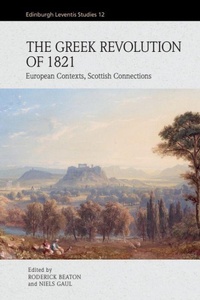
The Greek Revolution of 1821
European Contexts, Scottish Connections
Published on 31. July 2024
Book
Hardback
424 pages
978-1-3995-2063-8 (ISBN)
Description
Political history and history of ideas, art history, theories of nations and nationalism, Classical Reception studies, modern Greek history and modern Scottish history come together in this collection of essays by experts in all these fields. The starting point for the volume is the bicentenary of the Greek Revolution (1821-1832), for the first time linked to the cultural and intellectual history of Scotland, and particularly of Edinburgh, during roughly the same period. The book's two parts respectively contextualise the struggle for Greek national independence in space and time, and explore the engagement of Scots with Greece during the period, as well as parallels between the two nations. Throughout, the Greek Revolution and its Scottish supporters are viewed in relation to the Classical Tradition, or Classical Reception.
This pioneering book makes a unique contribution to the burgeoning literature on the Greek Revolution during the anniversary decade, and raises issues of national identity and self-determination that have contemporary resonances in both Greece and Scotland, at opposite ends of Europe, today.
This pioneering book makes a unique contribution to the burgeoning literature on the Greek Revolution during the anniversary decade, and raises issues of national identity and self-determination that have contemporary resonances in both Greece and Scotland, at opposite ends of Europe, today.
Reviews / Votes
The Greek Revolution of 1821: European Contexts, Scottish Connections is a staggering testament to just how international the Greek War of Independence was: in its origins, vision, scope and consequences. The volume's penetrating and interconnected essays add new layers of understanding to how the Greek revolution reverberated throughout Europe and beyond, even as the in-depth exploration of its uniquely Scottish connections reveals a compelling chapter of European intellectual history. There is much of interest -- and surprise -- here for the expert and relative newcomer alike. -- Johanna Hanink, Brown University A landmark collection of essays, The Greek Revolution of 1821: European Contexts, Scottish Connections masterfully links the Greek struggle for independence with the intellectual vitality of the Scottish Enlightenment. Redefining philhellenism and offering profound insights that resonate with contemporary discussions of nationalism, identity and cultural exchange, this volume is essential reading for anyone interested in the intersection of the Enlightenment and the Age of Revolution. -- Aristides Hatzis, University of AthensMore details
Series
Language
English
Place of publication
Edinburgh
United Kingdom
Target group
Professional and scholarly
Product notice
sewn/stitched
Cloth over boards
Illustrations
6 black and white illustrations, 28 colour illustrations
Dimensions
Height: 221 mm
Width: 147 mm
Thickness: 25 mm
Weight
839 gr
ISBN-13
978-1-3995-2063-8 (9781399520638)
Copyright in bibliographic data and cover images is held by Nielsen Book Services Limited or by the publishers or by their respective licensors: all rights reserved.
Schweitzer Classification
Other editions
Additional editions

E-Book
07/2024
Edinburgh University Press
€103.99
Available for download
Persons
Roderick Beaton grew up in Edinburgh, where he first began to study (ancient) Greek at George Watson's College. For thirty years until his retirement in 2018 he held the Koraes Chair of Modern Greek and Byzantine History, Language and Literature at King's College London, and is now Emeritus. In 2021 he returned to his birthplace as A. G. Leventis Visiting Professor of Greek at The University of Edinburgh. He is a Fellow of the British Academy (FBA), a Fellow of King's College (FKC), and Commander of the Order of Honour of the Hellenic Republic. He is currently Chair of the British School at Athens. His most recent books are:The Greeks: A Global History (Faber, UK; Basic, USA, 2021), The Greek Revolution of 1821 and its Global Significance (Aiora, 2021), Greece: Biography of a Modern Nation (Allen Lane/Penguin, 2019) and Byron's War: Romantic Rebellion, Greek Revolution (Cambridge University Press, 2013) Niels Gaul is A. G. Leventis Professor of Byzantine Studies and Director of the Centre for Late Antique, Islamic and Byzantine Studies at the University of Edinburgh. He is currently working toward the written version of the E. A. Lowe Lectures in Palaeography 2023, provisionally entitled Manuscripts of Character: Codex, Ethos and Authority in Byzantium. His most recent books are:Centre, Province and Periphery in the Age of Constantine VII Porphyrogennetos (co-edited, Harrassowitz, 2018)Thomas Magistros und die spaetbyzantinische Sophistik (Harrassowitz, 2011)
Content
List of Illustrations
Editors' Preface
Notes on Contributors
Introduction: Greek and Scottish Identities from the Enlightenment to the 'Age of Revolution', Roderick Beaton
PART I: EUROPEAN CONTEXTS
1. 'Unspoken Assumptions': Prophecies and Rumours in the Age of Greek Independence, Richard Clogg
2. Russia's Byzantine Heritage: Sixteenth-Century Myths and Eighteenth-Century Realities, Lucien Frary
3. Translating the French Revolution: People, Commitments, Texts, Method, Sanja Perovic
4. 'The Grand Sacrifice': Violence and Revolution in Adamantios Korais's Asma Polemistirion (1800), Simos Zenios
5. The Philiki Etaireia and Freemasonry: Secret Communication, the Public Sphere and Social Ideas, Julia Chatzipanagioti-Sangmeister
PART II: SCOTTISH CONNECTIONS
6. 'Finer than the Acropolis': Edinburgh, the Parthenon and the Scottish Genius, Matteo Zaccarini
7. 'A faithless truant to the classic page': Sir Walter Scott, Greek, Greece and the Greeks, Iain Gordon Brown
8. Through 'the Eye of an Experienced Traveller': Robert Wilson (1787-1871) in Ottoman and Revolutionary Greece, Alexia Petsalis-Diomidis
9. Thomas Gordon and the Ghost of Tripolitsa: A Study in Private Conflict and Public Relations, Alasdair C. Grant
10. George Finlay and the Greek Revolution of 1821: Scottish Enlightenment and Transnational Liberalism in Revolutionary Europe, Michalis Sotiropoulos
11. George Finlay, the Founding Figures of Greek National Historiography and Iconoclast Emperor Leon III: Byzantine Paratexts of Revolution, Niels Gaul
12. Edward Masson: Caledonian Witness to the Fortunes of Modern Greece, Vassiliki Kolocotroni
13. John Stuart Blackie and the Pronunciation of Ancient Greek, Gonda Van Steen
Afterword
14. Parallel Lives at the Limits of Europe: Enlightenment and Nation-Building in Scotland and Greece, Paschalis M. Kitromilides
Index
Editors' Preface
Notes on Contributors
Introduction: Greek and Scottish Identities from the Enlightenment to the 'Age of Revolution', Roderick Beaton
PART I: EUROPEAN CONTEXTS
1. 'Unspoken Assumptions': Prophecies and Rumours in the Age of Greek Independence, Richard Clogg
2. Russia's Byzantine Heritage: Sixteenth-Century Myths and Eighteenth-Century Realities, Lucien Frary
3. Translating the French Revolution: People, Commitments, Texts, Method, Sanja Perovic
4. 'The Grand Sacrifice': Violence and Revolution in Adamantios Korais's Asma Polemistirion (1800), Simos Zenios
5. The Philiki Etaireia and Freemasonry: Secret Communication, the Public Sphere and Social Ideas, Julia Chatzipanagioti-Sangmeister
PART II: SCOTTISH CONNECTIONS
6. 'Finer than the Acropolis': Edinburgh, the Parthenon and the Scottish Genius, Matteo Zaccarini
7. 'A faithless truant to the classic page': Sir Walter Scott, Greek, Greece and the Greeks, Iain Gordon Brown
8. Through 'the Eye of an Experienced Traveller': Robert Wilson (1787-1871) in Ottoman and Revolutionary Greece, Alexia Petsalis-Diomidis
9. Thomas Gordon and the Ghost of Tripolitsa: A Study in Private Conflict and Public Relations, Alasdair C. Grant
10. George Finlay and the Greek Revolution of 1821: Scottish Enlightenment and Transnational Liberalism in Revolutionary Europe, Michalis Sotiropoulos
11. George Finlay, the Founding Figures of Greek National Historiography and Iconoclast Emperor Leon III: Byzantine Paratexts of Revolution, Niels Gaul
12. Edward Masson: Caledonian Witness to the Fortunes of Modern Greece, Vassiliki Kolocotroni
13. John Stuart Blackie and the Pronunciation of Ancient Greek, Gonda Van Steen
Afterword
14. Parallel Lives at the Limits of Europe: Enlightenment and Nation-Building in Scotland and Greece, Paschalis M. Kitromilides
Index