

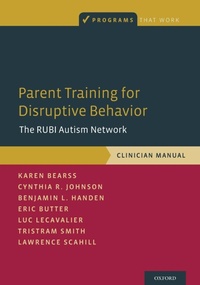
Parent Training for Disruptive Behavior
The RUBI Autism Network, Clinician Manual
Published on 27. September 2018
Book
Paperback/Softback
248 pages
978-0-19-062781-2 (ISBN)
Description
Autism spectrum disorder (ASD) begins in early childhood and is characterized by impairments in social interaction and communication, restricted interests and repetitive behavior. As many as half of children with ASD between the ages of 3 and 8 also exhibit disruptive behaviors that interfere with their overall development and family functioning.
This Therapist Guide, Parent Training for Disruptive Behavior, is designed for therapists to use with parents of children with ASD and challenging behaviors, such as tantrums, noncompliance, and aggression. Based on the principles of Applied Behavior Analysis and developed over more than a decade of research, the intervention consists of 11 core sessions as well as supplemental sessions, a home visit, and follow-up visits. Each session includes a therapist script, activity sheets, parent handouts, and checklists. Video vignettes are available online to illustrate concepts. The treatment manual is designed to be used in conjunction with the companion Workbook for parents. Each session is delivered individually in weekly outpatient visits. Homework assignments between sessions focus on implementing behavior change strategies collaboratively chosen by the therapist and parent.
This Therapist Guide, Parent Training for Disruptive Behavior, is designed for therapists to use with parents of children with ASD and challenging behaviors, such as tantrums, noncompliance, and aggression. Based on the principles of Applied Behavior Analysis and developed over more than a decade of research, the intervention consists of 11 core sessions as well as supplemental sessions, a home visit, and follow-up visits. Each session includes a therapist script, activity sheets, parent handouts, and checklists. Video vignettes are available online to illustrate concepts. The treatment manual is designed to be used in conjunction with the companion Workbook for parents. Each session is delivered individually in weekly outpatient visits. Homework assignments between sessions focus on implementing behavior change strategies collaboratively chosen by the therapist and parent.
More details
Series
Language
English
Place of publication
New York
United States
Target group
Professional and scholarly
Dimensions
Height: 254 mm
Width: 178 mm
Thickness: 14 mm
Weight
478 gr
ISBN-13
978-0-19-062781-2 (9780190627812)
Copyright in bibliographic data and cover images is held by Nielsen Book Services Limited or by the publishers or by their respective licensors: all rights reserved.
Schweitzer Classification
Other editions
Additional editions
Karen Bearss | Cynthia R. Johnson | Benjamin L. Handen
Parent Training for Disruptive Behavior
The RUBI Autism Network, Clinician Manual
E-Book
07/2018
OUP eBook
€39.49
Available for download
Karen Bearss | Cynthia R. Johnson | Benjamin L. Handen
Parent Training for Disruptive Behavior
The RUBI Autism Network, Clinician Manual
E-Book
07/2018
OUP eBook
€39.49
Available for download
Persons
Karen Bearss, PhD is Assistant Professor in the Department of Psychiatry and Behavioral Sciences at the University of Washington. Dr. Bearss specializes in the assessment and treatment of individuals with Autism Spectrum Disorder (ASD) and their families. Her current research focus is in developing, implementing, and evaluating evidence-based parenting interventions for children with Autism Spectrum Disorders (ASD). She is also invested in designing strategies for improving the dissemination and implementation of evidence-based treatments into the community.
Cynthia R. Johnson, PhD is the Director of the Cleveland Clinic Center for Autism and faculty of the Lerner College of Medicine, Case Western Reserve University. She is currently the principal investigator of a NIH-funded grant studying the efficacy of parent training in the treatment of feeding problems. She has had prior NIH funding on the efficacy of parent training in the treatment of disruptive behaviors in young children with Autism Spectrum Disorder and the treatment of sleep disturbances. Dr. Johnson is a licensed psychologist and a board-certified behavior analyst- doctoral level.
Benjamin Handen, PhD is Professor of Psychiatry and Pediatrics at the University of Pittsburgh School of Medicine and principal investigator of the University of Pittsburgh Autism Treatment Network (ATN). Over the past 30 years, Dr. Handen has led a number of federally-funded and foundation-funded studies involving both children and adults with autism spectrum disorder. His research has focused on both pharmacological and psychosocial interventions. He is a licensed psychologist and board-certified behavior analyst-doctoral level.
Eric M. Butter, PhD is an Associate Professor of Pediatrics and Psychology at the Ohio State University and Chief of Pediatric Psychology and Neuropsychology at Nationwide Children's Hospital in Columbus, Ohio, where is also the Director of the Child Development Center. Dr. Butter is a Clinical Psychologist with specialization in autism spectrum disorder and other neurodevelopmental disabilities and his research has focused on the bio-medical correlates, potential etiologies and treatment of these disorders.
Luc Lecavalier, PhD, is a Professor of Psychology and Psychiatry at The Ohio State University. He is a clinical psychologist who is interested in the assessment and treatment of individuals with autism spectrum disorder and other neurodevelopmental disabilities. He has authored or co-authored more than 100 publications on the topic.
Tristram Smith, PhD, is the Haggerty-Friedman Professor University of Rochester Medical Center (URMC), where he leads federally funded studies comparing the efficacy of different interventions for children with autism spectrum disorder. He is also a clinician in URMC's Community Consultation Program, serving students with ASD and other intellectual disabilities in schools and other agencies.
Lawrence Scahill, MSN, PhD, is Professor of Pediatrics at Emory University School of Medicine and Director of Clinical Trials at the Marcus Autism Center. He has played a central role in the Research Units on Pediatric Psychopharmacology (RUPP) Autism Network and the Research Units on Behavioral Intervention (RUBI).
Cynthia R. Johnson, PhD is the Director of the Cleveland Clinic Center for Autism and faculty of the Lerner College of Medicine, Case Western Reserve University. She is currently the principal investigator of a NIH-funded grant studying the efficacy of parent training in the treatment of feeding problems. She has had prior NIH funding on the efficacy of parent training in the treatment of disruptive behaviors in young children with Autism Spectrum Disorder and the treatment of sleep disturbances. Dr. Johnson is a licensed psychologist and a board-certified behavior analyst- doctoral level.
Benjamin Handen, PhD is Professor of Psychiatry and Pediatrics at the University of Pittsburgh School of Medicine and principal investigator of the University of Pittsburgh Autism Treatment Network (ATN). Over the past 30 years, Dr. Handen has led a number of federally-funded and foundation-funded studies involving both children and adults with autism spectrum disorder. His research has focused on both pharmacological and psychosocial interventions. He is a licensed psychologist and board-certified behavior analyst-doctoral level.
Eric M. Butter, PhD is an Associate Professor of Pediatrics and Psychology at the Ohio State University and Chief of Pediatric Psychology and Neuropsychology at Nationwide Children's Hospital in Columbus, Ohio, where is also the Director of the Child Development Center. Dr. Butter is a Clinical Psychologist with specialization in autism spectrum disorder and other neurodevelopmental disabilities and his research has focused on the bio-medical correlates, potential etiologies and treatment of these disorders.
Luc Lecavalier, PhD, is a Professor of Psychology and Psychiatry at The Ohio State University. He is a clinical psychologist who is interested in the assessment and treatment of individuals with autism spectrum disorder and other neurodevelopmental disabilities. He has authored or co-authored more than 100 publications on the topic.
Tristram Smith, PhD, is the Haggerty-Friedman Professor University of Rochester Medical Center (URMC), where he leads federally funded studies comparing the efficacy of different interventions for children with autism spectrum disorder. He is also a clinician in URMC's Community Consultation Program, serving students with ASD and other intellectual disabilities in schools and other agencies.
Lawrence Scahill, MSN, PhD, is Professor of Pediatrics at Emory University School of Medicine and Director of Clinical Trials at the Marcus Autism Center. He has played a central role in the Research Units on Pediatric Psychopharmacology (RUPP) Autism Network and the Research Units on Behavioral Intervention (RUBI).
Author
Assistant Professor, Marcus Autism CenterAssistant Professor, Marcus Autism Center, Emory University School of Medicine
Associate Professor, Department of Clinical & Health PsychologyAssociate Professor, Department of Clinical & Health Psychology, University of Florida
Professor of Psychiatry and PediatricsProfessor of Psychiatry and Pediatrics, University of Pittsburgh
Behavioral Treatment Specialist/Research AssociateBehavioral Treatment Specialist/Research Associate, Research Unit on Pediatric Psychopharmacology, The Ohio State University
ProfessorProfessor, Department of Psychology, The Ohio State University
Haggerty-Friedman Professor of Developmental/Behavioral Pediatric ResearchHaggerty-Friedman Professor of Developmental/Behavioral Pediatric Research, University of Rochester Medical Center
Professor of PediatricsProfessor of Pediatrics, Emory University School of Medicine
Content
CONTENTS
Acknowledgments
Introduction to the Manual
Introduction to the Behavior Support Plan
Core Sessions
Session 1: Behavioral Principles
Session 2: Prevention Strategies
Session 3: Daily Schedules
Session 4: Reinforcement 1
Session 5: Reinforcement 2
Session 6: Planned Ignoring
Session 7: Compliance Training
Session 8: Functional Communication Training
Session 9: Teaching Skills 1
Session 10: Teaching Skills 2
Session 11: Generalization and Maintenance
Appendix A Telephone Booster
Appendix B Home Visit
Appendix C Parent Training Case Example with Sample Behavior Support Plan
Appendix D Problem-Solving Common Challenges in Implementing the Program
Appendix E RUBI Progress Note
References
About the Authors
Acknowledgments
Introduction to the Manual
Introduction to the Behavior Support Plan
Core Sessions
Session 1: Behavioral Principles
Session 2: Prevention Strategies
Session 3: Daily Schedules
Session 4: Reinforcement 1
Session 5: Reinforcement 2
Session 6: Planned Ignoring
Session 7: Compliance Training
Session 8: Functional Communication Training
Session 9: Teaching Skills 1
Session 10: Teaching Skills 2
Session 11: Generalization and Maintenance
Appendix A Telephone Booster
Appendix B Home Visit
Appendix C Parent Training Case Example with Sample Behavior Support Plan
Appendix D Problem-Solving Common Challenges in Implementing the Program
Appendix E RUBI Progress Note
References
About the Authors