

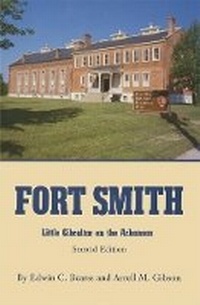
Fort Smith
Little Gibraltar on the Arkansas
2nd Edition
Published on 30. September 1979
Book
Paperback/Softback
384 pages
978-0-8061-1232-9 (ISBN)
Description
No history of the West is complete without the story of Fort Smith, the fort that ""refused to die."" Established in 1817, Fort Smith was repeatedly abandoned and reoccupied during the following fifty years, eventually becoming the mother post of the Southwest.
The original fort was installed on the Arkansas River by Major William Bradford and a company of the Rifles Regiment. Bradford's mission was to stop a bloody war between the Osages and the Cherokees, a conflict discouraging the emigration of eastern Indians to the lands west of the Mississippi and thereby interfering with the government's removal policy.
During the Civil War, Confederate armies at Wilson's Creek, Pea Ridge, and Prairie Grove were supplied from Fort Smith, and the Rebel force that crushed Opothleyoholo's band marched from Fort Smith. The fort was taken by Federal troops in September 1863 and served as a Union base for the remainder of the Civil War.
In 1871 the army again abandoned the fort, but the Federal Court for the Western District of Arkansas soon moved in. Under Judge Isaac Parker, the renowned ""Hanging Judge of Fort Smith,"" the court became a force for law and order in much of Indian Territory.
The original fort was installed on the Arkansas River by Major William Bradford and a company of the Rifles Regiment. Bradford's mission was to stop a bloody war between the Osages and the Cherokees, a conflict discouraging the emigration of eastern Indians to the lands west of the Mississippi and thereby interfering with the government's removal policy.
During the Civil War, Confederate armies at Wilson's Creek, Pea Ridge, and Prairie Grove were supplied from Fort Smith, and the Rebel force that crushed Opothleyoholo's band marched from Fort Smith. The fort was taken by Federal troops in September 1863 and served as a Union base for the remainder of the Civil War.
In 1871 the army again abandoned the fort, but the Federal Court for the Western District of Arkansas soon moved in. Under Judge Isaac Parker, the renowned ""Hanging Judge of Fort Smith,"" the court became a force for law and order in much of Indian Territory.
Reviews / Votes
A valuable addition to western military history . . . a fine example of how local history should be written. The authors demonstrate that, 'through the portals of Fort Smith, one can see the panorama of Southwestern history unfolding.'"" - Western Historical Quarterly""For everyone interested in the frontier Southwest and the Civil War."" - Civil War History
More details
Edition
Second Edition
Language
English
Place of publication
Oklahoma
United States
Target group
College/higher education
Professional and scholarly
Edition type
New edition
Illustrations
26 black & white illustrations, 4 maps
Dimensions
Height: 203 mm
Width: 133 mm
Thickness: 23 mm
Weight
408 gr
ISBN-13
978-0-8061-1232-9 (9780806112329)
Copyright in bibliographic data and cover images is held by Nielsen Book Services Limited or by the publishers or by their respective licensors: all rights reserved.
Schweitzer Classification
Persons
Edwin C. Bearss was Research Historian for Vicksburg National Military Park in Mississippi.
Arrell Morgan Gibson (1921-1987) was the George Lynn Cross Research Professor of History at the University of Oklahoma. He was the author of many books on western history, including The Chickasaws, The Life and Death of Colonel Albert Jennings Fountain, and Oklahoma: A History of Five Centuries, all published by the University of Oklahoma Press.
Arrell Morgan Gibson (1921-1987) was the George Lynn Cross Research Professor of History at the University of Oklahoma. He was the author of many books on western history, including The Chickasaws, The Life and Death of Colonel Albert Jennings Fountain, and Oklahoma: A History of Five Centuries, all published by the University of Oklahoma Press.