

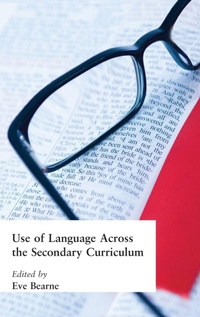
Use of Language Across the Secondary Curriculum
1st Edition
Published on 11. September 2017
Book
Hardback
288 pages
978-1-138-46640-1 (ISBN)
Description
Educational policy is becoming more concerned with the need to ensure that people leave school or college fully literate. We need good oral communicators in the workplace, and being able to understand and respond to different kinds of language is vital in today's society. Included here is a detailed and highly readable account of the ways in which language affects every aspect of study - it crosses all subject boundaries, yet it is commonly seen as the sole responsibility of the English teacher to manage this area of the curriculum. The first section of the book looks at the ideology behind language, while the second section considers how schools and local authorities have tackled improving levels of literacy. The third section is concerned with practical advice on how to teach language most successfully, irrespective of subject. Latter sections focus on developing a critical eye, and supporting pupils who have particular needs.
More details
Language
English
Place of publication
London
United Kingdom
Publishing group
Taylor & Francis Ltd
Target group
College/higher education
Dimensions
Height: 240 mm
Width: 161 mm
Thickness: 20 mm
Weight
602 gr
ISBN-13
978-1-138-46640-1 (9781138466401)
Copyright in bibliographic data and cover images is held by Nielsen Book Services Limited or by the publishers or by their respective licensors: all rights reserved.
Schweitzer Classification
Other editions
Additional editions
E-Book
01/2002
Routledge
€63.49
Available for download
E-Book
01/2002
Routledge
€63.49
Available for download
Book
12/1998
Routledge
€75.79
Shipment within 15-20 days
Person
Eve Bearne
Content
Introduction: Language and literacy PART 1: Questions and issues: the social and cultural aspects of language 1. `Sticks and stones...': the power of language Ian Frowe 2. Talking in class: spoken language and effective learning Helen Nicholson 3. Narrative and the development of values Mary Earl PART II: Starting points: raising standards of literacy 4. Improving literacy: establishing a culture of change Eve Bearne 5. Learning through language: Wirral takes action Marie Stacey 6. Reading and Gender Nigel Spratt and Ruth Sturdy PART III Language and learning : the three Rs - rights, responsibilities and resources 7. Will it work? the language of interaction in maths Tim Rowland 8. Communicating knowledge and ideas: the use of language in science Elaine Wilson 9. Drama and historical writing at Key Stage 3 Paul Goalen PART IV Developing a critical eye 10. React, research, respond and reflect: language and learning in art Richard Hickman 11. The language of self-assessment: towards aesthetic understanding in music Liz Mellor 12. Using reflective practice to monitor and evaluate language and learning Gill Venn and Ian Terrell PART V Difficulties with literacy and learning 13. Making connections I: James - a pupil with literacy difficulties Avril Dawson 14. Making connections II: access to learning for pupils with special educational needs Peter Fifield 15. Language in use - from policy to practice Index