

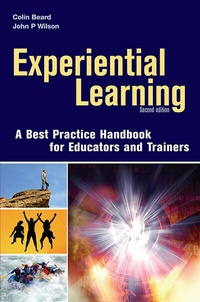
Experiential Learning
A Best Practice Handbook for Educators and Trainers
2nd Edition
Published on 3. May 2006
Book
Paperback/Softback
320 pages
978-0-7494-4489-1 (ISBN)
Description
This handbook pulls together for the first time both the theory and the practice of experiential learning and all types of learning that employ activity-based experience. Based on sound theoretical underpinning, and making full use of examples and guidance for successful implementation, Experiential Learning enables readers to unlease some of the more potent indgredients of learning through experience.
'Everything that can possibly provide, or affect, a learning experience, is discussed: most theories of learning, and every conceivable way to interest learners in an activity...Even very accomplished developers who prepare learning experiences for all types of learners, from grade level classes through executive seminars can undoubtedly find many ideas to expand the design options upon which they can draw.' Leadership and Organisational Development Journal.
Previously known as The Power of Experiential Learning.
'Everything that can possibly provide, or affect, a learning experience, is discussed: most theories of learning, and every conceivable way to interest learners in an activity...Even very accomplished developers who prepare learning experiences for all types of learners, from grade level classes through executive seminars can undoubtedly find many ideas to expand the design options upon which they can draw.' Leadership and Organisational Development Journal.
Previously known as The Power of Experiential Learning.
Reviews / Votes
"Full of creative ideas that can be used by trainers and facilitators to develop their range of skills...The book illustrates the sort of issues that managers and HR specialists should consider when deciding whether to use such events to develop and motivate staff. In particular, it will help them to formulate the sort of questions that need to be asked of experiential learning providers before handing over some of their cash from hard-earned training budgets." * People Management * "This book is valuable for all the boundary crossing it does. Other books on the subject do not go far beyond the walls of higher education, but this book draws on a huge range of sources... A stimulating collection of ideas and examples that encourages experimentation." * Dr Roger Greenaway, Reviewing Skills Training * "The range of coverage is impressive." * Journal of Adventure Education and Outdoor Learning * "Beard and Wilson manage to smoothly lead the reader on a superlative tour of must see concepts and principles." * Horizons Magazine * "I think you have written a beauty here and I suspect it is going places." * International Association of Experiential Education *More details
Edition
2nd Revised edition
Language
English
Place of publication
London
United Kingdom
Target group
College/higher education
Professional and scholarly
Edition type
Revised edition
Product notice
Paperback (trade)
Dimensions
Height: 234 mm
Width: 156 mm
Thickness: 17 mm
Weight
485 gr
ISBN-13
978-0-7494-4489-1 (9780749444891)
Copyright in bibliographic data and cover images is held by Nielsen Book Services Limited or by the publishers or by their respective licensors: all rights reserved.
Schweitzer Classification
Other editions
New editions
Book
08/2013
3rd Edition
Kogan Page Ltd
€57.13
Article exhausted; check for reprint
Previous edition
Colin Beard | John P. Wilson
Power of Experiential Learning
Book
12/2001
1st Edition
Kogan Page Ltd
€47.86
Article exhausted; check for reprint
Persons
Colin Beard is a senior lecturer at Sheffield Hallam University, director of The Experiential Company and has recently received the accolade of being awarded a National Fellowship Award.
Dr John P Wilson is the editor of Human Resource Development (published by Kogan Page), a senior lecturer at Sheffield Hallam University and also a director of The Experiential Company.
Dr John P Wilson is the editor of Human Resource Development (published by Kogan Page), a senior lecturer at Sheffield Hallam University and also a director of The Experiential Company.
Content
Chapter - 1: Unlocking powerful learning - the Learning Combination Lock model
Chapter - 2: Exploring experiential learning
Chapter - 3: Facilitation, good practice and ethics
Chapter - 4: Learning environments: spaces and places
Chapter - 5: Experiential learning activities
Chapter - 6: Learning activities: exploring reality
Chapter - 7: Working with the senses
Chapter - 8: Experience and emotions
Chapter - 9: Working with emotions
Chapter - 10: Experience and intelligence
Chapter - 11: Learning and change
Chapter - 12: Imagining and experiencing the future
Chapter - 2: Exploring experiential learning
Chapter - 3: Facilitation, good practice and ethics
Chapter - 4: Learning environments: spaces and places
Chapter - 5: Experiential learning activities
Chapter - 6: Learning activities: exploring reality
Chapter - 7: Working with the senses
Chapter - 8: Experience and emotions
Chapter - 9: Working with emotions
Chapter - 10: Experience and intelligence
Chapter - 11: Learning and change
Chapter - 12: Imagining and experiencing the future
1. Unlocking powerful learning -- a new model
Introduction
The tumblers
An overview of the chapters
Conclusion
2. Exploring experiential learning
Introduction
Defining experiential learning
A meaningful experience
Learning is personal
Painful learning
Detrimental experiential learning
Learning from mistakes
Formal versus experiential learning
The lineage of experience learning
Experience as learning styles
A chronology of experiential learning
Challenging the concept of experiential learning
Conclusion
3. Facilitation, good practice and ethics
Introduction
The booming business
The deliverers
Experiential provider roles
Intruding complicators or enabling animateurs
Wisdom and experience
Dysfunctional and indigenous learning
Setting the climate and conditions
Ground rules and values
Reviewing self-practice
Ethical behaviour
A question of balance
Ethical models
Codes of practice
Professional bodies and the professional codes of practice
Good practice: the environment
Conclusion
4. Learning environments: spaces and places
Introduction
Indoor learning: the new classroom
Outdoor learning
Disappearing boundaries: indoor--outdoor, natural--artificial
Reaching out: Learning in city space
Artificially created learning spaces
Pedagogy and personal development
Empathetic strategies and the outdoor therapeutic 'effect'
Outdoor environments: therapeutic experiential learning
Sustainable learning environments
Conclusion
5. Experiential learning activities
Introduction
The changing milieu
Planned or unplanned activity?
Dramaturgy
Innovation, activities, resources and objects -- a simple experiential typology
Adventurous journeys
Sequencing learning activities
Mind and body
Rules and obstacles
Constructing and deconstructing
Telling the story -- using physical objects
Conclusion
6. Learning activities: exploring reality
Introduction
What is a real experience?
Fantasy
Play and reality
Suspending reality: drama and role-playing
Metaphors and storytelling
Management development and cartoons
Using photographic images and computer software
Reflections on reality -- reading and writing
Rafts and planks. or real projects?
Conclusion
7. Working with the senses
Introduction
Re-awakening the senses
Appealing to the senses: higher education
Sensory stimulation in learning and therapy
Inner sensory work: presencing and anchoring
Conclusion
8. Experience and emotions
Introduction
Emotion and experiential learning
The power of the emotional state
Emotional waves
Experiencing emotional calm -- sorting time
Flow learning
Experience, learning and 'identity'
Conclusion
9. Working with emotions
Introduction
The emotional climate -- mood setting and relaxed alertness
Overcoming emotion -- fear
Mapping and accessing emotions
Using trilogies in emotional work
Using humour and other positive emotions
Accessing emotions through popular metaphors
Metaphoric intervention
Conclusion
1. Experience and intelligence
Introduction
Working with intelligence
Other forms of intelligence
Emotional quotient -- EQ
Spiritual quotient -- SQ
Naturalistic intelligence -- NQ
The creative quotient -- CQ
Conclusion
11. Learning and change
Introduction
Learning and change
Theories of learning: theories of change!
The development of reflective practice
Using problems and challenges
Reflection-in-action and reflection-on-action
Single and double loop learning
Encouraging conditions for reflection
The danger of formal education and training
Critical reflection
Action learning
The action learning set
Timing and duration of learning sets
Problems and action learning
Strategies for learning and change
Conclusion
12. Imagining and experiencing the future
Introduction
Imagination
Imagination versus action
Mental fitness for the future
Imagining the future
The value of problems
Imaginative strategies
Imagination and the child
Conclusion
Introduction
The tumblers
An overview of the chapters
Conclusion
2. Exploring experiential learning
Introduction
Defining experiential learning
A meaningful experience
Learning is personal
Painful learning
Detrimental experiential learning
Learning from mistakes
Formal versus experiential learning
The lineage of experience learning
Experience as learning styles
A chronology of experiential learning
Challenging the concept of experiential learning
Conclusion
3. Facilitation, good practice and ethics
Introduction
The booming business
The deliverers
Experiential provider roles
Intruding complicators or enabling animateurs
Wisdom and experience
Dysfunctional and indigenous learning
Setting the climate and conditions
Ground rules and values
Reviewing self-practice
Ethical behaviour
A question of balance
Ethical models
Codes of practice
Professional bodies and the professional codes of practice
Good practice: the environment
Conclusion
4. Learning environments: spaces and places
Introduction
Indoor learning: the new classroom
Outdoor learning
Disappearing boundaries: indoor--outdoor, natural--artificial
Reaching out: Learning in city space
Artificially created learning spaces
Pedagogy and personal development
Empathetic strategies and the outdoor therapeutic 'effect'
Outdoor environments: therapeutic experiential learning
Sustainable learning environments
Conclusion
5. Experiential learning activities
Introduction
The changing milieu
Planned or unplanned activity?
Dramaturgy
Innovation, activities, resources and objects -- a simple experiential typology
Adventurous journeys
Sequencing learning activities
Mind and body
Rules and obstacles
Constructing and deconstructing
Telling the story -- using physical objects
Conclusion
6. Learning activities: exploring reality
Introduction
What is a real experience?
Fantasy
Play and reality
Suspending reality: drama and role-playing
Metaphors and storytelling
Management development and cartoons
Using photographic images and computer software
Reflections on reality -- reading and writing
Rafts and planks. or real projects?
Conclusion
7. Working with the senses
Introduction
Re-awakening the senses
Appealing to the senses: higher education
Sensory stimulation in learning and therapy
Inner sensory work: presencing and anchoring
Conclusion
8. Experience and emotions
Introduction
Emotion and experiential learning
The power of the emotional state
Emotional waves
Experiencing emotional calm -- sorting time
Flow learning
Experience, learning and 'identity'
Conclusion
9. Working with emotions
Introduction
The emotional climate -- mood setting and relaxed alertness
Overcoming emotion -- fear
Mapping and accessing emotions
Using trilogies in emotional work
Using humour and other positive emotions
Accessing emotions through popular metaphors
Metaphoric intervention
Conclusion
1. Experience and intelligence
Introduction
Working with intelligence
Other forms of intelligence
Emotional quotient -- EQ
Spiritual quotient -- SQ
Naturalistic intelligence -- NQ
The creative quotient -- CQ
Conclusion
11. Learning and change
Introduction
Learning and change
Theories of learning: theories of change!
The development of reflective practice
Using problems and challenges
Reflection-in-action and reflection-on-action
Single and double loop learning
Encouraging conditions for reflection
The danger of formal education and training
Critical reflection
Action learning
The action learning set
Timing and duration of learning sets
Problems and action learning
Strategies for learning and change
Conclusion
12. Imagining and experiencing the future
Introduction
Imagination
Imagination versus action
Mental fitness for the future
Imagining the future
The value of problems
Imaginative strategies
Imagination and the child
Conclusion