

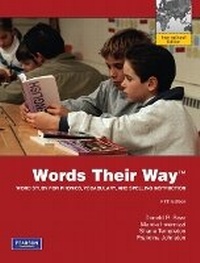
Words Their Way
Word Study for Phonics, Vocabulary, and Spelling Instruction: International Edition
5th Edition
Published on 14. July 2011
Book
Paperback/Softback
464 pages
978-0-13-271984-1 (ISBN)
Description
The developmentally driven Words Their Way (R) instructional approach is a phenomenon in word study, providing a practical way to study words with students. The keys to this successful, research-based approach are to know your students' literacy progress, organize for instruction, and implement word study. The Fifth Edition features an innovative redesign and introduces technology integration aligning text to all new classroom video, an interactive classroom assessment application, prepared and create-your-own word sorts, games, and more specific to each chapter. It gives you all the tools you need to carry out word study instruction that will motivate and engage your students, and help them to succeed in literacy learning. Ordered in a developmental format, Words Their Way (R) complements the use of any existing phonics, spelling, and vocabulary curricula.
We invite you to see what's new in Words Their Way (R) ...
Ground-breaking online PDToolkit for Words Their Way (R)gives educators access to:
all new how-to classroom videos
interactive classroom assessment tool featuring new user-friendly navigation
prepared and create-your-own word sorts
games, templates, and more!
Complimentary 12-month access packaged with each new Fifth Edition
To learn more, please visit: http://pdtoolkit.pearson.com
Innovative redesign of the book introduces technology integration aligning text to online videos, sorts, and assessments specific to each chapter.
Unprecedented inclusion of progress monitoring throughout the book.
Brand-new continuum of support model offers tips for better planning and carrying out word study lessons in the classroom.
Expanded discussion on oral vocabulary, secondary instruction, writing, and early/middle/late phases in the derivational relations stage.
Updated collection of classroom activities helps build the skills students need to move on to the next developmental stage.
New "Resources for Implementing Word Study in Your Classroom" provides information about resources teachers can use in their instruction.
Enhanced coverage of English learners provides tips and strategies for modifying instruction.
Classroom-ready appendices contain all the assessment instruments described in Chapter 2 as well as word sorts, sound boards, and game templates to get instruction underway. (Note: Includes reproducibles and perforated pages.)
We invite you to see what's new in Words Their Way (R) ...
Ground-breaking online PDToolkit for Words Their Way (R)gives educators access to:
all new how-to classroom videos
interactive classroom assessment tool featuring new user-friendly navigation
prepared and create-your-own word sorts
games, templates, and more!
Complimentary 12-month access packaged with each new Fifth Edition
To learn more, please visit: http://pdtoolkit.pearson.com
Innovative redesign of the book introduces technology integration aligning text to online videos, sorts, and assessments specific to each chapter.
Unprecedented inclusion of progress monitoring throughout the book.
Brand-new continuum of support model offers tips for better planning and carrying out word study lessons in the classroom.
Expanded discussion on oral vocabulary, secondary instruction, writing, and early/middle/late phases in the derivational relations stage.
Updated collection of classroom activities helps build the skills students need to move on to the next developmental stage.
New "Resources for Implementing Word Study in Your Classroom" provides information about resources teachers can use in their instruction.
Enhanced coverage of English learners provides tips and strategies for modifying instruction.
Classroom-ready appendices contain all the assessment instruments described in Chapter 2 as well as word sorts, sound boards, and game templates to get instruction underway. (Note: Includes reproducibles and perforated pages.)
More details
Edition
5th edition
Language
English
Place of publication
United States
Publishing group
Pearson Education (US)
Target group
College/higher education
Dimensions
Height: 216 mm
Width: 280 mm
Thickness: 15 mm
Weight
862 gr
ISBN-13
978-0-13-271984-1 (9780132719841)
Copyright in bibliographic data is held by Nielsen Book Services Limited or its licensors: all rights reserved.
Schweitzer Classification
Other editions
New editions
Donald Bear | Marcia Invernizzi | Shane Templeton
Words Their Way: Pearson New International Edition
Word Study for Phonics, Vocabulary, and Spelling Instruction
Book
07/2013
5th Edition
Pearson Education Limited
€71.98
Article exhausted; check for reprint
Previous edition
Donald R. Bear | Marcia Invernizzi | Shane Templeton
Words Their Way
Word Study for Phonics, Vocabulary, and Spelling Instruction
Book
06/2007
4th Edition
Pearson
€33.97
Article exhausted; check for reprint
Persons
Donald R. Bear is director of the E. L. Cord Foundation Center for Learning and Literacy where he and preservice, Master's and doctoral students teach and assess children who struggle to learn to read and write. Donald is a professor in the Department of Educational Specialties in the College of Education at the University of Nevada, Reno. Donald has been a classroom teacher and he researches and writes about literacy development and instruction. He is an author of numerous articles, book chapters, and books, including Words Their Way (R), Words Their Way (R)with English Learners, and Vocabulary Their Way.
Shane Templeton is Foundation Professor of Curriculum and Instruction at the University of Nevada, Reno, where he is Program Coordinator for Literacy Studies. A former elementary and secondary teacher, his research focuses on the development of orthographic knowledge. He has written several books on the teaching and learning of reading and language arts and is a member of the Usage Panel of the American Heritage Dictionary. He is author of the "Spelling Logics" column in Voices from the Middle, the middle school journal of the National Council of Teachers of English.
Marcia Invernizzi is a professor of reading education at the Curry School of Education at the University of Virginia. Marcia is also the director of the McGuffey Reading Center, where she teaches the clinical practica in reading diagnosis and remedial reading. Formerly an English and reading teacher, she works with Book Buddies, Virginia's Early Intervention Reading Initiative (EIRI), and Phonological Awareness Literacy Screening (PALS).
Francine Johnston is a former first grade teacher and reading specialist who learned about word study during her graduate work at the University of Virginia. She is now an associate professor in the School of Education at the University of North Carolina at Greensboro, where she teaches courses in reading, language arts, and children's literature. Francine frequently works with regional school systems as a consultant and researcher. Her research interests include current spelling practices and materials as well as the relationship between spelling and reading achievement.
Shane Templeton is Foundation Professor of Curriculum and Instruction at the University of Nevada, Reno, where he is Program Coordinator for Literacy Studies. A former elementary and secondary teacher, his research focuses on the development of orthographic knowledge. He has written several books on the teaching and learning of reading and language arts and is a member of the Usage Panel of the American Heritage Dictionary. He is author of the "Spelling Logics" column in Voices from the Middle, the middle school journal of the National Council of Teachers of English.
Marcia Invernizzi is a professor of reading education at the Curry School of Education at the University of Virginia. Marcia is also the director of the McGuffey Reading Center, where she teaches the clinical practica in reading diagnosis and remedial reading. Formerly an English and reading teacher, she works with Book Buddies, Virginia's Early Intervention Reading Initiative (EIRI), and Phonological Awareness Literacy Screening (PALS).
Francine Johnston is a former first grade teacher and reading specialist who learned about word study during her graduate work at the University of Virginia. She is now an associate professor in the School of Education at the University of North Carolina at Greensboro, where she teaches courses in reading, language arts, and children's literature. Francine frequently works with regional school systems as a consultant and researcher. Her research interests include current spelling practices and materials as well as the relationship between spelling and reading achievement.
Content
1. Developmental Word Knowledge
2. Getting Started: The Assessment of Orthographic Development
3. Organizing for Word Study: Principles and Practices
4. Word Study for Learners in the Emergent Stage
5. Word Study for Beginners in the Letter Name?Alphabetic Stage
6. Word Study for Transitional Learners in the Within Word Pattern Stage
7. Word Study for Intermediate Readers and Writers: The Syllables and Affixes Stage
8. Word Study for Advanced Readers and Writers: The Derivational Relations Stage
APPENDIX A: ASSESSMENT MATERIALS
APPENDIX B: SOUNDBOARDS
APPENDIX C: PICTURES FOR SORTS AND GAMES
APPENDIX D: SAMPLE WORD SORTS BY SPELLING STAGE
APPENDIX E: WORD LISTS
APPENDIX F: GAMES AND TEMPLATES FOR SORTS
APPENDIX G: RESOURCES
2. Getting Started: The Assessment of Orthographic Development
3. Organizing for Word Study: Principles and Practices
4. Word Study for Learners in the Emergent Stage
5. Word Study for Beginners in the Letter Name?Alphabetic Stage
6. Word Study for Transitional Learners in the Within Word Pattern Stage
7. Word Study for Intermediate Readers and Writers: The Syllables and Affixes Stage
8. Word Study for Advanced Readers and Writers: The Derivational Relations Stage
APPENDIX A: ASSESSMENT MATERIALS
APPENDIX B: SOUNDBOARDS
APPENDIX C: PICTURES FOR SORTS AND GAMES
APPENDIX D: SAMPLE WORD SORTS BY SPELLING STAGE
APPENDIX E: WORD LISTS
APPENDIX F: GAMES AND TEMPLATES FOR SORTS
APPENDIX G: RESOURCES