

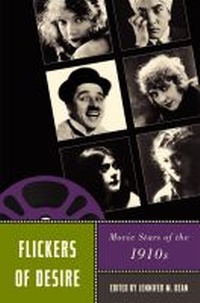
Flickers of Desire
Movie Stars of the 1910s
Published on 12. August 2011
Book
Hardback
288 pages
978-0-8135-5014-5 (ISBN)
Description
Today, we are so accustomed to consuming the amplified lives of film stars that the origins of the phenomenon may seem inevitable in retrospect. But the conjunction of the terms ""movie"" and ""star"" was inconceivable prior to the 1910s. Flickers of Desire explores the emergence of this mass cultural phenomenon, asking how and why a cinema that did not even run screen credits developed so quickly into a venue in which performers became the American film industry's most lucrative mode of product individuation. Contributors chart the rise of American cinema's first galaxy of stars through a variety of archival sources--newspaper columns, popular journals, fan magazines, cartoons, dolls, postcards, scrapbooks, personal letters, limericks, and dances. The iconic status of Charlie Chaplin's little tramp, Mary Pickford's golden curls, Pearl White's daring stunts, or Sessue Hayakawa's expressionless mask reflect the wild diversity of a public's desired ideals, while Theda Bara's seductive turn as the embodiment of feminine evil, George Beban's performance as a sympathetic Italian immigrant, or G. M. Anderson's creation of the heroic cowboy/outlaw character transformed the fantasies that shaped American filmmaking and its vital role in society.
More details
Series
Language
English
Place of publication
New Brunswick, NJ
United States
Illustrations
48
Dimensions
Height: 235 mm
Width: 156 mm
Weight
789 gr
ISBN-13
978-0-8135-5014-5 (9780813550145)
Copyright in bibliographic data and cover images is held by Nielsen Book Services Limited or by the publishers or by their respective licensors: all rights reserved.
Schweitzer Classification
Other editions
Additional editions
E-Book
07/2011
1st Edition
Rutgers University Press
€99.99
Available for download
Persons
Jennifer M. Bean is the director of the cinema studies program and an associate professor of comparative literature at the University of Washington. She is coeditor of A Feminist Reader in Early Cinema and a recipient of the prestigious Katherine Singer Kovacs Essay Award from the Society for Cinema and Media Studies.