

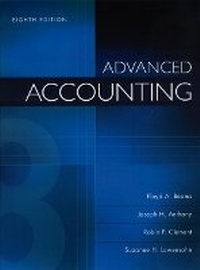
Advanced Accounting
International Edition
8th Edition
Published on 26. September 2002
Book
Paperback/Softback
762 pages
978-0-13-049364-4 (ISBN)
Description
For junior/senior-level courses in Advanced Accounting.
This student-friendly examination of accounting theory and practice offers extensive real-world examples and illustrations throughout-from corporations such as Microsoft, Coca Cola, Hershey Foods, IBM, General Motors, and General Electric. The authors' active writing style makes the presentation readable and appealing, explaining complex topics in a manner that students will find relevant. Less-frequently covered topics are transferred to Appendices or to the text's website, shortening the book and enabling students to focus on those concepts presented.
This student-friendly examination of accounting theory and practice offers extensive real-world examples and illustrations throughout-from corporations such as Microsoft, Coca Cola, Hershey Foods, IBM, General Motors, and General Electric. The authors' active writing style makes the presentation readable and appealing, explaining complex topics in a manner that students will find relevant. Less-frequently covered topics are transferred to Appendices or to the text's website, shortening the book and enabling students to focus on those concepts presented.
More details
Edition
8th edition
Language
English
Place of publication
United States
Publishing group
Pearson Education (US)
Target group
Professional and scholarly
Dimensions
Height: 280 mm
Width: 215 mm
Thickness: 28 mm
Weight
1569 gr
ISBN-13
978-0-13-049364-4 (9780130493644)
Copyright in bibliographic data and cover images is held by Nielsen Book Services Limited or by the publishers or by their respective licensors: all rights reserved.
Schweitzer Classification
Other editions
New editions

Floyd A. Beams | Robin P. Clement | Joseph H. Anthony
Advanced Accounting
Book
12/2005
9th Edition
Pearson
€71.79
Article exhausted; check for reprint
Persons
Floyd A. Beams, PH. D., is Professor Emeritus of Accounting at Virginia Tech. He holds B.S. and M.A. degrees in Business Administration from the University of Nebraska and a Ph.D. in Accounting from the University of Illinois. His journal articles have appeared in The Accounting Review, Journal of Accounting, Auditing and Finance, Journal of Accountancy, The Atlantic Economic Review, Management Accounting, and others, and have included topics on accounting theory, social accounting, financial reporting, income measurement, auditing, and cost accounting. Professor Beams has written a number of continuing professional education courses for the American Institute of Certified Public Accountants and was a frequent speaker for Virginia Tech's Accounting and Auditing Conference and Trends in the Education of Accountants seminar. He is a member of the American Accounting Association and the Institute of Management Accountants, and has served on various committees for both organizations. He received the National Association of Accountants' Lybrand Bronze Medal Award for outstanding contribution to accounting literature, a Distinguished Career in Accounting Award from the Virginia Society of CPAs, and the Virginia Outstanding Accounting Educator award from the Carman G. Blough student chapter of the Institute of Management Accountants.
Joseph H. Anthony, Associate Professor of Accounting, The Eli Broad College of Business, Michigan State University. B.A. 1971, M.S. 1974, Pennsylvania State University, Ph.D. 1984, The Ohio State University.
Professor Anthony joined the Michigan State University faculty in 1983. He is a Certified Public Accountant, a member of the American Accounting Association, American Institute of Certified Public Accountants, American Finance Association and Canadian Academic Accounting Association. He has been recognized as a Lilly Foundation Faculty Teaching Fellow, and as the MSU Accounting Department's Outstanding Teacher in 1998-99.
Professor Anthony teaches a variety of courses, including undergraduate introductory, intermediate, and advanced financial accounting. He also teaches financial accounting theory and financial statement analysis at the masters level, as well as financial accounting courses in the Executive MBA programs, and a doctoral seminar in financial accounting and capital markets research. He has previously co-authored an introductory financial accounting textbook.
Professor Anthony's research interests include financial statement analysis, corporate reporting, and the impact of accounting information in the securities markets. He has published a number of articles in leading accounting and finance journals, including The Journal of Accounting & Economics, The Journal of Finance, Contemporary Accounting Research, The Journal of Accounting, Auditing, & Finance, and Accounting Horizons.
Robin P. Clement, is an Instructor of Accounting in the Ourso College of Business Administration at Louisiana State University. She holds a bachelor degree in Accounting from The Ohio State University, an MBA from the University of Wisconsin-Milwaukee, and a Ph.D. from Michigan State University. Dr. Clement has taught at The University of Wisconsin-Milwaukee, Michigan State University, and Tulane University. Her area of specialty is financial accounting, having taught master's level Financial Accounting theory, Intermediate Accounting, and Advanced Accounting. Dr. Clement serves as the faculty adviser for the LSU chapter of Beta Alpha Psi. Dr. Clement has published A Study Guide for Financial Accounting: In an Economic Context with Joseph H. Anthony, currently in its 5th edition. Dr. Clement is also a member of the American Accounting Association.
Suzanne Lowensohn, PH.D., CPA, is an Assistant Professor of Accounting at Colorado State University. She earned a Ph.D. from the University of Miami and a Masters of Accountancy from the University of South Florida. Suzanne's research interests include governmental accounting, governmental auditing, and managerial accounting. She has published articles in such journals as Journal of Accounting and the Public Interest, Journal of Accounting and Finance Research, Research in Accounting Regulation, and Behavioral Research In Accounting.
Suzanne's professional activities include membership in the American Accounting Association, the Government Finance Officers Association, the Association of Government Accountants, and the Institute of Management Accountants.
Suzanne enjoys sports, traveling, and spending time with her husband, Tom, and two children, Grant and Tara.
Joseph H. Anthony, Associate Professor of Accounting, The Eli Broad College of Business, Michigan State University. B.A. 1971, M.S. 1974, Pennsylvania State University, Ph.D. 1984, The Ohio State University.
Professor Anthony joined the Michigan State University faculty in 1983. He is a Certified Public Accountant, a member of the American Accounting Association, American Institute of Certified Public Accountants, American Finance Association and Canadian Academic Accounting Association. He has been recognized as a Lilly Foundation Faculty Teaching Fellow, and as the MSU Accounting Department's Outstanding Teacher in 1998-99.
Professor Anthony teaches a variety of courses, including undergraduate introductory, intermediate, and advanced financial accounting. He also teaches financial accounting theory and financial statement analysis at the masters level, as well as financial accounting courses in the Executive MBA programs, and a doctoral seminar in financial accounting and capital markets research. He has previously co-authored an introductory financial accounting textbook.
Professor Anthony's research interests include financial statement analysis, corporate reporting, and the impact of accounting information in the securities markets. He has published a number of articles in leading accounting and finance journals, including The Journal of Accounting & Economics, The Journal of Finance, Contemporary Accounting Research, The Journal of Accounting, Auditing, & Finance, and Accounting Horizons.
Robin P. Clement, is an Instructor of Accounting in the Ourso College of Business Administration at Louisiana State University. She holds a bachelor degree in Accounting from The Ohio State University, an MBA from the University of Wisconsin-Milwaukee, and a Ph.D. from Michigan State University. Dr. Clement has taught at The University of Wisconsin-Milwaukee, Michigan State University, and Tulane University. Her area of specialty is financial accounting, having taught master's level Financial Accounting theory, Intermediate Accounting, and Advanced Accounting. Dr. Clement serves as the faculty adviser for the LSU chapter of Beta Alpha Psi. Dr. Clement has published A Study Guide for Financial Accounting: In an Economic Context with Joseph H. Anthony, currently in its 5th edition. Dr. Clement is also a member of the American Accounting Association.
Suzanne Lowensohn, PH.D., CPA, is an Assistant Professor of Accounting at Colorado State University. She earned a Ph.D. from the University of Miami and a Masters of Accountancy from the University of South Florida. Suzanne's research interests include governmental accounting, governmental auditing, and managerial accounting. She has published articles in such journals as Journal of Accounting and the Public Interest, Journal of Accounting and Finance Research, Research in Accounting Regulation, and Behavioral Research In Accounting.
Suzanne's professional activities include membership in the American Accounting Association, the Government Finance Officers Association, the Association of Government Accountants, and the Institute of Management Accountants.
Suzanne enjoys sports, traveling, and spending time with her husband, Tom, and two children, Grant and Tara.
Content
(NOTE: Each chapter concludes with a Summary and Electronic Supplement (Website) references.)
1. Business Combinations.
2. Stock Investments and Investor Accounting and Reporting.
3. An Introduction to Consolidated Financial Statements.
4. Consolidation Techniques and Procedures.
5. Intercompany Profit Transactions and Inventories.
6. Intercompany Profit Transactions and Plant Assets.
7. Intercompany Profit Transactions and Bonds.
8. Consolidations and Changes in Ownership Interests.
9. Indirect and Mutual Holdings.
10. Subsidiary Preferred Stock, Consolidated Earnings per Share, and Consolidated Income Taxation.
11. Consolidation Theories, Push-Down Accounting, and Corporate Joint Ventures.
12. Foreign Currency Concepts and Transactions.
13. Foreign Currency Financial Statements.
14. Segment and Interim Financial Reporting.
15. Partnerships-Formation, Operations and Changes in Ownership Interests.
16. Dissolution and Liquidation of a Partnership.
17. Corporate Liquidations and Reorganizations.
18. An Introduction to Accounting for State and Local Government.
19. Accounting for State and Local Governmental Units-Governmental Funds.
20. Accounting for State and Local Governmental Units-Proprietary and Fiduciary Funds.
21. Accounting for Non-for-Profit Organizations.
1. Business Combinations.
2. Stock Investments and Investor Accounting and Reporting.
3. An Introduction to Consolidated Financial Statements.
4. Consolidation Techniques and Procedures.
5. Intercompany Profit Transactions and Inventories.
6. Intercompany Profit Transactions and Plant Assets.
7. Intercompany Profit Transactions and Bonds.
8. Consolidations and Changes in Ownership Interests.
9. Indirect and Mutual Holdings.
10. Subsidiary Preferred Stock, Consolidated Earnings per Share, and Consolidated Income Taxation.
11. Consolidation Theories, Push-Down Accounting, and Corporate Joint Ventures.
12. Foreign Currency Concepts and Transactions.
13. Foreign Currency Financial Statements.
14. Segment and Interim Financial Reporting.
15. Partnerships-Formation, Operations and Changes in Ownership Interests.
16. Dissolution and Liquidation of a Partnership.
17. Corporate Liquidations and Reorganizations.
18. An Introduction to Accounting for State and Local Government.
19. Accounting for State and Local Governmental Units-Governmental Funds.
20. Accounting for State and Local Governmental Units-Proprietary and Fiduciary Funds.
21. Accounting for Non-for-Profit Organizations.