

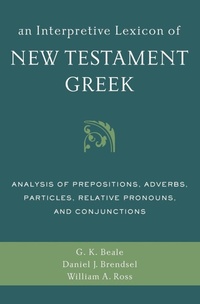
An Interpretive Lexicon of New Testament Greek
Analysis of Prepositions, Adverbs, Particles, Relative Pronouns, and Conjunctions
Published on 6. November 2014
Book
Paperback/Softback
96 pages
978-0-310-49411-9 (ISBN)
Description
Save considerable time in translating and exegesis of the Greek New Testament text.
This Lexicon has a very specific and important purpose: to make the process of New Testament interpretation easier and more accurate by providing a comprehensive yet concise interpretation of Greek words that determine logical relationships between statements or clauses.
These words (prepositions, adverbs, particles, relative pronouns, conjunctions and other connectors) are essential to revealing and supporting the main ideas in the text and are especially useful for interpreting logical arguments, such as those found in the epistles.
While not exhaustive, this Interpretive Lexicon lists the vast majority of Greek connecting words, especially those that are notorious for being some of the most difficult words to translate.
Features include:
Concise definitions for quick analysis.
Examples of where the word is found in Scripture.
Page references to several major lexical resources for further translation options and nuances.
Interpretation of the broader categories of each word (for example: locative (in, among, on), means-end (with, by), grounds (because, on account of), temporal (while, at), and so on.
The interpretive feature of the book--evaluating the word's function in discourse--is tremendously helpful for the exegetical process, allowing the translator to closely follow the logical flow of the text with greater efficiency. This Interpretive Lexicon is a valuable handbook for student, pastor, and scholar alike.
This Lexicon has a very specific and important purpose: to make the process of New Testament interpretation easier and more accurate by providing a comprehensive yet concise interpretation of Greek words that determine logical relationships between statements or clauses.
These words (prepositions, adverbs, particles, relative pronouns, conjunctions and other connectors) are essential to revealing and supporting the main ideas in the text and are especially useful for interpreting logical arguments, such as those found in the epistles.
While not exhaustive, this Interpretive Lexicon lists the vast majority of Greek connecting words, especially those that are notorious for being some of the most difficult words to translate.
Features include:
Concise definitions for quick analysis.
Examples of where the word is found in Scripture.
Page references to several major lexical resources for further translation options and nuances.
Interpretation of the broader categories of each word (for example: locative (in, among, on), means-end (with, by), grounds (because, on account of), temporal (while, at), and so on.
The interpretive feature of the book--evaluating the word's function in discourse--is tremendously helpful for the exegetical process, allowing the translator to closely follow the logical flow of the text with greater efficiency. This Interpretive Lexicon is a valuable handbook for student, pastor, and scholar alike.
More details
Language
English
Place of publication
United States
Publishing group
Zondervan
Target group
College/higher education
Professional and scholarly
Dimensions
Height: 203 mm
Width: 133 mm
Thickness: 7 mm
Weight
134 gr
ISBN-13
978-0-310-49411-9 (9780310494119)
Copyright in bibliographic data and cover images is held by Nielsen Book Services Limited or by the publishers or by their respective licensors: all rights reserved.
Schweitzer Classification
Other editions
Additional editions
Gregory K. Beale | Daniel Joseph Brendsel | William A. Ross
An Interpretive Lexicon of New Testament Greek
Analysis of Prepositions, Adverbs, Particles, Relative Pronouns, and Conjunctions
E-Book
10/2014
Zondervan Academic
€8.99
Available for download
Persons
Gregory K. Beale (PhD, University of Cambridge) is J. Gresham Machen Chair of New Testatment, Proferssor of New Testament and Bible Theology at Wheaton College Graduate School.
William A. Ross is a doctoral student at the University of Cambridge.
William A. Ross is a doctoral student at the University of Cambridge.