

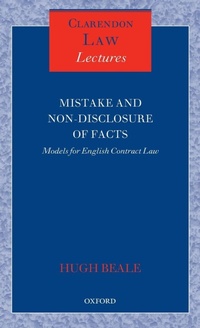
Mistake and Non-Disclosure of Fact
Models for English Contract Law
Published on 23. August 2012
Book
Hardback
172 pages
978-0-19-959388-0 (ISBN)
Description
In this book Hugh Beale examines the case for reforming the law on mistake and non-disclosure of fact to bring English law closer to the law in much of continental Europe. There, and in common law countries like the US, a party may avoid a contract for mistake of fact on a more liberal basis, and a party who deliberately keeps silent knowing that the other party is making a mistake may be guilty of fraud. This is not necessarily the case in England and Wales.
Developing a proposal for law reform, the author concedes that the English courts require a law that puts great emphasis on certainty and expects parties to look out for their own interests; but posits that this individualistic approach is not suitable for smaller businesses which are less sophisticated and which are likely to be making low value contracts, so that relative cost of taking advice will be high. He argues that the solution may not be to reform English contract law generally, but to support the development of an optional instrument on contract law, along the lines of the Common European Sales Law recently proposed by the European Commission.
This measure is aimed specifically at the needs of small and medium enterprises, and contains the protective rules found in the other jurisdictions. It is aimed primarily at cross-border sales, but Member States would be given the option of adopting it for domestic transactions too. This would give small businesses the choice of using the current "hard-nosed" law or adopting the more protective optional instrument, recognizing that different parties require different things from the law governing their contract.
Developing a proposal for law reform, the author concedes that the English courts require a law that puts great emphasis on certainty and expects parties to look out for their own interests; but posits that this individualistic approach is not suitable for smaller businesses which are less sophisticated and which are likely to be making low value contracts, so that relative cost of taking advice will be high. He argues that the solution may not be to reform English contract law generally, but to support the development of an optional instrument on contract law, along the lines of the Common European Sales Law recently proposed by the European Commission.
This measure is aimed specifically at the needs of small and medium enterprises, and contains the protective rules found in the other jurisdictions. It is aimed primarily at cross-border sales, but Member States would be given the option of adopting it for domestic transactions too. This would give small businesses the choice of using the current "hard-nosed" law or adopting the more protective optional instrument, recognizing that different parties require different things from the law governing their contract.
More details
Series
Language
English
Place of publication
Oxford
United Kingdom
Target group
College/higher education
Dimensions
Height: 222 mm
Width: 145 mm
Thickness: 13 mm
Weight
356 gr
ISBN-13
978-0-19-959388-0 (9780199593880)
Copyright in bibliographic data and cover images is held by Nielsen Book Services Limited or by the publishers or by their respective licensors: all rights reserved.
Schweitzer Classification
Other editions
Additional editions

E-Book
08/2012
1st Edition
OUP Oxford
€61.69
Available for download
E-Book
08/2012
1st Edition
Oxford University Press
€112.45
Available for download
Person
Hugh Beale QC FBA is Professor of Law at the University of Warwick, and a Visiting Professor at the University of Amsterdam and the University of Oxford. He was a member of the Commission on European Contract Law from 1987-1999, and was a Law Commissioner for England and Wales with responsibility for the Commercial and Common Law Team from 2000-2007. An honorary QC, he is also the editor of Chitty on Contracts.
Content
I: DEFINING THE ISSUES ; Background: 'European' Principles of Contract Law ; Defining the Issue ; Real Differences between English and the 'European' Laws ; Conclusions ; II: MISTAKE AND NON-DISCLOSURE IN OTHER SYSTEMS ; Commonwealth Laws ; European Models ; United States ; What to Make of the Survey? ; III: POSSIBLE MODELS FOR ENGLISH LAW ; Models Not to Follow ; The Underlying Aim: Protection of Autonomy or Fairness in Exchange? ; A Plausible 'Informed Consent' Model ; Remedies ; A Provisional Proposal