

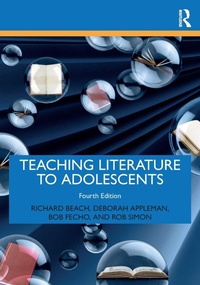
Teaching Literature to Adolescents
4th Edition
Published on 29. December 2020
Book
Paperback/Softback
312 pages
978-0-367-36620-9 (ISBN)
Description
Now in its fourth edition, this popular textbook introduces prospective and practicing English teachers to current methods of teaching literature in middle and high school classrooms. This new edition broadens its focus to cover important topics such as critical race theory; perspectives on teaching fiction, nonfiction, and drama; the integration of digital literacy; and teacher research for ongoing learning and professional development. It underscores the value of providing students with a range of different critical approaches and tools for interpreting texts. It also addresses the need to organize literature instruction around topics and issues of interest to today's adolescents. By using authentic dilemmas and contemporary issues, the authors encourage preservice English teachers and their instructors to raise and explore inquiry-based questions that center on the teaching of a variety of literary texts, both classic and contemporary, traditional and digital.
New to the Fourth Edition:
Expanded attention to digital tools, multimodal learning, and teaching online
New examples of teaching contemporary texts
Expanded discussion and illustration of formative assessment
Revised response activities for incorporating young adult literature into the literature curriculum
Real-world examples of student work to illustrate how students respond to the suggested strategies
Extended focus on infusing multicultural and diverse literature in the classroom
Each chapter is organized around specific questions that preservice teachers consistently raise as they prepare to become English language arts teachers. The authors model critical inquiry throughout the text by offering authentic case narratives that raise important considerations of both theory and practice. A companion website, a favorite of English education instructors, http://teachingliterature.pbworks.com, provides resources and enrichment activities, inviting teachers to consider important issues in the context of their current or future classrooms.
New to the Fourth Edition:
Expanded attention to digital tools, multimodal learning, and teaching online
New examples of teaching contemporary texts
Expanded discussion and illustration of formative assessment
Revised response activities for incorporating young adult literature into the literature curriculum
Real-world examples of student work to illustrate how students respond to the suggested strategies
Extended focus on infusing multicultural and diverse literature in the classroom
Each chapter is organized around specific questions that preservice teachers consistently raise as they prepare to become English language arts teachers. The authors model critical inquiry throughout the text by offering authentic case narratives that raise important considerations of both theory and practice. A companion website, a favorite of English education instructors, http://teachingliterature.pbworks.com, provides resources and enrichment activities, inviting teachers to consider important issues in the context of their current or future classrooms.
Reviews / Votes
Review #1: Rick Lybeck, Assistant Professor, Minnesota State University, USA."The volume's critical sociocultural approach to teaching literature is exactly what's needed in this era of high-stakes testing and accountability. Here, the spirit of literature as exploration is revivified through real-world examples and methods to help secondary students not only find meaning in the texts they're reading, but to engage compelling aspects of politics, identity, and agency as they do."
Review #2: Russell E. Greinke, Associate Professor of English, University of Central Missouri, USA.
"Here is why I use the BAFS book (that is how I abbreviate it on my syllabus): Other YA lit texts typically arrange chapters around subjects such as contemporary realistic fiction, historical fiction, biography, adventure, etc. I prefer topics such as reading, responding, evaluating, and assessing, so I am not stuck assigning books from rigid categories like "biography." I like those straight-talking teacher vignettes, e.g., p. 3."
[I would consider buying the fourth edition]. Consider a condensed version, though. The students need to spend most of the semester reading YA lit and planning how to teach specific works. To give thorough coverage to all 12 chapters of BAFS is a huge time bite."
Review #3: Sabrina Jones, English Instructor, Marshall University, USA.
"There are some things I really like about this text. First, it emphasizes multiliteracy, and thus teaching a variety of literature types. It has activities for teaching social issues through YA fiction and using that as a vehicle for promoting action. This is very empowering for students. There's also a fresh focus on digital media literacy. As technology grows, it is very important that teachers are able to grow with it and incorporate it in the classroom. I
particularly love the detailed use of lesson plans and classroom-ready activities in chapters 8 and 9. I would like to see more of this in other chapters."
Review #4: David Bowles, Assistant Professor, University of Texas Rio Grande Valley, USA.
"The attitude of the authors/editors toward students' diversity-both demographic and in terms of reading/learning-is a powerful antidote to the overreliance on canon that they have experienced in other English courses. And the chapters are written in a style that eschews convoluted, academic-sounding prose for accessible and forthright discussions of the issues. Finally, to reiterate a point I made above, the immediate application of concepts in the form of lesson plans at the end of chapters is pretty fantastic."
More details
Edition
4th edition
Language
English
Place of publication
London
United Kingdom
Publishing group
Taylor & Francis Ltd
Target group
College/higher education
Illustrations
9 s/w Zeichnungen, 3 s/w Tabellen
3 Tables, black and white; 9 Line drawings, black and white
Dimensions
Height: 254 mm
Width: 178 mm
Thickness: 18 mm
Weight
616 gr
ISBN-13
978-0-367-36620-9 (9780367366209)
Copyright in bibliographic data and cover images is held by Nielsen Book Services Limited or by the publishers or by their respective licensors: all rights reserved.
Schweitzer Classification
Other editions
New editions
Richard Beach | Deborah Appleman | Rob Simon
Teaching Literature to Adolescents
Book
approx. 07/2026
5th Edition
Routledge
€62.00
Not yet published
Additional editions
Richard Beach | Deborah Appleman | Rob Simon
Teaching Literature to Adolescents
Book
12/2020
4th Edition
Routledge
€205.10
Shipment within 15-20 days
Richard Beach | Deborah Appleman | Rob Simon
Teaching Literature to Adolescents
E-Book
12/2020
4th Edition
Routledge
€69.99
Available for download
Richard Beach | Deborah Appleman | Rob Simon
Teaching Literature to Adolescents
E-Book
12/2020
4th Edition
Routledge
€69.99
Available for download
Previous edition
Richard Beach | Deborah Appleman | Bob Fecho
Teaching Literature to Adolescents
Book
06/2016
3rd Edition
Routledge
€81.89
Withdrawn from sale
Persons
Richard Beach is Professor Emeritus of English Education at the University of Minnesota, USA.
Deborah Appleman is the Hollis L. Caswell Professor and Chair of Educational Studies at Carleton College, USA.
Bob Fecho is Professor of English Education at Teachers College, Columbia University, USA.
Rob Simon is Associate Professor of Multiliteracies in Education at the Ontario Institute for Studies in Education of the University of Toronto, Canada.
Deborah Appleman is the Hollis L. Caswell Professor and Chair of Educational Studies at Carleton College, USA.
Bob Fecho is Professor of English Education at Teachers College, Columbia University, USA.
Rob Simon is Associate Professor of Multiliteracies in Education at the Ontario Institute for Studies in Education of the University of Toronto, Canada.
Content
Preface
Part 1: Why Should I Teach Literature?
1) Why Teaching Literature Still Matters
2) How Will I Come To Know My Students?
Part 2: What Texts Will Students Read and View in My Classroom?
3) How Do I Plan an Integrated Curriculum?
4) How Do I Choose and Teach Beyond the Canon?
5) Use of Multimodal/Digital Tools for Responding to and Creating Multimodal/Digital Texts
Part 3: How Will I Teach Literature?
6) How Do I Foster Different Ways of Talking and Writing about Literature?
7) How Do I Encourage Students to Respond to Literature Through Multiple Critical Perspectives?
8) How Do I Engage Students in Writing and Enacting Literary Texts?
9) How Can I Engage Students in Responding to Poetry and Spoken Word?
10) How Do I Integrate Reading Instruction with Teaching Literature?
11) How Do I Assess and Evaluate Students' Learning?
Part 4: We Make the Road by Walking
12) How Do I Develop as a Teacher Across a Professional Life Span?
Part 1: Why Should I Teach Literature?
1) Why Teaching Literature Still Matters
2) How Will I Come To Know My Students?
Part 2: What Texts Will Students Read and View in My Classroom?
3) How Do I Plan an Integrated Curriculum?
4) How Do I Choose and Teach Beyond the Canon?
5) Use of Multimodal/Digital Tools for Responding to and Creating Multimodal/Digital Texts
Part 3: How Will I Teach Literature?
6) How Do I Foster Different Ways of Talking and Writing about Literature?
7) How Do I Encourage Students to Respond to Literature Through Multiple Critical Perspectives?
8) How Do I Engage Students in Writing and Enacting Literary Texts?
9) How Can I Engage Students in Responding to Poetry and Spoken Word?
10) How Do I Integrate Reading Instruction with Teaching Literature?
11) How Do I Assess and Evaluate Students' Learning?
Part 4: We Make the Road by Walking
12) How Do I Develop as a Teacher Across a Professional Life Span?