

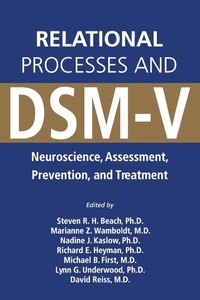
Relational Processes and DSM-V
Neuroscience, Assessment, Prevention, and Treatment
Published on 18. August 2006
Book
Paperback/Softback
293 pages
978-1-58562-238-2 (ISBN)
Description
Seeking to integrate the large volume of clinical research
on relational processes and mental health disorders with other scientific
advances in psychiatry, Relational Processes and DSM-V builds on
exciting advances in clinical research on troubled relationships. These
advances included marked improvements in the assessment and epidemiology of
troubled relationships as well the use of genetics, neuroscience, and
immunology to explore the importance of close relationships in clinical
practice. Advances in family-based intervention, and prevention are also
highlighted to help practitioners and researchers find common ground and
begin an empirically based discussion about the best way to revise the DSM.
Given the overwhelming research showing that relationships play a role in
regulating neurobiology and genetic expression and are critical for
understanding schizophrenia, conduct disorder, and depression among other
disorders, relational processes must be a part of any empirically based plan
for revising psychiatric nosology in DSM-V.
The chapters in this book
counter the perspective that we can safely discard the biopsychosocial model
that has guided psychiatry in the past. The contributors examine the
relevance of close relationships in such issues as the basic psychopathology
of mental disorders, factors influencing maintenance and relapse, sources of
burden for family members, and guiding family-based interventions. By tying
relational processes to basic research on psychopathology, they demonstrate
the value of integrating basic behavioral and brain research with a
sophisticated understanding of the self-organizing and self-sustaining
characteristics of relationships. Coverage includes:
* research linking relational processes to neuroscience, neurobiology,
health outcomes, intervention research, prevention research, and
genetics
* consideration of specific circumstances, such as promoting
healthy parenting following divorce and relational processes in depressed
Latino adolescents
* optimal approaches to the assessment of relational
processes with clinical significance, such as child abuse, partner abuse,
and expressed emotion.
* a simple introduction to the methodology of
taxometrics, offering insight into whether key relational processes are
distinct categories or continuously distributed variables
* an overview
of the links between relational processes and psychiatric outcomes,
providing a theoretical foundation for the discussion of links to
psychopathology
Together, these contributions seek to develop a
shared commitment among clinicians, researchers, and psychopathologists to
take seriously the issue of relational processes as they relate to diagnoses
within DSM-and to encourage mental health care workers at all levels to
harness the generative and healing properties of intimate relationships and
make them a focus of clinical practice. It is a book that will prove useful
to all who are interested in integrating greater sensitivity to relational
processes in their work.
on relational processes and mental health disorders with other scientific
advances in psychiatry, Relational Processes and DSM-V builds on
exciting advances in clinical research on troubled relationships. These
advances included marked improvements in the assessment and epidemiology of
troubled relationships as well the use of genetics, neuroscience, and
immunology to explore the importance of close relationships in clinical
practice. Advances in family-based intervention, and prevention are also
highlighted to help practitioners and researchers find common ground and
begin an empirically based discussion about the best way to revise the DSM.
Given the overwhelming research showing that relationships play a role in
regulating neurobiology and genetic expression and are critical for
understanding schizophrenia, conduct disorder, and depression among other
disorders, relational processes must be a part of any empirically based plan
for revising psychiatric nosology in DSM-V.
The chapters in this book
counter the perspective that we can safely discard the biopsychosocial model
that has guided psychiatry in the past. The contributors examine the
relevance of close relationships in such issues as the basic psychopathology
of mental disorders, factors influencing maintenance and relapse, sources of
burden for family members, and guiding family-based interventions. By tying
relational processes to basic research on psychopathology, they demonstrate
the value of integrating basic behavioral and brain research with a
sophisticated understanding of the self-organizing and self-sustaining
characteristics of relationships. Coverage includes:
* research linking relational processes to neuroscience, neurobiology,
health outcomes, intervention research, prevention research, and
genetics
* consideration of specific circumstances, such as promoting
healthy parenting following divorce and relational processes in depressed
Latino adolescents
* optimal approaches to the assessment of relational
processes with clinical significance, such as child abuse, partner abuse,
and expressed emotion.
* a simple introduction to the methodology of
taxometrics, offering insight into whether key relational processes are
distinct categories or continuously distributed variables
* an overview
of the links between relational processes and psychiatric outcomes,
providing a theoretical foundation for the discussion of links to
psychopathology
Together, these contributions seek to develop a
shared commitment among clinicians, researchers, and psychopathologists to
take seriously the issue of relational processes as they relate to diagnoses
within DSM-and to encourage mental health care workers at all levels to
harness the generative and healing properties of intimate relationships and
make them a focus of clinical practice. It is a book that will prove useful
to all who are interested in integrating greater sensitivity to relational
processes in their work.
More details
Language
English
Place of publication
VA
United States
Target group
Professional and scholarly
US School Grade: College Graduate Student and over
Product notice
Paperback (trade)
Illustrations
2 Tables, unspecified; 15 Line drawings, black and white
Dimensions
Height: 233 mm
Width: 153 mm
Thickness: 15 mm
Weight
424 gr
ISBN-13
978-1-58562-238-2 (9781585622382)
Copyright in bibliographic data and cover images is held by Nielsen Book Services Limited or by the publishers or by their respective licensors: all rights reserved.
Schweitzer Classification
Other editions
Additional editions
Steven R. H. Beach
Relational Processes and DSM-V
Neuroscience, Assessment, Prevention, and Intervention
E-Book
12/2006
1st Edition
American Psychiatric Publishing
€69.49
Available for download
Persons
Steven R. H. Beach, Ph.D., is Director of the
Institute for Behavioral Research at the University of Georgia in Athens,
Georgia.
Marianne Z. Wamboldt, M.D., is Vice Chair for Child
Psychiatry, University of Colorado at Denver and Health Sciences Center, and
Chair of Psychiatry and Behavioral Science at The Children's Hospital of
Denver in Denver, Colorado.
Nadine J. Kaslow, Ph.D., is
Professor and Chief Psychologist in the Department of Psychiatry and
Behavioral Sciences at Emory School of Medicine/Grady Health System in
Atlanta, Georgia.
Richard E. Heyman, Ph.D., is Research
Professor in the Department of Psychology at the State University of New
York at Stony Brook in Stony Brook, New York.
Michael B. First,
M.D., is Associate Professor of Clinical Psychiatry at the New York
State Psychiatric Institute/Columbia University, in New York, New
York.
Lynn G. Underwood, Ph.D., is Professor of Biomedical
Humanities and Director of the Center for Literature, Medicine and the
Health Care Professions at Hiram College in Hiram, Ohio.
David
Reiss, M.D., is Vivian Gill Distinguished Professor of Research in
the Department of Psychiatry and Behavioral Sciences at George Washington
University Medical Center in Washington, D.C.
Institute for Behavioral Research at the University of Georgia in Athens,
Georgia.
Marianne Z. Wamboldt, M.D., is Vice Chair for Child
Psychiatry, University of Colorado at Denver and Health Sciences Center, and
Chair of Psychiatry and Behavioral Science at The Children's Hospital of
Denver in Denver, Colorado.
Nadine J. Kaslow, Ph.D., is
Professor and Chief Psychologist in the Department of Psychiatry and
Behavioral Sciences at Emory School of Medicine/Grady Health System in
Atlanta, Georgia.
Richard E. Heyman, Ph.D., is Research
Professor in the Department of Psychology at the State University of New
York at Stony Brook in Stony Brook, New York.
Michael B. First,
M.D., is Associate Professor of Clinical Psychiatry at the New York
State Psychiatric Institute/Columbia University, in New York, New
York.
Lynn G. Underwood, Ph.D., is Professor of Biomedical
Humanities and Director of the Center for Literature, Medicine and the
Health Care Professions at Hiram College in Hiram, Ohio.
David
Reiss, M.D., is Vivian Gill Distinguished Professor of Research in
the Department of Psychiatry and Behavioral Sciences at George Washington
University Medical Center in Washington, D.C.
Content
CONTRIBUTORS
PREFACE
INTRODUCTION
ACKNOWLEDGMENTS
Chapter
1. RELATIONAL PROCESSES AND MENTAL HEALTH: A Bench-to-Bedside Dialogue to
Guide DSM-V
Part I: Biological Underpinnings
Chapter 2. NEUROBIOLOGY
OF THE SOCIAL BRAIN: Lessons From Animal Models About Social
Relationships
Chapter 3. REFINING THE CATEGORICAL LANDSCAPE OF THE DSM:
Role of Animal Models
Chapter 4. MARRIAGE, HEALTH, AND IMMUNE
FUNCTION
Chapter 5. FAMILY EXPRESSED EMOTION PRIOR TO ONSET OF
PSYCHOSIS
Chapter 6. GENETIC STRATEGIES FOR DELINEATING RELATIONAL
TAXONS: Origins, Outcomes, and Relation to Individual
Psychopathology
Part II: Assessment
Chapter 7. CHILDHOOD
MALTREATMENT AND ADULT PSYCHOPATHOLOGY: Some Measurement Options
Chapter
8. TAXOMETRICS AND RELATIONAL PROCESSES: Relevance and Challenges for the
Next Nosology of Mental Disorders
Chapter 9. RELATIONAL DIAGNOSES: From
Reliable, Rationally Derived Criteria to Testable Taxonic
Hypotheses
Chapter 10. DEFINING RELATIONAL DISORDERS AND IDENTIFYING
THEIR CONNECTIONS TO AXES I AND II
Chapter 11. EXPRESSED EMOTION AND
DSM-V
Part III: Prevention and Treatment
Chapter 12. PREVENTION AS
THE PROMOTION OF HEALTHY PARENTING FOLLOWING PARENTAL DIVORCE
Chapter
13. CULTURAL AND RELATIONAL PROCESSES IN DEPRESSED LATINO
ADOLESCENTS
Chapter 14. ROLE OF COUPLES RELATIONSHIPS IN UNDERSTANDING
AND TREATING MENTAL DISORDERS
Part IV: Summary and Implications for
Future Research
Chapter 15. RECOMMENDATIONS FOR RESEARCH ON RELATIONAL
DISORDERS AND PROCESSES: A Roadmap for DSM-V
INDEX
PREFACE
INTRODUCTION
ACKNOWLEDGMENTS
Chapter
1. RELATIONAL PROCESSES AND MENTAL HEALTH: A Bench-to-Bedside Dialogue to
Guide DSM-V
Part I: Biological Underpinnings
Chapter 2. NEUROBIOLOGY
OF THE SOCIAL BRAIN: Lessons From Animal Models About Social
Relationships
Chapter 3. REFINING THE CATEGORICAL LANDSCAPE OF THE DSM:
Role of Animal Models
Chapter 4. MARRIAGE, HEALTH, AND IMMUNE
FUNCTION
Chapter 5. FAMILY EXPRESSED EMOTION PRIOR TO ONSET OF
PSYCHOSIS
Chapter 6. GENETIC STRATEGIES FOR DELINEATING RELATIONAL
TAXONS: Origins, Outcomes, and Relation to Individual
Psychopathology
Part II: Assessment
Chapter 7. CHILDHOOD
MALTREATMENT AND ADULT PSYCHOPATHOLOGY: Some Measurement Options
Chapter
8. TAXOMETRICS AND RELATIONAL PROCESSES: Relevance and Challenges for the
Next Nosology of Mental Disorders
Chapter 9. RELATIONAL DIAGNOSES: From
Reliable, Rationally Derived Criteria to Testable Taxonic
Hypotheses
Chapter 10. DEFINING RELATIONAL DISORDERS AND IDENTIFYING
THEIR CONNECTIONS TO AXES I AND II
Chapter 11. EXPRESSED EMOTION AND
DSM-V
Part III: Prevention and Treatment
Chapter 12. PREVENTION AS
THE PROMOTION OF HEALTHY PARENTING FOLLOWING PARENTAL DIVORCE
Chapter
13. CULTURAL AND RELATIONAL PROCESSES IN DEPRESSED LATINO
ADOLESCENTS
Chapter 14. ROLE OF COUPLES RELATIONSHIPS IN UNDERSTANDING
AND TREATING MENTAL DISORDERS
Part IV: Summary and Implications for
Future Research
Chapter 15. RECOMMENDATIONS FOR RESEARCH ON RELATIONAL
DISORDERS AND PROCESSES: A Roadmap for DSM-V
INDEX