

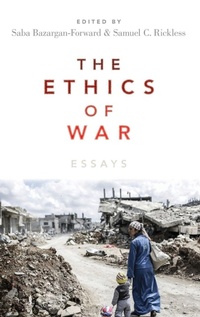
The Ethics of War
Essays
Published on 9. March 2017
Book
Hardback
304 pages
978-0-19-937614-8 (ISBN)
Description
Just War theory - as it was developed by the Catholic theologians of medieval Europe and the jurists of the Renaissance - is a framework for the moral and legal evaluation of armed conflicts. To this day, Just War theory informs the judgments of ethicists, government officials, international lawyers, religious scholars, news coverage, and perhaps most importantly, the public as a whole. The influence of Just War theory is as vast as it is subtle - we have been socialized into evaluating wars largely according to the principles of this medieval theory, which, according to the eminent philosopher David Rodin, is "one of the few basic fixtures of medieval philosophy to remain substantially unchallenged in the modern world".
Some of the most basic assumptions of Just War Theory have been dismantled in a barrage of criticism and analysis in the first dozen years of the 21st century. "The Ethics of War" continues and pushes past this trend. This anthology is an authoritative treatment of the ethics and law of war by both the eminent scholars who first challenged the orthodoxy of Just War theory, as well as by new thinkers.
The twelve original essays span both foundational and topical issues in the ethics of war, including an investigation of: whether there is a "greater-good" obligation that parallels the canonical lesser-evil justification in war; the conditions under which citizens can wage war against their own government; whether there is a limit to the number of combatants on the unjust side who can be permissibly killed; whether the justice of the cause for which combatants fight affects the moral permissibility of fighting; whether duress ever justifies killing in war; the role that collective liability plays in the ethics of war; whether targeted killing is morally and legally permissible; the morality of legal prohibitions on the use of indiscriminate weapons; the justification for the legal distinction between directly and indirectly harming civilians; whether human rights of unjust combatants are more prohibitive than have been thought; the moral repair of combatants suffering from PTSD; and the moral categories and criteria needed to understand the proper justification for ending war.
Some of the most basic assumptions of Just War Theory have been dismantled in a barrage of criticism and analysis in the first dozen years of the 21st century. "The Ethics of War" continues and pushes past this trend. This anthology is an authoritative treatment of the ethics and law of war by both the eminent scholars who first challenged the orthodoxy of Just War theory, as well as by new thinkers.
The twelve original essays span both foundational and topical issues in the ethics of war, including an investigation of: whether there is a "greater-good" obligation that parallels the canonical lesser-evil justification in war; the conditions under which citizens can wage war against their own government; whether there is a limit to the number of combatants on the unjust side who can be permissibly killed; whether the justice of the cause for which combatants fight affects the moral permissibility of fighting; whether duress ever justifies killing in war; the role that collective liability plays in the ethics of war; whether targeted killing is morally and legally permissible; the morality of legal prohibitions on the use of indiscriminate weapons; the justification for the legal distinction between directly and indirectly harming civilians; whether human rights of unjust combatants are more prohibitive than have been thought; the moral repair of combatants suffering from PTSD; and the moral categories and criteria needed to understand the proper justification for ending war.
Reviews / Votes
The argumentative chapters in this volume convey the contours of the most important ethical issues surrounding the revisionist approach to war as well as make genuine progress on those issues. The volume is therefore worth careful reading both for those looking for a thorough introduction to the revisionist approach and for seasoned philosophers of war looking for new insights. * Isaac Anderson Wagner, University of Copenhagen, Ethical Theory and Moral Practice * If one is ready for The Ethics of War, he or she will be rewarded since most of the articles are high in quality. * Nick Fotion, Journal of Moral Philosophy *More details
Language
English
Place of publication
New York
United States
Target group
College/higher education
Dimensions
Height: 240 mm
Width: 161 mm
Thickness: 21 mm
Weight
625 gr
ISBN-13
978-0-19-937614-8 (9780199376148)
Copyright in bibliographic data and cover images is held by Nielsen Book Services Limited or by the publishers or by their respective licensors: all rights reserved.
Schweitzer Classification
Other editions
Additional editions
E-Book
01/2017
1st Edition
OUP eBook
€39.49
Available for download
E-Book
01/2017
1st Edition
OUP eBook
€50.49
Available for download
Persons
Bazargan: Assistant Professor; Rickless: Professor; both at Department of Philosophy, University of California San Diego
Samuel C. Rickless earned his B. A. from Harvard in 1986, spent two years on a Marshall Scholarship at Balliol College, Oxford (1986-1988), where he earned a B. Phil., and then earned his Ph.D. in philosophy from UCLA in 1996. After five years as an Assistant Professor of philosophy at Florida State University, he moved to UC San Diego, where he is now a Full Professor.
Samuel C. Rickless earned his B. A. from Harvard in 1986, spent two years on a Marshall Scholarship at Balliol College, Oxford (1986-1988), where he earned a B. Phil., and then earned his Ph.D. in philosophy from UCLA in 1996. After five years as an Assistant Professor of philosophy at Florida State University, he moved to UC San Diego, where he is now a Full Professor.
Content
1. Liability, Proportionality, and the Number of Aggressors Jeff McMahan
2. The Lesser Evil Obligation David Rodin
3. Human Rights, Proportionality and the Lives of Soldiers Larry May
4. Resolving the Responsibility Dilemma Ricahard Arneson
5. Duress and Duty Victor Tadros
6. Can States be Corporately Liable to Attack in War? Francois Tanguay-Renaud
7. Targeting al Qaeda: Law and Morality in the US "War on Terror" Andrew Altman
8. Killing with Discrimination Adil Ahmad Haque
9. Double Effect and the Laws of War George Draper
10. Beyond the Paradigm of Self-Defense? On Revolutionary Violence Mattias Iser
11. War's Endings and the Structure of Just War Theory Seth Lazar
12. Moral Recovery After War: The Role of Hope Nancy Sherman
2. The Lesser Evil Obligation David Rodin
3. Human Rights, Proportionality and the Lives of Soldiers Larry May
4. Resolving the Responsibility Dilemma Ricahard Arneson
5. Duress and Duty Victor Tadros
6. Can States be Corporately Liable to Attack in War? Francois Tanguay-Renaud
7. Targeting al Qaeda: Law and Morality in the US "War on Terror" Andrew Altman
8. Killing with Discrimination Adil Ahmad Haque
9. Double Effect and the Laws of War George Draper
10. Beyond the Paradigm of Self-Defense? On Revolutionary Violence Mattias Iser
11. War's Endings and the Structure of Just War Theory Seth Lazar
12. Moral Recovery After War: The Role of Hope Nancy Sherman