

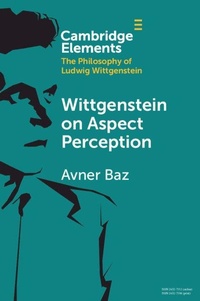
Wittgenstein on Aspect Perception
Published on 26. November 2020
Book
Paperback/Softback
64 pages
978-1-108-81315-0 (ISBN)
Description
The perception of what he calls 'aspects' preoccupied Wittgenstein and gave him considerable trouble in his final years. The Wittgensteinian aspect defies any number of traditional philosophical dichotomies: the aspect is neither subjective (inner, metaphysically private) nor objective; it presents perceivable unity and sense that are (arguably) not (yet) conceptual; it is 'subject to the will', but at the same time is normally taken to be genuinely revelatory of the object perceived under it. This Element begins with a grammatical and phenomenological characterization of Wittgensteinian 'aspects'. It then challenges two widespread ideas: that aspects are to be identified with concepts; and that aspect perception has a continuous version that is characteristic of (normal) human perception. It concludes by proposing that aspect perception brings to light the distinction between the world as perceived and the world as objectively construed, and the role we play in the constitution of the former.
More details
Series
Language
English
Place of publication
Cambridge
United Kingdom
Target group
Professional and scholarly
Product notice
Paperback (trade)
Illustrations
Worked examples or Exercises
Dimensions
Height: 229 mm
Width: 152 mm
Thickness: 3 mm
Weight
100 gr
ISBN-13
978-1-108-81315-0 (9781108813150)
Copyright in bibliographic data and cover images is held by Nielsen Book Services Limited or by the publishers or by their respective licensors: all rights reserved.
Schweitzer Classification
Other editions
Additional editions
Avner Baz
Wittgenstein on Aspect Perception
E-Book
11/2020
Cambridge University Press
€20.99
Available for download
Person
Content
Introduction; 1. The grammar and phenomenology of Wittgensteinian aspects; 2. Aspects and concepts; 3. Aspects as perceived internal relations; 4. Continuous aspect perception?; 5. Aspects and perceptual indeterminacy; Conclusion: the significance of aspect perception; Appendix: the natural attitude and the limitations of the Wittgensteinian grammatical investigation.