

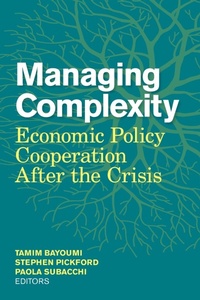
Managing Complexity
Economic Policy Cooperation after the Crisis
Published on 26. January 2016
Book
Paperback/Softback
350 pages
978-0-8157-2715-6 (ISBN)
Description
A critical look at the challenges facing international policy cooperation in the new postcrisis environment.
The global financial crisis of 2007?09 highlighted the economic interdependencies between all major countries, raising the issues of international cooperation. Managing Complexity: Economic Policy Cooperation after the Crisis looks at how, following the global financial crisis, countries have changed the way they cooperate with each other on matters of economic policy.
In this volume, the result of a joint research project of Chatham House and the International Monetary Fund, researchers and policymakers who were directly involved in the crisis take a critical look at the challenges facing international policy cooperation in the new postcrisis environment and at how the theory and practice of cooperation have evolved as a result of the crisis.
The global financial crisis of 2007?09 highlighted the economic interdependencies between all major countries, raising the issues of international cooperation. Managing Complexity: Economic Policy Cooperation after the Crisis looks at how, following the global financial crisis, countries have changed the way they cooperate with each other on matters of economic policy.
In this volume, the result of a joint research project of Chatham House and the International Monetary Fund, researchers and policymakers who were directly involved in the crisis take a critical look at the challenges facing international policy cooperation in the new postcrisis environment and at how the theory and practice of cooperation have evolved as a result of the crisis.
Reviews / Votes
The progress in policy cooperation at both regional and global levels has been very disappointing since the Asian Financial crisis. Due to lack of trust, countries are reluctant to concede their sovereignty for regional policy cooperation. At the same time, global institutions shaped by the post-war hegemonic international order are incapable of providing leadership for global policy cooperation. I cannot agree more with diagnoses made by managing complexity on the problems and causes of the lack of policy cooperation in the global economy. I am sure that managing complexity will help decision-makers to design better roadmap for policy cooperation so as to minimize the adverse spillovers of the reserve currency countries on the global economy."- Yu Yongding, Academician, Chinese Academy of Social Sciences (CASS); former Director, Institute of World Economics and Politics, CASS;"The financial crisis brought about a new era in policy cooperation. Managing Complexity sets out the issues from multiple perspectives?from academics to practitioners, from the U.S. experience to that of East Asia. It is important reading for all those interested in policy cooperation."- Christine Lagarde, Managing Director, International Monetary Fund;
"Bringing together policymakers, academics, and policy experts, Managing Complexity draws a lucid picture of the strengths and weaknesses of the global governance framework, as well as incentives for and impediments to international cooperation. Economic theory is clear that international cooperation can enhance economic outcomes: this book illustrates why the reality is much more complex."- Reza Moghadam, Vice Chairman for Global Capital Markets, Morgan Stanley
More details
Language
English
Place of publication
United States
Publishing group
Bloomsbury Publishing Plc
Target group
Professional and scholarly
Dimensions
Height: 229 mm
Width: 152 mm
Thickness: 25 mm
Weight
675 gr
ISBN-13
978-0-8157-2715-6 (9780815727156)
Copyright in bibliographic data and cover images is held by Nielsen Book Services Limited or by the publishers or by their respective licensors: all rights reserved.
Schweitzer Classification
Other editions
Additional editions
Tanim Bayoumi | Stephen Pickford | Paola Subacchi
Managing Complexity
Economic Policy Cooperation After the Crisis
E-Book
01/2016
1st Edition
Brookings Institution Press
€57.99
Available for download
Tanim Bayoumi | Stephen Pickford | Paola Subacchi
Managing Complexity
Economic Policy Cooperation After the Crisis
E-Book
01/2016
1st Edition
Brookings Institution
€33.49
Available for download
Tanim Bayoumi | Stephen Pickford | Paola Subacchi
Managing Complexity
Economic Policy Cooperation After the Crisis
E-Book
01/2016
1st Edition
Brookings Institution
€33.49
Available for download
Persons
Tamim Bayoumi is deputy director of the Strategy, Policy, and Review Department of the International Monetary Fund, where he oversees several strands of the multilateral policy and research agenda. He was previously head of the division covering the United States and Canada in the Western Hemisphere Department and the chief of the economic
studies and modeling divisions, both in the Research Department of the IMF.
Stephen Pickford is a senior fellow in the International Economics Department at Chatham House in London, focusing on economic policies and governance in Europe and the G-20. Before that he was a senior policymaker at the U.K. Treasury, and he has worked at the IMF and the World Bank.
Paola Subacchi is director of international economic research at Chatham House in London, where she works on international economic governance. The author of several books, reports, and articles, she is also a media commentator and writes regularly for Project Syndicate and Foreign Policy.
studies and modeling divisions, both in the Research Department of the IMF.
Stephen Pickford is a senior fellow in the International Economics Department at Chatham House in London, focusing on economic policies and governance in Europe and the G-20. Before that he was a senior policymaker at the U.K. Treasury, and he has worked at the IMF and the World Bank.
Paola Subacchi is director of international economic research at Chatham House in London, where she works on international economic governance. The author of several books, reports, and articles, she is also a media commentator and writes regularly for Project Syndicate and Foreign Policy.