

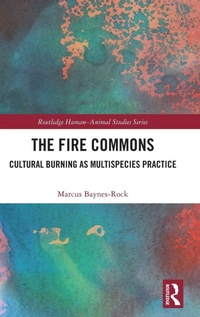
The Fire Commons
Cultural Burning as Multispecies Practice
1st Edition
Published on 5. June 2026
Book
Hardback
172 pages
978-1-041-16311-4 (ISBN)
Description
This book explores the multispecies dimensions of First Nations burning practices and shows how these integrate with Aboriginal ontologies to resist the ideological and structural violence of colonization.
Under the shadow of climate-driven catastrophes, cultural burning is undergoing a resurgence as a tradition-based remedy to contemporary ecological breakdown. However, while colonial states offer support for cultural burning programmes, they simultaneously threaten to undermine their ideological foundations. This book describes a world of relational, multispecies land management in which Indigenous relations with land challenge the colonial triumvirate of modernity, state, and capitalism. By telling the stories of these human/animal entanglements it suggests pathways towards democratizing fire so that land management can be truly decolonized.
Serving as an intervention in contemporary environmental discourse, advocating for a more holistic and relational understanding of fire in the Anthropocene, this book will appeal to policymakers, conservationists, and researchers in the fields of environmental sciences, ecology, human geography, Indigenous studies, and posthumanism.
Under the shadow of climate-driven catastrophes, cultural burning is undergoing a resurgence as a tradition-based remedy to contemporary ecological breakdown. However, while colonial states offer support for cultural burning programmes, they simultaneously threaten to undermine their ideological foundations. This book describes a world of relational, multispecies land management in which Indigenous relations with land challenge the colonial triumvirate of modernity, state, and capitalism. By telling the stories of these human/animal entanglements it suggests pathways towards democratizing fire so that land management can be truly decolonized.
Serving as an intervention in contemporary environmental discourse, advocating for a more holistic and relational understanding of fire in the Anthropocene, this book will appeal to policymakers, conservationists, and researchers in the fields of environmental sciences, ecology, human geography, Indigenous studies, and posthumanism.
More details
Series
Language
English
Place of publication
London
United Kingdom
Publishing group
Taylor & Francis Ltd
Target group
College/higher education
Professional and scholarly
Academic and Undergraduate Advanced
Illustrations
16 s/w Abbildungen, 16 s/w Photographien bzw. Rasterbilder
16 Halftones, black and white; 16 Illustrations, black and white
Dimensions
Height: 234 mm
Width: 156 mm
Weight
500 gr
ISBN-13
978-1-041-16311-4 (9781041163114)
Copyright in bibliographic data and cover images is held by Nielsen Book Services Limited or by the publishers or by their respective licensors: all rights reserved.
Schweitzer Classification
Other editions
Additional editions
E-Book
06/2026
Routledge
€60.49
Available for download
E-Book
06/2026
Routledge
€60.49
Available for download
Person
Marcus Baynes-Rock is an anthropologist who studies the cultural interfaces of humans and other animals. His first book, Among the Bone Eaters, is a narrative of intersubjectivity with urban hyenas in the town of Harar, Ethiopia. His second book, Crocodile Undone, is a critical examination of the domestication of native animals in Australia. His writing deploys critiques of modernity and capitalism in order to arrest the unmaking of the Earth.
Content
1 Re-Storying as Method in Multispecies Studies
2 Digging Mammals and Fire Ecologies in Australian Landscapes
3 Contemporary Cultural Burning Grounded in Tradition
4 Macropods and Lizards Compelling People to Burn
5 A Question of More-than-Human Agency
6 Birds Altering Landscapes beyond the Fire Lines
7 Cultural Burning versus Colonial Unmaking
2 Digging Mammals and Fire Ecologies in Australian Landscapes
3 Contemporary Cultural Burning Grounded in Tradition
4 Macropods and Lizards Compelling People to Burn
5 A Question of More-than-Human Agency
6 Birds Altering Landscapes beyond the Fire Lines
7 Cultural Burning versus Colonial Unmaking