

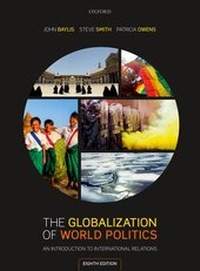
The Globalization of World Politics
An Introduction to International Relations
8th Edition
Published on 16. December 2019
Book
Paperback/Softback
648 pages
978-0-19-882554-8 (ISBN)
Description
The Globalization of World Politics, the bestselling introduction to international relations, offers the most comprehensive coverage of the key theories and global issues in world politics.
The eighth edition engages with contemporary global challenges, featuring a brand new chapter on Refugees and Forced Migration and updated coverage of decolonization to ensure the book continues to cover those topics that will define the key issues in IR into the future.
Tailored pedagogical features help readers to evaluate key IR debates and apply theory and concepts to real world events. A fully updated Opposing Opinions feature facilitates critical and reflective debate on contemporary policy challenges, from decolonising universities to debates over migration and the state.
Leading scholars in the field introduce readers to the history, theory, structures and key issues in IR, providing students with an ideal introduction and a constant guide throughout their studies.
Students and lecturers are further supported by extensive online resources to encourage deeper engagement with content:
Student resources:
International relations simulations encourage students to develop negotiation and problem solving skills by engaging with topical events and processes
IR theory in practice case studies encourage students to apply theories to current and evolving global events
Video podcasts from contributors help students to engage with key issues and cases in IR
Guidance on how to evaluate the Opposing Opinions feature, supporting students to engage in nuanced debate over key policy challenges
Interactive library of links to journal articles, blogs and video content to deepen students' understanding of key topics and explore their research interests
Flashcard glossary to reinforce understanding of key terms
Multiple choice questions for self-study help students to reinforce their understanding of the key points of each chapter
Revision guide to consolidate understanding and revise key terms and themes
Instructor Resources:
Case studies help to contextualise and deepen theoretical understanding
Test bank - fully customisable assessment questions to test and reinforce students' understanding of key concepts
Question bank - a bank of short answer and essay questions to promote students' critical reflection on core issues and themes within each chapter
Customisable PowerPoint slides help to support effective teaching preparation
Figures and tables from the book allow clear presentation of key data and support students' data analysis
The eighth edition engages with contemporary global challenges, featuring a brand new chapter on Refugees and Forced Migration and updated coverage of decolonization to ensure the book continues to cover those topics that will define the key issues in IR into the future.
Tailored pedagogical features help readers to evaluate key IR debates and apply theory and concepts to real world events. A fully updated Opposing Opinions feature facilitates critical and reflective debate on contemporary policy challenges, from decolonising universities to debates over migration and the state.
Leading scholars in the field introduce readers to the history, theory, structures and key issues in IR, providing students with an ideal introduction and a constant guide throughout their studies.
Students and lecturers are further supported by extensive online resources to encourage deeper engagement with content:
Student resources:
International relations simulations encourage students to develop negotiation and problem solving skills by engaging with topical events and processes
IR theory in practice case studies encourage students to apply theories to current and evolving global events
Video podcasts from contributors help students to engage with key issues and cases in IR
Guidance on how to evaluate the Opposing Opinions feature, supporting students to engage in nuanced debate over key policy challenges
Interactive library of links to journal articles, blogs and video content to deepen students' understanding of key topics and explore their research interests
Flashcard glossary to reinforce understanding of key terms
Multiple choice questions for self-study help students to reinforce their understanding of the key points of each chapter
Revision guide to consolidate understanding and revise key terms and themes
Instructor Resources:
Case studies help to contextualise and deepen theoretical understanding
Test bank - fully customisable assessment questions to test and reinforce students' understanding of key concepts
Question bank - a bank of short answer and essay questions to promote students' critical reflection on core issues and themes within each chapter
Customisable PowerPoint slides help to support effective teaching preparation
Figures and tables from the book allow clear presentation of key data and support students' data analysis
Reviews / Votes
Chapter 10 brings many new insights, excellent examples and debates on postcolonial and decolonial approaches. The Opposing Opinions feature will ignite heated and reflexive debate amongst students * Dr Birsen Erdogan, Maastricht University * Chapter 25 covers a topic of great relevance and interest to students, including good discussion of the theoretical and legal debate of various categories of refugees and effective examples and case studies to illustrate the complexities of this most challenging policy issue * Professor Craig Mark, Kyoritsu Women's University *More details
Edition
8th Revised edition
Language
English
Place of publication
Oxford
United Kingdom
Target group
College/higher education
Edition type
Revised edition
Dimensions
Height: 265 mm
Width: 195 mm
Thickness: 25 mm
Weight
1203 gr
ISBN-13
978-0-19-882554-8 (9780198825548)
Copyright in bibliographic data and cover images is held by Nielsen Book Services Limited or by the publishers or by their respective licensors: all rights reserved.
Schweitzer Classification
Other editions
New editions
John Baylis | Patricia Owens | Steve Smith
The Globalization of World Politics
An Introduction to International Relations
Book
04/2026
10th Edition
Oxford University Press
€62.50
Available immediately
Persons
John Baylis is Emeritus Professor of Politics and International Relations and former Pro-Vice Chancellor at Swansea University.
Steve Smith is Vice-Chancellor and Professor of International Studies, University of Exeter.
Patricia Owens is Professor and Head of the Department of International Relations, University of Sussex.
Steve Smith is Vice-Chancellor and Professor of International Studies, University of Exeter.
Patricia Owens is Professor and Head of the Department of International Relations, University of Sussex.
Editor
Emeritus Professor of Politics and International Relations and former Pro Vice ChancellorEmeritus Professor of Politics and International Relations and former Pro Vice Chancellor, Swansea University
Vice-Chancellor and Professor of International StudiesVice-Chancellor and Professor of International Studies, University of Exeter
Professor and Head of International RelationsProfessor and Head of International Relations, University of Sussex
Content
Part 1: INTERNATIONAL RELATIONS IN A GLOBAL ERA Introduction John Baylis, Patricia Owens and Steve Smith 1: Globalization and global politicsAnthony McGrewPart 2: THE HISTORICAL CONTEXT 2: The rise of modern international orderGeorge Lawson 3: International history of the twentieth centuryLen Scott 4: From the end of the cold war to a new world dis-order?Michael Cox 5: Rising powers and the emerging global orderAndrew HurrellPart 3: THEORIES OF WORLD POLITICS 6: Liberal InternationalismTim Dunne 7: Marxist theories of international relationsStephen Hobden and Richard Wyn Jones 8: RealismTim Dunne and Brian Schmidt 9: FeminismHelen Kinsella 10: Postcolonial and decolonial approachesMeera Sabaratnam 11: PoststructuralismLene Hansen 12: Social ConstructivismMichael Barnett 13: International ethicsRichard ShapcottPart 4: STRUCTURES AND PROCESSES 14: War and world politicsTarak Barkawi 15: International and global securityJohn Baylis 16: Global political economyNicola Phillips 17: GenderPaul Kirby 18: Race in world politicsRobbie Shilliam 19: International lawChristian Reus-Smit 20: International organisations in world politicsSusan Park 21: The United NationsDevon Curtis and Paul Taylor 22: NGOs in world politicsJutta Joachim 23: Regionalism in international affairsEdward Best and Thomas ChristiansenPart 5: INTERNATIONAL ISSUES 24: Environmental issuesJohn Vogler 25: Refugees and forced migrationAriadna Estevez Lopez 26: Poverty, hunger, and developmentTony Evans 27: Global trade and global financeMatthew Watson 28: Terrorism and globalisationJames Kiras 29: Proliferation of weapons of mass destructionSheena Chestnut Greitens 30: Nationalism, national self-determination and international relationsJohn Breuilly 31: Human rightsRatna Kapur 32: Humanitarian intervention in world politicsAlex Bellamy and Nicholas Wheeler