

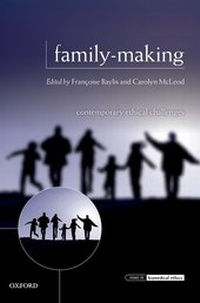
Family-Making
Contemporary Ethical Challenges
Published on 3. July 2014
Book
Hardback
332 pages
978-0-19-965606-6 (ISBN)
Description
This volume explores the ethics of making or expanding families through adoption or technologically assisted reproduction. For many people, these methods are separate and distinct: they can choose either adoption or assisted reproduction. But for others, these options blend together. For example, in some jurisdictions, the path of assisted reproduction for same-sex couples is complicated by the need for the partner who is not genetically related to the resulting child to adopt this child if she wants to become the child's legal parent.
The essays in this volume critically examine moral choices to pursue adoption, assisted reproduction, or both, and highlight the social norms that can distort decision-making. Among these norms are those that favour people having biologically related children ('bionormativity') or that privilege a traditional understanding of family as a heterosexual unit with one or more children where both parents are the genetic, biological, legal, and social parents of these children.
As a whole, the book looks at how adoption and assisted reproduction are morally distinct from one another, but also emphasizes how the two are morally similar. Choosing one, the other, or both of these approaches to family-making can be complex in some respects, but ought to be simple in others, provided that one's main goal is to become a parent.
The essays in this volume critically examine moral choices to pursue adoption, assisted reproduction, or both, and highlight the social norms that can distort decision-making. Among these norms are those that favour people having biologically related children ('bionormativity') or that privilege a traditional understanding of family as a heterosexual unit with one or more children where both parents are the genetic, biological, legal, and social parents of these children.
As a whole, the book looks at how adoption and assisted reproduction are morally distinct from one another, but also emphasizes how the two are morally similar. Choosing one, the other, or both of these approaches to family-making can be complex in some respects, but ought to be simple in others, provided that one's main goal is to become a parent.
Reviews / Votes
Family-Making is filled with philosophically rich explorations of the nature and limits of parental obligations to their children, whether the children enter their families through sexual reproduction, ART, or adoption. In reading these essays, I found myself longing for the goods of childhood, cherishing the joys of parenting, and marveling at the many-splendored nature of our familial structures and the weighty (and sometimes confusing) moral responsibilities that attach to them. * Sara Goering, ennedy Institute of Ethics Journal *More details
Series
Language
English
Place of publication
Oxford
United Kingdom
Target group
College/higher education
Professional and scholarly
Dimensions
Height: 240 mm
Width: 163 mm
Thickness: 27 mm
Weight
646 gr
ISBN-13
978-0-19-965606-6 (9780199656066)
Copyright in bibliographic data and cover images is held by Nielsen Book Services Limited or by the publishers or by their respective licensors: all rights reserved.
Schweitzer Classification
Other editions
Additional editions
Book
03/2017
Oxford University Press
€45.79
Shipment within 15-20 days
E-Book
07/2014
1st Edition
OUP eBook
€38.49
Available for download
Persons
Francoise Baylis is Professor and Canada Research Chair in Bioethics and Philosophy at Dalhousie University, Canada, and founder of the NovelTechEthics research team. She is an elected Fellow of the Royal Society of Canada and the Canadian Academy of Health Sciences. Her research interests are many and varied, and she has a love of thought-provoking questions. Her publications on the ethics of assisted human reproduction and human embryo research span more than thirty years. In addition to her academic research on reproductive ethics, she contributes to national policy via government research contracts, membership on national committees, and public education. This work--all of which is informed by a strong commitment to the common good--focuses largely on issues of social justice. Her website is http://noveltechethics.ca. Her blog is http://impactethics.ca.
Carolyn McLeod is Associate Professor of Philosophy, an Affiliate Member of Women's Studies and Feminist Research, and a member of the Rotman Institute of Philosophy at the University of Western Ontario. Her research interests lie at the intersection of health care ethics, feminist theory, and moral theory. She has had a long-standing interest in reproductive ethics, beginning with her book, Self-Trust and Reproductive Autonomy (MIT Press, 2002). She has published on various topics in this area, including reproductive autonomy, the commodification of womens reproductive labour, and conscientious refusals by health care professionals to provide reproductive health services such as abortions. Recently, her knowledge of the ethics of having children has broadened to include issues that concern adoption. Her website is http://carolynmcleod.com.
Carolyn McLeod is Associate Professor of Philosophy, an Affiliate Member of Women's Studies and Feminist Research, and a member of the Rotman Institute of Philosophy at the University of Western Ontario. Her research interests lie at the intersection of health care ethics, feminist theory, and moral theory. She has had a long-standing interest in reproductive ethics, beginning with her book, Self-Trust and Reproductive Autonomy (MIT Press, 2002). She has published on various topics in this area, including reproductive autonomy, the commodification of womens reproductive labour, and conscientious refusals by health care professionals to provide reproductive health services such as abortions. Recently, her knowledge of the ethics of having children has broadened to include issues that concern adoption. Her website is http://carolynmcleod.com.
Content
FAMILIES: OF PARENTS AND CHILDREN 15; BIONORMATIVITY: PHILOSOPHICAL AND EMPIRICAL PERSPECTIVES; BECOMING A PARENT: PERSONAL CHOICES; BECOMING A PARENT: STATE INTERESTS; SPECIAL RESPONSIBILITIES OF PARENTS; CONTESTED PRACTICES