

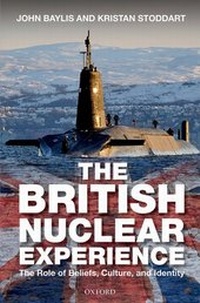
The British Nuclear Experience
The Roles of Beliefs, Culture and Identity
Published on 18. December 2014
Book
Hardback
312 pages
978-0-19-870202-3 (ISBN)
Description
Based on a detailed analysis of archives and high level interviews this book looks at the role of beliefs, culture and identity in the making of British nuclear policy from 1945 through to the present day. This book also examines Britain's nuclear experience by moving away from traditional interpretations of why states develop and maintain nuclear weapons by adopting a more contemporary approach to political theory.
Traditional mainstream explanations tend to stress the importance of factors such as the 'maximization of power', the pursuit of 'national security interests' and the role of 'structure' in a largely anarchic international system. This book does not dismiss these approaches, but argues that British experience suggests that focusing on 'beliefs', 'culture' and 'identity', provides a more useful insight and distinctive interpretation into the process of British nuclear decision making than the more traditional approaches.
Traditional mainstream explanations tend to stress the importance of factors such as the 'maximization of power', the pursuit of 'national security interests' and the role of 'structure' in a largely anarchic international system. This book does not dismiss these approaches, but argues that British experience suggests that focusing on 'beliefs', 'culture' and 'identity', provides a more useful insight and distinctive interpretation into the process of British nuclear decision making than the more traditional approaches.
Reviews / Votes
Anyone wishing to understand the United Kingdom's seven-decades-old relationship with nuclear weapons...should start with this excellent new book by leading British scholars John Baylis and Kristan Stoddart. The British Nuclear Experience provides a fascinating and highly accessible narrative of the somewhat peculiar story of both the day-to-day dynamics and the broader evolution of nuclear thinking and policy in the United Kingdom. * Andrew Futter, H-Diplo * Baylis and Stoddart, in their jointly authored book, provide a much needed update to Lawrence Freedmans classic Britain and nuclear weapons (Macmillan, 1980), filling in the most recent 35 years. * Andrew Dorman, Kings College London, Conflict, security and defence * Meticulously reconstructed from once top secret documents, this is a brilliantly analysed case-study of strategic culture, decision-making processes and bureaucratic politics. It should be on every IR or Public Policy reading list! * Prof D.B.G Heuser, Department of Politics & IR, University of Reading * Britain was one of the founders of the nuclear club and is still an active member. John Baylis and Kristan Stoddart provide a unique and comprehensive history of why and how the country retained its nuclear status, drawing attention to the importance of a "deterrence habit of mind". * Professor Sir Lawrence Freedman, FBA, Professor of War Studies, Kings College London * Nuclear weapons policy-making runs like an irradiated thread throughout the history of Britain since 1940. There are no more skilful unearthers of that thread than John Baylis and Kristan Stoddart. * Professor Lord Peter Hennessy FBA, Attlee Professor of Contemporary British History, Queen Mary, University of London * Meticulously reconstructed from once top secret documents, this is a brilliantly analysed case-study of strategic culture, decision-making processes and bureaucratic politics. It should be on every IR or Public Policy reading list! * Prof D.B.G Heuser, Department of Politics & IR, University of Reading *More details
Language
English
Place of publication
Oxford
United Kingdom
Target group
College/higher education
Professional and scholarly
Dimensions
Height: 240 mm
Width: 163 mm
Thickness: 22 mm
Weight
634 gr
ISBN-13
978-0-19-870202-3 (9780198702023)
Copyright in bibliographic data and cover images is held by Nielsen Book Services Limited or by the publishers or by their respective licensors: all rights reserved.
Schweitzer Classification
Other editions
Additional editions
John Baylis | Kristan Stoddart
The British Nuclear Experience
The Roles of Beliefs, Culture and Identity
E-Book
12/2014
1st Edition
OUP eBook
€60.99
Available for download
Persons
John Baylis is Emeritus Professor at Swansea University, where he was a Pro-Vice Chancellor. During the course of a distinguished career he has published a number of influential volumes, including Ambiguity and Deterrence: British Nuclear Strategy 1945-196 , Alternative Nuclear Futures: The Role of Nuclear Weapons in the Post-Cold-War Era (edited with R O'Neill), The Globalization of World Politics (edited with S Smith and P Owens, fifth edition) and Strategy in the Contemporary World (edited with J Wirtz and C Gray, fourth edition).
Kristan Stoddart is Senior Lecturer in International Politics at Aberystwyth University. His publications include Losing an Empire and Finding a Role?, Britain, the United States, NATO, and Nuclear Weapons 1964-1970, and The Sword and the Shield: Britain, the United States, NATO, and Nuclear Weapons 1970-1976.
Kristan Stoddart is Senior Lecturer in International Politics at Aberystwyth University. His publications include Losing an Empire and Finding a Role?, Britain, the United States, NATO, and Nuclear Weapons 1964-1970, and The Sword and the Shield: Britain, the United States, NATO, and Nuclear Weapons 1970-1976.
Content
Introduction ; 1. The Emergence of a Deterrence 'Habit of Mind' ; 2. The Chiefs of Staff, Nuclear Weapons and Global Strategy ; 3. From Atomic Weapons to Thermonuclear Weapons ; 4. Forging the 'Special' Anglo-American Nuclear Relationship ; 5. Polaris, Independence and Interdependence ; 6. The Polaris Improvement Programme and Chevaline ; 7. The Polaris Replacement Debate under Labour ; 8. The Adoption of Trident ; 9. NATO Modernization Plans, SDI and the End of the Cold War ; 10. Trident Replacement/Renewal: From 'New Labour' to the Coalition Government ; Conclusion