

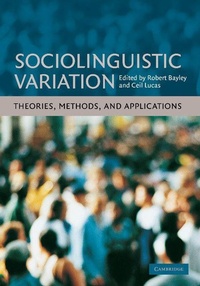
Sociolinguistic Variation
Theories, Methods, and Applications
Published on 18. October 2007
Book
Paperback/Softback
422 pages
978-0-521-69181-9 (ISBN)
Description
Why does human language vary from one person, or one group, to another? In what ways does it vary? How do linguists go about studying variation in, say, the sound system or the sentence structure of a particular language? Why is the study of language variation important outside the academic world, in say education, the law, employment or housing? This book provides an overview of these questions, bringing together a team of experts to survey key areas within the study of language variation and language change. Covering both the range of methods used to research variation in language, and the applications of such research to a variety of social contexts, it is essential reading for advanced students and researchers in sociolinguistics, communication, linguistic anthropology and applied linguistics.
More details
Language
English
Place of publication
Cambridge
United Kingdom
Target group
Professional and scholarly
Product notice
Paperback (trade)
Illustrations
49 Tables, unspecified; 18 Line drawings, unspecified
Dimensions
Height: 244 mm
Width: 170 mm
Thickness: 23 mm
Weight
724 gr
ISBN-13
978-0-521-69181-9 (9780521691819)
Copyright in bibliographic data and cover images is held by Nielsen Book Services Limited or by the publishers or by their respective licensors: all rights reserved.
Schweitzer Classification
Other editions
Additional editions
E-Book
01/2008
1st Edition
Cambridge University Press
€38.49
Available for download
Book
10/2007
Cambridge University Press
€134.70
Shipment within 15-20 days
Persons
Robert Bayley is Professor in the Department of Linguistics at the University of California, Davis. Ceil Lucas is Professor in the Department of Linguistics at Gallaudet University.
Content
Introduction Robert Bayley and Ceil Lucas; Part I. Theories: 1. Variation and phonological theory Gregory R. Guy; 2. Variation and syntactic theory Lisa Green; 3. The psycholinguistic unity of inherent variability: old Occam whips out his razor Ralph W. Fasold and Dennis R. Preston; 4. The study of variation in historical perspective Kirk Hazen; 5. Style in dialogue: Bakhtin and sociolinguistic theory Allan Bell; 6. Variation and historical linguistics Michael Montgomery; 7. Second language acquisition: a variationist perspective Robert Bayley; 8. Variation and modality Ceil Lucas; Part II. Methods: 9. Fieldwork Natalie Schilling-Estes; 10. Quantitative analysis Sali A. Tagliamonte; 11. Sociophonetics Erik R. Thomas; Part III. Applications: 12. Sociolinguistic variation and education Carolyn Temple Adger and Donna Christian; 13. Lessons learned from the Ebonics controversy: implications for language assessment Anna F. Vaughn-Cooke; 14. Variation and versatility in the classroom: contrastive analysis revisited Angela E. Rickford and John R. Rickford; 15. Social-political influences on research practices: examining language acquisition by African American children Ida J. Stockman; 16. Sociolinguistic variation and the law Ronald R. Butters; 17. Attitudes towards variation and ear-witness testimony John Baugh; Afterword Roger W. Shuy.