

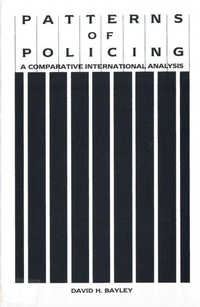
Patterns of Policing
A Comparative International Analysis
Published on 1. August 1990
Book
Paperback/Softback
280 pages
978-0-8135-1618-9 (ISBN)
Description
"Patterns of Policing" is the first comparison of the development and operation of police in countries throughout the world, concentrating on Asia, Europe, and North America. Bayley examines the variability in police work, suggests reasons for this variation, and makes preditions about the future role of police.He considers how contemporary police institutions have developed. Police forces worldwide tend to be public rather than private, to concentrate on crime fighting rather than services, and to be professionally trained and recruited. There is, however, great variation in the structure of police forces, which are generally either centralized or, as in the United States, decentralized.
The behavior of the police toward their constituents also varies by nation. As urbanization and industrialization increase, the public finds itself in greater contact with police and may begin to rely on them more for protection. There are also marked differences cross-nationally in the way police relate to political and community life.
The behavior of the police toward their constituents also varies by nation. As urbanization and industrialization increase, the public finds itself in greater contact with police and may begin to rely on them more for protection. There are also marked differences cross-nationally in the way police relate to political and community life.
Reviews / Votes
An eye-opening and somewhat heroic construction designed to shift our perspective on the nature and causes of police work... important and long overdue... By design, it is an empirical and wide-ranging work that pays attention to the available numbers and public claims of police officials. (Contemporary Sociology) An eye-opening and somewhat heroic construction designed to shift our perspective on the nature and causes of police work... important and long overdue... By design, it is an empirical and wide-ranging work that pays attention to the available numbers and public claims of police officials. (Contemporary Sociology) Bayley has posed key questions on police functioning... and responded by using a model-building approach based on theoretical propositions and subjected to an international data base. (Choice) Bayley has posed key questions on police functioning... and responded by using a model-building approach based on theoretical propositions and subjected to an international data base. (Choice)More details
Series
Edition
None edition
Language
English
Place of publication
New Brunswick NJ
United States
Target group
College/higher education
Product notice
Paperback (trade)
Unsewn / adhesive bound
Dimensions
Height: 229 mm
Width: 153 mm
Thickness: 18 mm
Weight
472 gr
ISBN-13
978-0-8135-1618-9 (9780813516189)
Copyright in bibliographic data and cover images is held by Nielsen Book Services Limited or by the publishers or by their respective licensors: all rights reserved.
Schweitzer Classification
Person
David H. Bayley is a Professor in the School of Criminal Justice at the State University of New York-Albany. He is the author of The Police and Political Development in India and Forces of Order: Police Behavior in Japan and the United States.
Content
List of Figures
List of Tables
Preface
Part 1 - Introduction
1 Toward a Theory of Policing
Part 2 - Evolution
2 The Development of Modern Police
3 The Structure of Policing
4 Police Strength
Part 3 - Function
5 Police Work
6 A Theory of Encounters
Part 4 - Politics
7 Control of the Police
8 Police in Political Life
Part 5 - Conclusion
9 Future of Policing
Appendix
Notes
Bibliography
Index
List of Tables
Preface
Part 1 - Introduction
1 Toward a Theory of Policing
Part 2 - Evolution
2 The Development of Modern Police
3 The Structure of Policing
4 Police Strength
Part 3 - Function
5 Police Work
6 A Theory of Encounters
Part 4 - Politics
7 Control of the Police
8 Police in Political Life
Part 5 - Conclusion
9 Future of Policing
Appendix
Notes
Bibliography
Index