

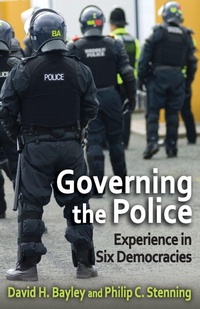
Governing the Police
Experience in Six Democracies
1st Edition
Published on 30. March 2016
Book
Paperback/Softback
226 pages
978-1-4128-6338-4 (ISBN)
Description
Every modern democracy in our increasingly complex world must confront a fundamental problem: how should politicians manage police, ensuring that they act in the public interest while avoiding the temptation to utilize them in a partisan manner? Drawing on first-hand experiences from six democracies, the authors describe how frequently disagreements arise between politicians and police commanders, what issues are involved, and how they are resolved.
Governing the Police is organized into three parts: the intellectual and governmental context of democratic governance; the experience of chief officers in that relationship; and the reflections on lessons learned. Instead of describing practices within each individual country, it compares them across countries, developing generalizations about practices, explanations for differences, and assessments of success in managing the police/political relationship.
Focusing mainly on the daily, informal interactions between politicians and police as they balance their respective duties, this book compares the experiences and opinions of chief police officers in Australia, Britain, Canada, India, New Zealand, and the United States. By examining the experiences of important officials, the authors explain how the balance between accountability and independence can be managed and what challenges leaders face. The authors conclude by posing well-informed recommendations for improving police governance.
Governing the Police is organized into three parts: the intellectual and governmental context of democratic governance; the experience of chief officers in that relationship; and the reflections on lessons learned. Instead of describing practices within each individual country, it compares them across countries, developing generalizations about practices, explanations for differences, and assessments of success in managing the police/political relationship.
Focusing mainly on the daily, informal interactions between politicians and police as they balance their respective duties, this book compares the experiences and opinions of chief police officers in Australia, Britain, Canada, India, New Zealand, and the United States. By examining the experiences of important officials, the authors explain how the balance between accountability and independence can be managed and what challenges leaders face. The authors conclude by posing well-informed recommendations for improving police governance.
More details
Language
English
Place of publication
New York
United States
Publishing group
Taylor & Francis Inc
Target group
College/higher education
General and Postgraduate
Dimensions
Height: 216 mm
Width: 140 mm
Thickness: 12 mm
Weight
293 gr
ISBN-13
978-1-4128-6338-4 (9781412863384)
Copyright in bibliographic data and cover images is held by Nielsen Book Services Limited or by the publishers or by their respective licensors: all rights reserved.
Schweitzer Classification
Other editions
Additional editions
E-Book
07/2017
Routledge
€68.49
Available for download
E-Book
07/2017
Routledge
€68.49
Available for download
Book
04/2016
1st Edition
Routledge
€206.00
Shipment within 10-15 days
Person
David H. Bayley is distinguished professor emeritus in the School of Criminal Justice, State University of New York at Albany, USA. Philip C. Stenning is professor of criminology and criminal justice, and a member of the Griffith Criminology Institute, at Griffith University in Queensland, Australia.
Content
Acknowledgments1 A Democratic DilemmaPart I: Contexts2 When Things Go Wrong
3 History and Research
4 Settings and SystemsPart II: The Practice of Police Governance5 Governing at the Cutting Edge
6 Advice about ManagingPart III: Re-thinking Police Governance7 Why Governance Fails
8 The Changing Contexts of Governance
9 Improving Police GovernanceIndex
3 History and Research
4 Settings and SystemsPart II: The Practice of Police Governance5 Governing at the Cutting Edge
6 Advice about ManagingPart III: Re-thinking Police Governance7 Why Governance Fails
8 The Changing Contexts of Governance
9 Improving Police GovernanceIndex