

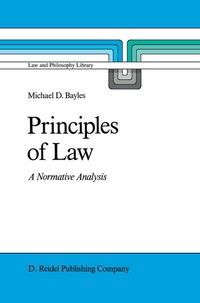
Principles of Law
A Normative Analysis
1st Edition
Published on 30. June 1987
Book
Hardback
XXII, 398 pages
978-90-277-2412-0 (ISBN)
Description
During the last half of the twentieth century, legal philosophy (or legal theory or jurisprudence) has grown significantly. It is no longer the do main of a few isolated scholars in law and philosophy. Hundreds of scho lars from diverse fields attend international meetings on the subject. In some universities, large lecture courses of five hundred students or more study it. The primary aim of the Law and Philosophy Library is to present some of the best original work on legal philosophy from both the Anglo American and European traditions. Not only does it help make some of the best work available to an international audience, but it also en courages increased awareness of, and interaction between, the two major traditions. The primary focus is on full-length scholarly monographs, aIthouogh some eidted volumes of original papers are also included. The Library editors are assisted by an Editorial Advisory Board of inter nationally renowned scholars.
Reviews / Votes
` For the important enterprise of ordering, sifting, and making the law understandable to the philosophically inclined student, Bayles' book is a major - indeed, encyclopedic - contribution. It represents a large amount of extremely competent work. 'Conrad D. Johnson, University of Maryland
` Principles of Law is one of the few books since Oliver Wendell Holmes' The Common Law to address philosophical issues at a level between the general conditions for any legal system and specific issues such as punishment or strict liability. It asks what normative principles a rational person in a contemporary common l aw society would want judges to use in deciding cases. Principles are then developed for procedural, property, contract, tort, and criminal law. The adversary model of adjudication is shown to place an important constraint on acceptable principles. ... Several features make this book a valuablesupplement for law school and other students. Chapters have a similar structure, proceeding from aims to remedies. Seventeen to 20 principles are provided for each field, and well-known American and English cases are cited. Technical legal terms are explained when introduced. The discussion is both more theoretical and concise than in many supplements.
More details
Series
Language
English
Place of publication
Dordrecht
Netherlands
Publishing group
Springer
Target group
Professional and scholarly
Research
Illustrations
XXII, 398 p.
Dimensions
Height: 241 mm
Width: 160 mm
Thickness: 28 mm
Weight
799 gr
ISBN-13
978-90-277-2412-0 (9789027724120)
DOI
10.1007/978-94-009-3775-8
Schweitzer Classification
Other editions
Additional editions
E-Book
12/2012
Springer
€53.49
Available for download
Book
07/1987
Kluwer Academic Publishers
€53.49
Shipment within 15-20 days
Content
Analytical Table of Contents.- 1. Introduction: A Framework for Analysis.- 1.0. Introduction.- 1.1. A Normative Approach.- 1.2. Rational Persons.- 1.3. Values.- 1.4. Legal Principles.- 1.5. Elements of a Legal Case.- 2. Procedural Law.- 2.0. Introduction.- 2.1. Aims.- 2.2. The Adversary System.- 2.3. Elements of Procedure.- 3. Property Law.- 3.0. Introduction.- 3.1. Aims.- 3.2. Forms of Property.- 3.3. Rights and Limits.- 3.4. Acquisition and Disposal.- 4. Contract Law.- 4.0. Introduction.- 4.1. Aims.- 4.2. Contract Formation.- 4.3. Duties, Defects, and Defenses.- 4.4. Discharge and Remedies.- 5. Tort Law.- 5.0. Introduction.- 5.1. Aims.- 5.2. Duties.- 5.3. Defenses.- 5.4. Remedies.- 5.5. Beyond Tort Law.- 6. Criminal Law.- 6.0. Introduction.- 6.1. Aims.- 6.2. Criminal Acts.- 6.3. Defenses.- 6.4. Punishment.- 7. Values in the Law.- 7.0. Introduction.- 7.1. A Nontheory?.- 7.2. Freedom.- 7.3. Responsibility.- 7.4. Equality and Fairness.- 7.5. Social Good.- Appendix: Summary of Principles.- Works Cited.- Table of Cases.