

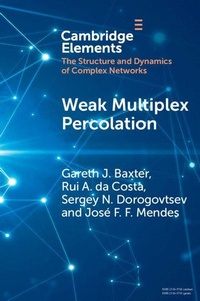
Weak Multiplex Percolation
Published on 27. January 2022
Book
Paperback/Softback
374 pages
978-1-108-79107-6 (ISBN)
Description
In many systems consisting of interacting subsystems, the complex interactions between elements can be represented using multilayer networks. However percolation, key to understanding connectivity and robustness, is not trivially generalised to multiple layers. This Element describes a generalisation of percolation to multilayer networks: weak multiplex percolation. A node belongs to a connected component if at least one of its neighbours in each layer is in this component. The authors fully describe the critical phenomena of this process. In two layers with finite second moments of the degree distributions the authors observe an unusual continuous transition with quadratic growth above the threshold. When the second moments diverge, the singularity is determined by the asymptotics of the degree distributions, creating a rich set of critical behaviours. In three or more layers the authors find a discontinuous hybrid transition which persists even in highly heterogeneous degree distributions, becoming continuous only when the powerlaw exponent reaches $1+1/(M-1)$ for $M$ layers.
More details
Series
Language
English
Place of publication
Cambridge
United Kingdom
Product notice
Paperback (trade)
Illustrations
Worked examples or Exercises
Dimensions
Height: 229 mm
Width: 152 mm
Thickness: 4 mm
Weight
89 gr
ISBN-13
978-1-108-79107-6 (9781108791076)
Copyright in bibliographic data and cover images is held by Nielsen Book Services Limited or by the publishers or by their respective licensors: all rights reserved.
Schweitzer Classification
Other editions
Additional editions
Gareth J. Baxter | Rui A. da Costa | Sergey N. Dorogovtsev
Weak Multiplex Percolation
E-Book
01/2022
Cambridge University Press
€15.49
Available for download
Persons
Content
1. Introduction; 2. Weak multiplex percolation; 3. Relation to other percolation models; 4. Critical phenomena with rapidly decaying degree distributions; 5. Critical phenomena with broad degree distributions; 6. Conclusions; References.