

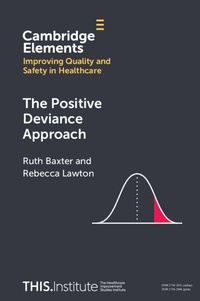
The Positive Deviance Approach
Published on 8. September 2022
Book
Paperback/Softback
52 pages
978-1-009-23711-6 (ISBN)
Description
Positive deviance is an asset-based improvement approach. At its core is the belief that solutions to problems already exist within communities, and that identifying, understanding, and sharing these solutions enables improvements at scale. Originating in the field of international public health in the 1960s, positive deviance is now, with some adaptations, seeing growing application in healthcare. We present examples of how positive deviance has been used to support healthcare improvement. We draw on an emerging view of safety, known as Safety II, to explain why positive deviance has drawn the interest of researchers and improvers alike. In doing so, we identify a set of fundamental values associated with the positive deviance approach and consider how far they align with current use. Throughout, we consider the untapped potential of the approach, reflect on its limitations, and offer insights into the possible challenges of using it in practice. This title is also available as Open Access on Cambridge Core.
More details
Series
Language
English
Place of publication
Cambridge
United Kingdom
Edition type
New edition
Product notice
Paperback (trade)
Illustrations
Worked examples or Exercises
Dimensions
Height: 229 mm
Width: 152 mm
Thickness: 3 mm
Weight
91 gr
ISBN-13
978-1-009-23711-6 (9781009237116)
Copyright in bibliographic data and cover images is held by Nielsen Book Services Limited or by the publishers or by their respective licensors: all rights reserved.
Schweitzer Classification
Other editions
Additional editions
Ruth Baxter
Positive Deviance Approach
E-Book
08/2022
Cambridge University Press
€15.49
Available for download
Ruth Baxter | Rebecca Lawton
The Positive Deviance Approach
E-Book
08/2022
Cambridge University Press
€15.49
Available for download
Content
1. Introduction; 2. The Positive Deviance Approach in Action; 3. Critiques of the Positive Deviance Approach; 4. Conclusions; 5. Further Reading; Contributors; References.