

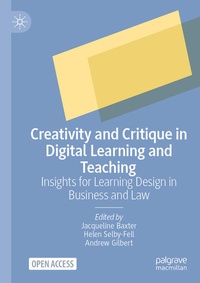
Creativity and Critique in Digital Learning and Teaching
Description
This open access edited collection is aimed at educators, student services staff, and university management. It is timely in adopting a forward-facing view of various aspects of digital teaching and learning in business and law and provides a vital resource for those designing, managing or thinking about digital learning in both fields.
Reviews / Votes
"This essential book on innovation, inclusivity, and excellence in digital education is a vital resource for business, law, and higher education professionals exploring the transformative role of generative AI and addressing digital poverty's impact. Offering valuable tools , it provides a framework to enhance digital programs, ensuring learning outcomes with rigor and relevance. As education confronts the challenges of technological progress and societal change, this book sets a forward-looking agenda, guiding those dedicated to shaping the future of business and law education and beyond. In short, it is an indispensable read for educators, administrators, and policymakers aiming to foster an inclusive, innovative educational landscape." (Dr Inci Toral, Associate Professor, University of Birmingham Business School, UK)
"This book shares valuable practice of how to navigate innovative approaches in digital education environment that are attainable for staff and accessible and engaging for students." (Professor Radka Newton, Director of Centre for Scholarship and Innovation in Management Education, Lancaster University Management School)
"Creativity and critical thinking are the bedrock of effective designs for learning with technology - this excellent book shows us how such designs must also respect equity and ethics to fully meet the new educational challenges of our times." (Professor Agnes Kukulska-Hulme Professor of learning Technology and Communication, The Open University)
"Digital scholarship is an area of growing importance and centrality. This book aims to inform and clarify foundational assumptions in learners and teachers, and to reduce the mismatch of expectations on all sides by the provision of considered and evidence-based scholarship." (Professor Caroline Strevens, Portsmouth Law School, University of Portsmouth)
"This book examines the rapid evolution of digital teaching and learning in higher education, a shift accelerated by the Covid pandemic. Focusing on business and law education, it provides a critically reflective analysis of digital learning's challenges and opportunities. Drawing on extensive empirical evidence, the text explores crucial themes, such as digital inclusion, engagement, fostering a sense of belonging, assessment, and the role of AI. It also addresses key areas such as; student perspectives and the changing role of educators. By unpacking the complexities of digital transformation, the book offers insights valuable to scholars, educators, and higher education managers seeking to enhance educational practices. This resource aims to bridge the gap between scholarship and practice, enabling readers to improve digital education with a nuanced understanding of both micro and holistic perspectives." (Andreas Wamsley, Associate Professor Marjon Business Plymouth Marjon University)
"Jacqueline Baxter, Andrew Gilbert and Helen Selby-Fell have compiled an excellent collection of works inspired by the scholarship of teaching and learning (SoTL) on business and law in a digital environment. This brilliant new book is an essential guide for anyone designing courses in a blended or fully digital format and looking for inspiration. Keeping a practical orientation in mind, the editors have compiled a series of mind-expanding chapters on a multitude of substantive issues and woven them into an informative guide on how to use creative approaches and digital technologies to enhance student experience and success. This book is a must-read for educators, student support services and university management aiming to professionalise teaching and learning in an increasingly digital environment and prepare business and law schools for the integration of new and potentially disruptive technologies into the design of curricular and co-curricular activities." (Carolin Decker-Lange, Brunel University London, UK)
"These chapters deserve to be a major resource for anyone seeking to understand the challenges of contemporary police professionalisation. They draw on up to date research to highlight the complexities that partnership, organisational cultures and the need to promote 'knowledge into practice' bring to an occupation that, despite seeking professional status, is faced with an ongoing political ambiguity about what form this should actually take. In doing so, this work skilfully addresses a range of crucial issues - from the principles of effective learning collaborations between organisations to an analysis of the role of reflective practice in modern policework." (Professor Tom Cockcroft, School of Law and Policing, University of Central Lancashire)
More details
Other editions
Additional editions
Persons
Jacqueline Baxter is Professor of Public Leadership and Management, and founding Director of the Scholarship Centre for innovation in online Legal and Business education (SCiLAB) in the Faculty of Business and Law at The Open University, UK, which she led from 2019 to 2024. She is Fellow of the Academy of Social Sciences and Principal Fellow of the Higher Education Academy.
Helen Selby-Fell holds a Senior Lectureship in Policing and is Deputy Director of SCiLAB in the Faculty of Business and Law at The Open University, UK.
Andrew Gilbert is Senior Lecturer in Law and Associate Dean for Curriculum and Partnerships in the Faculty of Business and Law at The Open University, UK.
Content
Chapter 1. Where are we now with digital teaching? Critical reflections on digital teaching and SoTL in business and law.- Chapter 2. Every truth has two sides: the impact of ChatGPT on law and business education.- Chapter 3. Digital Poverty in the UK and its impact on higher education: a human rights approach.- Chapter 4. Investigating student engagement with digital interactive learning tools at level one: actual and perceived value of these resources.- Chapter 5. Teaching skills online in the BA in Business Studies.- Chapter 6. Police-academic partnerships: delivering the Police Constable Degree Apprenticeship.- Chapter 7. How to develop a sense of belonging in online distance learning?.- Chapter 8. Supporting care experienced students: piloting a project in the Faculty of Business and Law.- Chapter 9. Navigating the award gap of ethnic minority students.- Chapter 10 Designing digital law clinics for student success.- Chapter 11. An exploration of the use of reflective assessment by policing apprentices whilst in an operational setting.- Chapter 12. Simulation games in teaching operations and supply chain management.- Chapter 13. The futures of digital learning and teaching.