

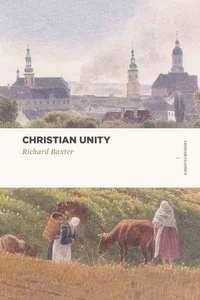
Christian Unity
Published on 25. January 2017
Book
Paperback/Softback
210 pages
978-1-68359-006-4 (ISBN)
Description
In these pages, Richard Baxter addresses Christians around Europe in a time of religious upheaval. Here, he strives to show how Christians of all backgrounds can be unified--a unique stance during years of religious warfare between Catholics and Protestants. In two treatises on Ephesians 4:3 and Romans 14:1, he lays out a vision for how Christian love could heal the ruptures separating the different forms of Christianity in his time.
Lexham Classics are beautifully typeset new editions of classic works. Each book has been carefully transcribed from the original texts, ensuring an accurate representation of the writing as the author intended it to be read.
Lexham Classics are beautifully typeset new editions of classic works. Each book has been carefully transcribed from the original texts, ensuring an accurate representation of the writing as the author intended it to be read.
More details
Language
English
Place of publication
Bellingham
United States
Target group
Professional and scholarly
Product notice
Paperback (trade)
Unsewn / adhesive bound
Dimensions
Height: 229 mm
Width: 155 mm
Thickness: 18 mm
Weight
227 gr
ISBN-13
978-1-68359-006-4 (9781683590064)
Copyright in bibliographic data and cover images is held by Nielsen Book Services Limited or by the publishers or by their respective licensors: all rights reserved.
Schweitzer Classification
Person
Richard Baxter (1615-1691) was ordained in 1638 and served in ministry at Kidderminster. A Puritan Nonconformist pastor, he resisted the governance of the Church of England and renounced his ordination. Baxter became notorious for his ecumenical beliefs during a time of great religious conflict, and he was sentenced to prison for his paraphrase of the New Testament. He wrote prolifically throughout his life, and although he contributed to Puritan theology, he was unique in rejecting limited atonement and believing that repentance and obedience could affect one's salvation. Though controversial in his time, his written works are today valuable for their theological strengths.