

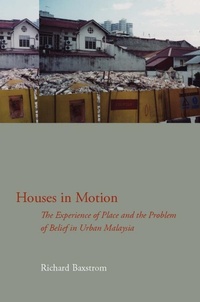
Houses in Motion
The Experience of Place and the Problem of Belief in Urban Malaysia
Published on 14. July 2008
Book
Hardback
304 pages
978-0-8047-5891-8 (ISBN)
Description
Houses in Motion: The Experience of Place and the Problem of Belief in Urban Malaysia is about the transformation of urban space and the reordering of the demographic character of Brickfields, one of the oldest neighborhoods in Kuala Lumpur. Baxstrom offers an ethnographic account of the complex attempts on the part of the state and the community to reconcile techno-rational conceptions of law, development, and city planning with local experiences of place, justice, relatedness, and possibilities for belief in an aggressively changing world. The book combines classic methods of anthropological research and an engagement with the work of theorists such as Gilles Deleuze and Henri Lefebvre, and moves beyond previous studies of Southeast Asian cities by linking larger conceptual issues of ethics, belief, and experience to the concrete trajectories of everyday urban life in the region.
Reviews / Votes
"Particularly interesting in this monograph are Baxstrom's in-depth vignettes of specific interviewees and groups struggling to find their place within a space of flux. These ethnographic segments give a grounded depth to his work, underscoring the fluidity of Malaysian identity, rather than trying to fit individuals into neat categories of affinity."-Sandra Smeltzer, Urban Studies Journal "Readers interested in issues of race, governance, and the transformation of Malaysia's urban landscapes will find Baxstrom's work relevant to the growing body of Malaysian urban studies."-Frank Chua, H-Net Reviews "This timely, sensitive ethnography describes the transformation-amounting to the near-disappearance-of Brickfields, one of the oldest neighborhoods of Kuala Lumpur, Malaysia."-Patricia Sloane-White, Journal of Urban History "Houses in Motion provides an absorbing look at the ways Brickfields residents negotiate urban space through religious discourse, not in spite of it."-Sareeta Amrute, Journal of Anthropological Research "Houses in Motion is an innovative, playful and yet deep analysis of what makes for moral subjects in the city. Henceforth when I visit Brickfields, Kuala Lumpur in my imagination-or when I become overcome by the moral load of terms such as religious reform, development, secularism, or corruption-I will remember the ordinary ways in which Brickfield residents inhabited, suffered, or tried to overcome the monumentalism of these projects."-Veena Das, Johns Hopkins University "Houses in Motion is a finely crafted, ethnographically accessible, and theoretically innovative piece of scholarship. It provides timely and valuable contributions to the fields of Malaysian studies, Southeast Asian studies, and urban anthropology in the first instance."-Seng-Guan Yeoh, Monash UniversityMore details
Series
Edition
New edition
Language
English
Place of publication
Palo Alto
United States
Target group
College/higher education
Professional and scholarly
Edition type
New edition
Product notice
Cloth
Illustrations
1 table, 2 maps
Dimensions
Height: 231 mm
Width: 155 mm
Thickness: 23 mm
Weight
544 gr
ISBN-13
978-0-8047-5891-8 (9780804758918)
Copyright in bibliographic data and cover images is held by Nielsen Book Services Limited or by the publishers or by their respective licensors: all rights reserved.
Schweitzer Classification
Person
Richard Baxstrom holds the position of Lecturer in the Department of Social Anthropology, University of Edinburgh.
Content
[Table of Contents] @fmct: Contents @toc4: Acknowledgments @toc2: Introduction @toc1: I. HISTORICAL CONTEXT @toc2: 1. The Founding of Brickfields and the Prewar Development of Kuala Lumpur 2. The Malayan Emergency, Islamic Reform, and the Trajectory of Urban Governmentality in Kuala Lumpur @toc1: II. LAW, JUSTICE, AND THE EXPERIENCE OF EVERYDAY LIFE IN BRICKFIELDS, 2000'2002 @toc2: 3. Law, Justice, Disappearance: the Experience of Place in a Time of Radical Transformation 4. Strangers, Counterfeiters, and Gangsters: Figures of Belonging and the Problem of Belief 5. Ambivalent Encounters in the City: Islam, Hinduism, and Urban Governmentality Conclusion @toc4: Notes Bibliography Index