

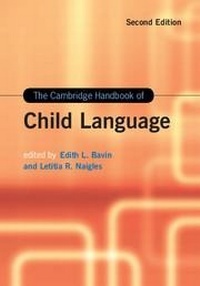
The Cambridge Handbook of Child Language
2nd Edition
Published on 26. November 2015
Book
Hardback
1037 pages
978-1-107-08732-3 (ISBN)
Description
The most authoritative resource for students and researchers, The Cambridge Handbook of Child Language has been thoroughly updated and extended. Enhancements include new chapters on the acquisition of words, processing deficits in children with specific language impairments, and language in children with Williams syndrome, new authors for the bilingualism and autism chapters, a refocused discourse chapter on written narratives, and a new section on reading and reading disorders, cementing the handbook's position as the best study of the subject available. In a wide-ranging survey, language development is traced from prelinguistic infancy to adolescence in typical and atypical contexts; the material is intuitively grouped into six thematic sections, enabling readers to easily find specific in-depth information. With topics as varied as statistical learning, bilingualism, and the neurobiology of reading disorders, this multidisciplinary Handbook is an essential reference for students and researchers in linguistics, psychology, cognitive science, speech pathology, education and anthropology.
More details
Series
Edition
2nd Revised edition
Language
English
Place of publication
Cambridge
United Kingdom
Target group
Professional and scholarly
Edition type
Revised edition
Product notice
Laminated cover
Illustrations
11 Tables, black and white; 20 Halftones, unspecified; 9 Line drawings, unspecified
Dimensions
Height: 254 mm
Width: 185 mm
Thickness: 52 mm
Weight
2160 gr
ISBN-13
978-1-107-08732-3 (9781107087323)
Copyright in bibliographic data and cover images is held by Nielsen Book Services Limited or by the publishers or by their respective licensors: all rights reserved.
Schweitzer Classification
Other editions
Additional editions
Edith L. Bavin | Letitia R. Naigles
The Cambridge Handbook of Child Language
E-Book
07/2016
2nd Edition
Cambridge University Press
€130.99
Available for download
Edith L. Bavin
Cambridge Handbook of Child Language
E-Book
11/2015
Cambridge University Press
€113.99
Available for download
Previous edition
Edith L. Bavin
The Cambridge Handbook of Child Language
Book
03/2009
Cambridge University Press
€148.56
Article exhausted; check for reprint
Persons
Edith L. Bavin is Professor in the School of Psychological Science at La Trobe University, Australia. Letitia R. Naigles is Professor in Psychology at the University of Connecticut.
Content
List of figures; List of tables; List of contributors; Acknowledgements; 1. Introduction: perspectives on child language Letitia R. Naigles and Edith L. Bavin; Part I. Theoretical and Methodological Approaches: 2. Innateness and learnability Virginia Valian; 3. Statistical learning Erik Thiessen and Lucy Erickson; 4. Neurocognition of language development Angela D. Friederici and Michael A. Skeide; 5. The usage-based theory of language acquisition Michael Tomasello; 6. Crosslinguistic approaches to language acquisition Sabine Stoll; Part II. Early Developments: 7. Speech perception Suzanne Curtin and Stephanie Archer; 8. Crosslinguistic perspectives on segmentation and categorization in early language acquisition Barbara Hoehle; 9. From gesture to word Susan Goldin-Meadow; Part III. Phonology, Morphology and Syntax: 10. Babbling and words: a dynamic systems perspective on phonological development Marilyn M. Vihman, Rory A. DePaolis and Tamar Keren-Portnoy; 11. The acquisition of prosodic phonology and morphology Katherine Demuth; 12. The acquisition of grammatical categories Heike Behrens; 13. Verb argument structure Shanley E. M. Allen; 14. The first language acquisition of complex sentences Barbara Lust, Claire Foley ?and Cristina D. Dye; 15. The morphosyntax interface Kamil Ud Deen; Part IV. Semantics, Pragmatics and Discourse: 16. Lexical meaning Eve V. Clark; 17. The acquisition of words Susan A. Graham, Valerie San Juan and Ena Vukatana; 18. Sentence scope Stephen Crain; 19. Sentence processing Jesse Snedeker and Yi Ting Huang; 20. Pragmatic development Judith Becker Bryant; 21. Language development beyond the sentence Ruth Berman; Part V. Varieties of Development: 22. Language development in bilingual children Erika Hoff; 23. Sign language acquisition studies Diane Lillo-Martin; 24. Children with specific language impairment (SLI) J. Bruce Tomblin; 25. Language symptoms and their possible sources of specific language impairment Laurence B. ?Leonard; 26. Processing deficits in children with language impairments Lisa M. D. Archibald and Nicolette B. Noonan; 27. Language development in genetic disorders Fiona M. Richardson and Michael S. C. Thomas; 28. Language development in children with Williams syndrome: genes, modularity, and the importance of development Shevaun Lewis and Barbara Landau; 29. Language in children with autism spectrum disorders Letitia Naigles and Iris Chin; Part VI. Reading: 30. Precursors to reading: phonological awareness and letter knowledge Eva Marinus and Anne Castles; 31. Reading disorders Fiona J. Duff and Margaret J. Snowling; 32. Predictors of reading skills across languages Heikki ?Lyytinen, Hua Shu and Ulla Richardson; 33. Neurobiology of reading disorders: implications of functional neuroimaging studies in dyslexia and specific reading comprehension deficits Katherine Swett, Stephen Bailey, Angela Sefcik and Laurie Cutting; 34. The development of reading comprehension skill: processing and memory Julie A. Van Dyke and Nicole Landi; References; Index.