

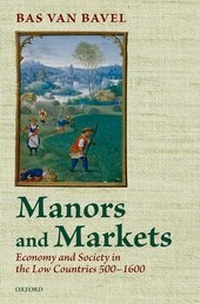
Manors and Markets
Economy and Society in the Low Countries 500-1600
Published on 25. March 2010
Book
Hardback
512 pages
978-0-19-927866-4 (ISBN)
Description
The Low Countries -- an area roughly embracing the present-day Netherlands and Belgium -- formed a patchwork of varied economic and social development in the Middle Ages, with some regions displaying a remarkable dynamism. Manors and Markets charts the history of these vibrant economies and societies, and contrasts them with alternative paths of development, from the early medieval period to the beginning of the seventeenth century.
Providing a concise overview of social and economic changes over more than a thousand years, Bas van Bavel assesses the impact of the social and institutional organization that saw the Low Countries become the most urbanized and densely populated part of Europe by the end of the Middle Ages. By delving into the early and high medieval history of society, van Bavel uncovers the foundations of the flourishing of the medieval Flemish towns and the forces that propelled Holland towards its Golden Age.
Exploring the Low Countries at a regional level, van Bavel highlights the importance of localized structures for determining the nature of social transitions and economic growth. He assesses the role of manorial organization, the emergence of markets, the rise of towns, the quest for self-determination by ordinary people, and the sharp regional differences in development that can be observed in the very long run. In doing so, the book offers a significant contribution to the debate about the causes of economic and social change, both past and present.
Providing a concise overview of social and economic changes over more than a thousand years, Bas van Bavel assesses the impact of the social and institutional organization that saw the Low Countries become the most urbanized and densely populated part of Europe by the end of the Middle Ages. By delving into the early and high medieval history of society, van Bavel uncovers the foundations of the flourishing of the medieval Flemish towns and the forces that propelled Holland towards its Golden Age.
Exploring the Low Countries at a regional level, van Bavel highlights the importance of localized structures for determining the nature of social transitions and economic growth. He assesses the role of manorial organization, the emergence of markets, the rise of towns, the quest for self-determination by ordinary people, and the sharp regional differences in development that can be observed in the very long run. In doing so, the book offers a significant contribution to the debate about the causes of economic and social change, both past and present.
Reviews / Votes
Manors and Markets will remain mandatory reading for every specialist of pre-industrial economic history for some time; but, on a broader level, the issues addressed in this book are also fundamental to the history of Europe in general * Jan Dumolyn, English Historical Review * impressive study * Martha Howell, American Historical Review * Written with authority and skill ... but there is also an underlying commitment and enthusiasm which carries the reader along * Christopher Dyer, Low Countries Historical Review * Wonderfully rich ... a happy, and persuasive, tale indeed * Anne E.C. McCants, E.H. Net *More details
Language
English
Place of publication
Oxford
United Kingdom
Target group
College/higher education
Professional and scholarly
Dimensions
Height: 240 mm
Width: 163 mm
Thickness: 31 mm
Weight
851 gr
ISBN-13
978-0-19-927866-4 (9780199278664)
Copyright in bibliographic data and cover images is held by Nielsen Book Services Limited or by the publishers or by their respective licensors: all rights reserved.
Schweitzer Classification
Other editions
Additional editions
E-Book
08/2016
1st Edition
OUP eBook
€29.49
Available for download
Person
Bas van Bavel is distinguished professor of Transitions of Economy and Society at Utrecht University. He acts as the academic director of the Utrecht University interdisciplinary priority area -- Institutions for Open Societies -- and he is a member of the Royal Dutch Academy of Sciences.
Content
1. Introduction: purpose, context, and approach ; 2. Land and occupation ; 3. Power, property, and social structures ; 4. Agriculture and industries ; 5. Markets in the high and late Middle Ages ; 6. Social change in the late Middle Ages ; 7. The economy in the late Middle Ages ; 8. Economic growth and social change in the long run