

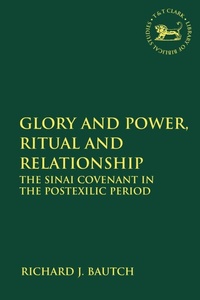
Glory and Power, Ritual and Relationship
The Sinai Covenant in the Postexilic Period
Published on 19. September 2019
Book
Paperback/Softback
192 pages
978-0-567-69206-1 (ISBN)
Description
The book's point of departure is the return from the Exile, which is presented as an opportunity for Jews, primarly those in Judah, to interpret anew the relationship between God and Israel. The relationship had traditionally been thought of as a covenant, and central to the book's thesis is that post-exilic writers used a paradigm that was essentially that of the pre-exilic Mosiac covenant, i.e. a pact between God and humanity conditioned by the latter's observance of the law. The first part of the book describes the process whereby the Mosaic covenant was renovated and its content brought up to date. In this discussion, familiar topoi of Second Temple Judaism such as penitential prayer, creation theology, and kinship ethos are shown to be integral to a contemporary concept of creation.
The second part of the book explores a paradox. On the one hand, the fact that the Mosaic covenant was articulated in the discourse of kinship marked it with an insularity that in turn made this covenant attractive to sectarian groups. Here, evidence is adduced largely from the Dead Sea Scrolls. On the other hand, as the dominant paradigm the Mosaic covenant had ascribed to it a high level of normativity, as seen in the work of tradents such as the Priestly editors and the author of Jubilees. Ultimately, the Mosaic covenant was invoked at the center and the periphery as both a normative theological concept and a cipher to sectarian self-identity. The book concludes that by the end of the Second Temple period, although the Mosiac covenant was normative in terms of a covenantal nomism that was incumbent upon the Jews, the covenant's sectarian tendenz made its precepts non-binding and optional.
The second part of the book explores a paradox. On the one hand, the fact that the Mosaic covenant was articulated in the discourse of kinship marked it with an insularity that in turn made this covenant attractive to sectarian groups. Here, evidence is adduced largely from the Dead Sea Scrolls. On the other hand, as the dominant paradigm the Mosaic covenant had ascribed to it a high level of normativity, as seen in the work of tradents such as the Priestly editors and the author of Jubilees. Ultimately, the Mosaic covenant was invoked at the center and the periphery as both a normative theological concept and a cipher to sectarian self-identity. The book concludes that by the end of the Second Temple period, although the Mosiac covenant was normative in terms of a covenantal nomism that was incumbent upon the Jews, the covenant's sectarian tendenz made its precepts non-binding and optional.
More details
Series
Language
English
Place of publication
Edinburgh
United Kingdom
Publishing group
Bloomsbury Publishing PLC
Target group
College/higher education
Dimensions
Height: 234 mm
Width: 156 mm
Thickness: 10 mm
Weight
292 gr
ISBN-13
978-0-567-69206-1 (9780567692061)
Copyright in bibliographic data and cover images is held by Nielsen Book Services Limited or by the publishers or by their respective licensors: all rights reserved.
Schweitzer Classification
Other editions
Additional editions
Richard J. Bautch
Glory and Power, Ritual and Relationship
The Sinai Covenant in the Postexilic Period
E-Book
09/2009
1st Edition
T.& T.Clark Ltd
€39.49
Available for download
Person
Richard Bautch is Associate Dean of Humanities and
Associate Professor of Humanities at St. Edwards University in Austin, Texas.
Associate Professor of Humanities at St. Edwards University in Austin, Texas.
Content
1. The Renovation of the Covenant after the Return from Exile
2. The Form of the Mosaic Covenant
3. Sectarian Applications of the Mosaic Covenant
4. The Mosaic Covenant as a Dominant Paradigm
5. Conclusion and a Case Study
2. The Form of the Mosaic Covenant
3. Sectarian Applications of the Mosaic Covenant
4. The Mosaic Covenant as a Dominant Paradigm
5. Conclusion and a Case Study