

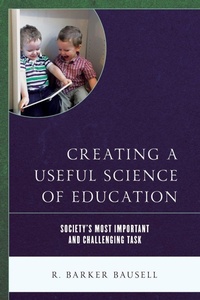
Creating a Useful Science of Education
Society's Most Important and Challenging Task
Published on 4. October 2017
Book
Paperback/Softback
152 pages
978-1-4758-3817-6 (ISBN)
Description
Bausell provides a restrictive but defensible view of the purpose of educational research which is to produce instructional, curricular, or assessment products rather than seldom read and soon forgotten academic papers.This book poses and answers two questions: (a) whether it is possible for the science of education to develop into a discipline that could constructively impact the education of students and, if so (b) what type of research would be required for this transformation. Three genres of research were identified that possess the potential for impacting school instruction if the end result of this work is an instructional product capable of increasing learning by increased access to instruction or engagement therewith. Finally, specific suggestions are tendered for creating the infrastructure needed to realize this unique vision of what the science of education should be.
Reviews / Votes
In this exciting new, two-volume trek, Bausell introduces us-with insight and levity-to diverse genres of unproductive research. Happily, he also tosses us several solution strategies to make our schools sparkle. -- Dr. W. James Popham, professor emeritus, UCLA and former president of the American Educational Research Association (AERA) Dr. Bausell provides an insightful and long overdue summary and critique of educational research, which, in addition to upsetting the status quo, should inform decisions made by academics, professionals, administrators, and policymakers alike. -- Harold Murai, professor emeritus, College of Education, Sacramento State University Barker Bausell's orientation toward education research and practice is consistent with his other body of work: careful analysis, removal of poetic distraction from science, with a dash of logical positivism. His desire is not to tear down education research-but rather to help build a better applied scientific foundation. Indeed, various applied sciences are directed by political and financial motives as well as by a desire to understand a topic and, in this case, help people learn better. Sometimes other motives are barriers to improvement. He illustrates misdirected efforts and effective direction, using logic, systematic empirical summary, aspects of philosophy of science, and honesty. -- Steve Sussman, professor, Preventive Medicine, Psychology, and Social Work, University of Southern CaliforniaMore details
Language
English
Place of publication
United States
Publishing group
Bloomsbury Publishing Plc
Target group
Professional and scholarly
Dimensions
Height: 229 mm
Width: 152 mm
Thickness: 8 mm
Weight
231 gr
ISBN-13
978-1-4758-3817-6 (9781475838176)
Copyright in bibliographic data and cover images is held by Nielsen Book Services Limited or by the publishers or by their respective licensors: all rights reserved.
Schweitzer Classification
Other editions
Additional editions
R. Barker Bausell
Creating a Useful Science of Education
Society'S Most Important and Challenging Task
E-Book
10/2017
1st Edition
Rowman & Littlefield Publishers
€28.49
Available for download
R. Barker Bausell
Creating a Useful Science of Education
Society'S Most Important and Challenging Task
E-Book
10/2017
1st Edition
Rowman & Littlefield Publishers
€28.49
Available for download
Person
Dr. R. Barker Bausell was the first educational researcher to demonstrate the learning superiority of both tutoring and small group instruction when the curriculum, teacher differences, instructional time, and student differences were rigorously controlled. He served as a biostatistician, research methodologist, and the Director of Research in two departments within the University of Maryland over a 35+ year career and was the founding editor/editor-in-chief of the peer reviewed, Evaluation and the Health Profession for 33 of those years. He has authored 12 other books including: Conducting Meaningful Experiments: 40 Steps to Becoming a Scientist, Too Simple to Fail: A Case for Educational Change, and Snake Oil Science: The Truth about Complementary and Alternative Medicine.
Content
Introduction
Chapter One: The Importance of Developing Instructional Products
Chapter Two: Digital and Developmental Instructional Research
Chapter Three: Decision Making in Product Development Research
Chapter Four: Chapter Four: Assessment Products that Might Contribute to a Useful Science of Education
Chapter Five: Research that Might Improve Learning despite the Traditional Classroom
Chapter Six: Research Conducted in the Most Important Instructional Environment (And the
Most Difficult in which to Intervene)
Chapter Seven: Curriculum Research
Chapter Eight: A Big Science Experiment that Might Jumpstart the Science's Infrastructure
Concluding Thoughts
References
Chapter One: The Importance of Developing Instructional Products
Chapter Two: Digital and Developmental Instructional Research
Chapter Three: Decision Making in Product Development Research
Chapter Four: Chapter Four: Assessment Products that Might Contribute to a Useful Science of Education
Chapter Five: Research that Might Improve Learning despite the Traditional Classroom
Chapter Six: Research Conducted in the Most Important Instructional Environment (And the
Most Difficult in which to Intervene)
Chapter Seven: Curriculum Research
Chapter Eight: A Big Science Experiment that Might Jumpstart the Science's Infrastructure
Concluding Thoughts
References