

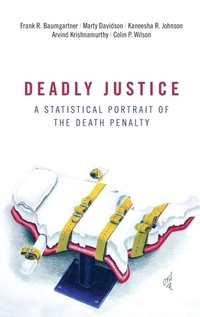
Deadly Justice
A Statistical Portrait of the Death Penalty
Published on 4. January 2018
Book
Hardback
414 pages
978-0-19-084153-9 (ISBN)
Description
In 1976, the US Supreme Court ruled in Gregg v. Georgia that the death penalty was constitutional if it complied with certain specific provisions designed to ensure that it was reserved for the 'worst of the worst.' The same court had rejected the death penalty just four years before in the Furman decision because it found that the penalty had been applied in a capricious and arbitrary manner. The 1976 decision ushered in the 'modern' period of the US death penalty, setting the country on a course to execute over 1,400 inmates in the ensuing years, with over 8,000 individuals currently sentenced to die.
Now, forty years after the decision, the eminent political scientist Frank Baumgartner along with a team of younger scholars (Marty Davidson, Kaneesha Johnson, Arvind Krishnamurthy, and Colin Wilson) have collaborated to assess the empirical record and provide a definitive account of how the death penalty has been implemented. Each chapter addresses a precise empirical question and provides evidence, not opinion, about whether how the modern death penalty has functioned. They decided to write the book after Justice Breyer issued a dissent in a 2015 death penalty case in which he asked for a full briefing on the constitutionality of the death penalty. In particular, they assess the extent to which the modern death penalty has met the aspirations of Gregg or continues to suffer from the flaws that caused its rejection in Furman. To answer this question, they provide the most comprehensive statistical account yet of the workings of the capital punishment system. Authoritative and pithy, the book is intended for both students in a wide variety of fields, researchers studying the topic, and--not least--the Supreme Court itself.
Now, forty years after the decision, the eminent political scientist Frank Baumgartner along with a team of younger scholars (Marty Davidson, Kaneesha Johnson, Arvind Krishnamurthy, and Colin Wilson) have collaborated to assess the empirical record and provide a definitive account of how the death penalty has been implemented. Each chapter addresses a precise empirical question and provides evidence, not opinion, about whether how the modern death penalty has functioned. They decided to write the book after Justice Breyer issued a dissent in a 2015 death penalty case in which he asked for a full briefing on the constitutionality of the death penalty. In particular, they assess the extent to which the modern death penalty has met the aspirations of Gregg or continues to suffer from the flaws that caused its rejection in Furman. To answer this question, they provide the most comprehensive statistical account yet of the workings of the capital punishment system. Authoritative and pithy, the book is intended for both students in a wide variety of fields, researchers studying the topic, and--not least--the Supreme Court itself.
Reviews / Votes
"Baumgartner et al. question whether the death penalty as it is practiced today meets the standards for constitutional legitimacy imposed in Furman. Baumgartner et al. address every empirical issue relevant to that question, ranging from the process by which capital punishment is meted out in jurisdictions, to which crimes in which jurisdictions merit the death penalty, to how often persons are exonerated from death row. They also provide extensive statisticalevidence of differences in execution rates according to race and gender, and consider the evidence of whether the death penalty deters crime. This excellent volume is essential reading for anyone
interested in the constitutionality of the death penalty." -- CHOICE
"Overall, the work contains much good information and some valuable insights. I was especially intrigued with the way the authors framed the difference between Furman and Gregg. They noted that in the former case the Court ruled based on plentiful evidence and experience with how the system actually worked. In Gregg, they were ruling prospectively-based on untested proposals about how the system might be improved. One decision was based on empirical evidence;
the other on theory. Baumgartner, et. al. have given us some useful tools to measure the success of that theory." - Mary Welek Atwell, Professor Emerita of Criminal Justice, Radford University
More details
Language
English
Place of publication
New York
United States
Target group
Professional and scholarly
Dimensions
Height: 240 mm
Width: 161 mm
Thickness: 27 mm
Weight
784 gr
ISBN-13
978-0-19-084153-9 (9780190841539)
Copyright in bibliographic data and cover images is held by Nielsen Book Services Limited or by the publishers or by their respective licensors: all rights reserved.
Schweitzer Classification
Other editions
Additional editions
Frank Baumgartner | Marty Davidson | Kaneesha Johnson
Deadly Justice
A Statistical Portrait of the Death Penalty
Book
01/2018
Oxford University Press Inc
€50.00
Shipment within 15-20 days

Frank Baumgartner | Marty Davidson | Kaneesha Johnson
Deadly Justice
A Statistical Portrait of the Death Penalty
E-Book
11/2017
1st Edition
OUP eBook
€25.49
Available for download

Frank Baumgartner | Marty Davidson | Kaneesha Johnson
Deadly Justice
A Statistical Portrait of the Death Penalty
E-Book
11/2017
1st Edition
OUP eBook
€25.49
Available for download
Persons
FB: Professor of Political Science, University of North Carolina; author of many books for Princeton UP and the U of Chicago Press
MW: Student, UNC
KJ: Student, UNC
AK: Student, UNC
CW: Student, UNC
MW: Student, UNC
KJ: Student, UNC
AK: Student, UNC
CW: Student, UNC
Content
List of Tables
List of Figures
Preface
Acknowledgments
Chapter 1. Furman, Gregg, and the Creation of the Modern Death Penalty
Chapter 2. The Capital Punishment Process.
Chapter 3. Homicide in America
Chapter 4. Comparing Homicides with Execution Cases
Chapter 5. Which Crimes Are Capital Eligible, and is Death Reserved for the Worst Offenders?
Chapter 6. Which Jurisdictions Execute and which Ones Don't?
Chapter 7. How Often Are Death Sentences Overturned?
Chapter 8. How Long Does It Take?
Chapter 9. How Often Are People Exonerated from Death Row?
Chapter 10. How Are the Executions Carried Out?
Chapter 11. How Often Are Scheduled Executions Delayed or Cancelled?
Chapter 12. Mental Illness and Death Row
Chapter 13. How Deep Is Public Support for the Death Penalty?
Chapter 14. Why Does the Death Penalty Cost So Much?
Chapter 15. Does the Death Penalty Deter?
Chapter 16. Is the Death Penalty Dying?
Chapter 17. Does the Modern Death Penalty Meet the Goals of Furman?
Epilogue: How This Book Came About
References
Associated Web Site:
Appendices
A. State Laws Relating to Capital Crimes and Aggravating Circumstances
B. State Laws Relating to Mitigating Circumstances
C. Appendix to Chapter 12 on Mental Illness
D. Appendix to Chapter 13 on Public Opinion
E. Appendix to Chapter 14 on Cost
F. Relevant Supreme Court Cases
Data used in this book
A. The Carolina Execution Database (all executions, 1977 through 2015)
B. Homicides by County and by Year, 1984 to 2012
C. Homicides by State and Year, 1984 to 2012
D. Executions by County and by Year, 1975 to 2015
E. Executions by State and by Year, 1975 to 2015
F. Pennsylvania Death Warrants
G. Replication data for Figures used in the book
H. Web sites with data we use
a. Death Penalty Information Center
b. Clark County Prosecutor Execution database
c. National Registry of Exonerations
I. Movies / documentaries / popular culture links
List of Figures
Preface
Acknowledgments
Chapter 1. Furman, Gregg, and the Creation of the Modern Death Penalty
Chapter 2. The Capital Punishment Process.
Chapter 3. Homicide in America
Chapter 4. Comparing Homicides with Execution Cases
Chapter 5. Which Crimes Are Capital Eligible, and is Death Reserved for the Worst Offenders?
Chapter 6. Which Jurisdictions Execute and which Ones Don't?
Chapter 7. How Often Are Death Sentences Overturned?
Chapter 8. How Long Does It Take?
Chapter 9. How Often Are People Exonerated from Death Row?
Chapter 10. How Are the Executions Carried Out?
Chapter 11. How Often Are Scheduled Executions Delayed or Cancelled?
Chapter 12. Mental Illness and Death Row
Chapter 13. How Deep Is Public Support for the Death Penalty?
Chapter 14. Why Does the Death Penalty Cost So Much?
Chapter 15. Does the Death Penalty Deter?
Chapter 16. Is the Death Penalty Dying?
Chapter 17. Does the Modern Death Penalty Meet the Goals of Furman?
Epilogue: How This Book Came About
References
Associated Web Site:
Appendices
A. State Laws Relating to Capital Crimes and Aggravating Circumstances
B. State Laws Relating to Mitigating Circumstances
C. Appendix to Chapter 12 on Mental Illness
D. Appendix to Chapter 13 on Public Opinion
E. Appendix to Chapter 14 on Cost
F. Relevant Supreme Court Cases
Data used in this book
A. The Carolina Execution Database (all executions, 1977 through 2015)
B. Homicides by County and by Year, 1984 to 2012
C. Homicides by State and Year, 1984 to 2012
D. Executions by County and by Year, 1975 to 2015
E. Executions by State and by Year, 1975 to 2015
F. Pennsylvania Death Warrants
G. Replication data for Figures used in the book
H. Web sites with data we use
a. Death Penalty Information Center
b. Clark County Prosecutor Execution database
c. National Registry of Exonerations
I. Movies / documentaries / popular culture links