

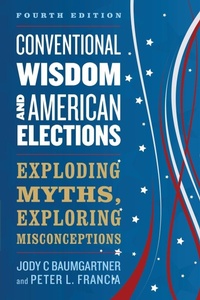
Conventional Wisdom and American Elections
Exploding Myths, Exploring Misconceptions
4th Edition
Published on 12. November 2019
Book
Paperback/Softback
232 pages
978-1-5381-2916-6 (ISBN)
Description
During every election cycle, political observers generate a seemingly limitless supply of theories, opinions, and predictions. Unfortunately, many of these assertions oversimplify complex subjects or overhype the latest political fads. Inevitably, some misinformation becomes part of the conventional wisdom about American elections. The objective of Conventional Wisdom and American Elections: Exploding Myths, Exploring Misconceptions is to bring clarity to several of these subjects.
For example, it is now commonplace for commentators to emphasize the negative tactics and practices of the campaigns of presidential candidates. In 2016, some commentators suggested that the presidential campaign was the "nastiest" ever, with the campaigns of President Donald Trump, Hillary Clinton, and their supporters, going to "new extremes" of negativity. However, these claims are not new. Dating as far back as the presidential election of 1800, critics of Thomas Jefferson stated that his potential victory would bring about legal prostitution and the burning of the Bible. In 1824, opponents of Andrew Jackson charged that he was a murderer and that his wife was a bigamist. Perhaps most scurrilous of all, Jackson's opponents even accused his dead mother of being a prostitute.
In total, Conventional Wisdom and American Elections identifies eleven widely held myths and misconceptions about elections in the United States. The conclusions drawn throughout the book are based on the most current political science research. In some instances, the literature is clear in debunking popular myths about American elections. On other issues, research findings are more mixed. In either case, Conventional Wisdom and American Elections clarifies the issues so that readers can discern between those in which scholars have largely resolved and those in which honest debate remains.
For example, it is now commonplace for commentators to emphasize the negative tactics and practices of the campaigns of presidential candidates. In 2016, some commentators suggested that the presidential campaign was the "nastiest" ever, with the campaigns of President Donald Trump, Hillary Clinton, and their supporters, going to "new extremes" of negativity. However, these claims are not new. Dating as far back as the presidential election of 1800, critics of Thomas Jefferson stated that his potential victory would bring about legal prostitution and the burning of the Bible. In 1824, opponents of Andrew Jackson charged that he was a murderer and that his wife was a bigamist. Perhaps most scurrilous of all, Jackson's opponents even accused his dead mother of being a prostitute.
In total, Conventional Wisdom and American Elections identifies eleven widely held myths and misconceptions about elections in the United States. The conclusions drawn throughout the book are based on the most current political science research. In some instances, the literature is clear in debunking popular myths about American elections. On other issues, research findings are more mixed. In either case, Conventional Wisdom and American Elections clarifies the issues so that readers can discern between those in which scholars have largely resolved and those in which honest debate remains.
More details
Edition
4th edition
Language
English
Place of publication
United States
Publishing group
Bloomsbury Publishing Plc
Target group
College/higher education
US School Grade: From College Freshman to College Graduate Student
Illustrations
9 BW Photos, 11 Graphs, 17 Tables
Dimensions
Height: 229 mm
Width: 152 mm
Thickness: 13 mm
Weight
346 gr
ISBN-13
978-1-5381-2916-6 (9781538129166)
Copyright in bibliographic data and cover images is held by Nielsen Book Services Limited or by the publishers or by their respective licensors: all rights reserved.
Schweitzer Classification
Other editions
Additional editions
Jody C. Baumgartner | Peter L. Francia
Conventional Wisdom and American Elections
Exploding Myths, Exploring Misconceptions
E-Book
11/2019
4th Edition
Rowman & Littlefield Publishers
€32.99
Available for download
Jody C. Baumgartner | Peter L. Francia
Conventional Wisdom and American Elections
Exploding Myths, Exploring Misconceptions
E-Book
11/2019
4th Edition
Bloomsbury eBooks US
€32.99
Available for download
Persons
Dr. Jody C Baumgartner is the Thomas Harriot College of Arts and Sciences Distinguished Professor of Political Science at East Carolina University. He has numerous books, authored and edited, to his credit. In 2017, he edited The Internet and the 2016 Presidential Campaign with Terri Towner, and in 2018, Political Humor in a Changing Media Landscape: A New Generation of Research with Amy Becker. He has also written or collaborated on numerous articles and book chapters on political humor, the vice presidency, and other subjects.
Dr. Peter L. Francia is the Thomas Harriot College of Arts and Sciences Director of the Center for Survey Research and is professor in the Department of Political Science at East Carolina University. He is the author of numerous academic publications on various topics related to American elections. His books include The Financiers of Congressional Elections: Investors, Ideologues, and Intimates, co-authored with John C. Green, Paul S. Herrnson, Lynda W. Powell, and Clyde Wilcox; The Future of Organized Labor in American Politics; and the volume, Guide to Interest Groups and Lobbying in the United States, co-edited with Burdett A. Loomis and Dara Z. Strolovitch. Dr. Francia's insights on American politics have been included in the press accounts of national media outlets including CNN, National Public Radio, and the Wall Street Journal.
Dr. Peter L. Francia is the Thomas Harriot College of Arts and Sciences Director of the Center for Survey Research and is professor in the Department of Political Science at East Carolina University. He is the author of numerous academic publications on various topics related to American elections. His books include The Financiers of Congressional Elections: Investors, Ideologues, and Intimates, co-authored with John C. Green, Paul S. Herrnson, Lynda W. Powell, and Clyde Wilcox; The Future of Organized Labor in American Politics; and the volume, Guide to Interest Groups and Lobbying in the United States, co-edited with Burdett A. Loomis and Dara Z. Strolovitch. Dr. Francia's insights on American politics have been included in the press accounts of national media outlets including CNN, National Public Radio, and the Wall Street Journal.
Content
List of Illustrations
Introduction
Chapter 1. The 'Independent' and 'Swing' Voter Myth v. the Reality of Mobilizing the Base
Chapter 2. To Vote or Not to Vote: Three Myths about Voter Turnout
Chapter 3. End of the Two Party System? The Myth of the Rise of Third Parties
Chapter 4. Buying Elections? Campaign Finance Law and Money's Influence in Elections and Politics
Chapter 5. The Veepstakes: Balancing the Ticket and Other Myths about Vice Presidential Selection
Chapter 6. Mudslinging 101: Have Presidential Campaigns Really Become Nastier?
Chapter 7. Where Have You Gone, Walter Cronkite? The 'News' Just Ain't What It Used To Be
Chapter 8. Game Changer? Misconceptions about the Significance of Presidential Debates
Chapter 9. Science or Voodoo? Misconceptions about National Election Polls
Chapter 10. May the Best Man Win? The Illusion of Competitive Congressional Elections
Chapter 11. The American People Have Spoken'...Or Have They? The Myth of the Presidential Mandate
Index
About the Authors
Introduction
Chapter 1. The 'Independent' and 'Swing' Voter Myth v. the Reality of Mobilizing the Base
Chapter 2. To Vote or Not to Vote: Three Myths about Voter Turnout
Chapter 3. End of the Two Party System? The Myth of the Rise of Third Parties
Chapter 4. Buying Elections? Campaign Finance Law and Money's Influence in Elections and Politics
Chapter 5. The Veepstakes: Balancing the Ticket and Other Myths about Vice Presidential Selection
Chapter 6. Mudslinging 101: Have Presidential Campaigns Really Become Nastier?
Chapter 7. Where Have You Gone, Walter Cronkite? The 'News' Just Ain't What It Used To Be
Chapter 8. Game Changer? Misconceptions about the Significance of Presidential Debates
Chapter 9. Science or Voodoo? Misconceptions about National Election Polls
Chapter 10. May the Best Man Win? The Illusion of Competitive Congressional Elections
Chapter 11. The American People Have Spoken'...Or Have They? The Myth of the Presidential Mandate
Index
About the Authors