

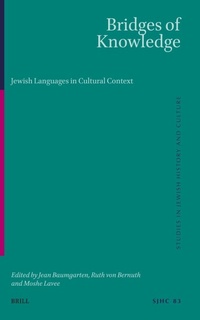
Bridges of Knowledge
Jewish Languages in Cultural Context
Published on 25. September 2025
Book
Hardback
332 pages
978-90-04-73081-6 (ISBN)
Description
In this collaborative volume, the editors examine the role of Judeo-languages in literary, social, religious, and cultural channels of knowledge transfer, particularly in the dissemination of oral and written traditions beyond the core intellectual elite to the secondary Jewish intelligentsia and broader audiences. This phenomenon is evident in Yiddish, Judeo-Spanish, Judeo-Arabic, Judeo-Italian, Judeo-French, and Judeo-Turkish from the Middle Ages to the 20th century. The studies in this book present a wide range of manuscripts and printed editions, highlighting the diverse functions and roles of Judeo-languages as vehicles for the distribution, transmission, and mediation of knowledge.
More details
Series
Language
English
Place of publication
Leiden
Netherlands
Target group
Professional and scholarly
College/higher education
Product notice
sewn/stitched
Cloth over boards
Dimensions
Height: 235 mm
Width: 155 mm
Thickness: 19 mm
Weight
640 gr
ISBN-13
978-90-04-73081-6 (9789004730816)
Copyright in bibliographic data and cover images is held by Nielsen Book Services Limited or by the publishers or by their respective licensors: all rights reserved.
Schweitzer Classification
Persons
Jean Baumgarten is Directeur de recherche emeritus at the Centre National de la recherche scientifique (CNRS, Paris). He has published articles and books on the Yiddish language and literature (16th-18th century), cultural studies of the Ashkenazi culture, Jewish mysticism and Hasidism.
Ruth von Bernuth is Professor at the North Carolina University. She published books and articles on German and Yiddish literature and culture (15th-18th centuries). Her most recent research focus is the Bible and Biblical literature in Yiddish.
Moshe Lavee is a lecturer in Talmud and Midrash (department of Jewish History,) chair of eLijah-Lab for Digital Humanities (University of Haifa). He published articles and books on Aggadic Midrash from the Genizah, the construction of identity in rabbinic Literature, and DH applications for Jewish Studies.
Ruth von Bernuth is Professor at the North Carolina University. She published books and articles on German and Yiddish literature and culture (15th-18th centuries). Her most recent research focus is the Bible and Biblical literature in Yiddish.
Moshe Lavee is a lecturer in Talmud and Midrash (department of Jewish History,) chair of eLijah-Lab for Digital Humanities (University of Haifa). He published articles and books on Aggadic Midrash from the Genizah, the construction of identity in rabbinic Literature, and DH applications for Jewish Studies.
Content
Acknowledgment
List of Figures
1 Introduction
?1?Anatomy of the Problem
?2?This Book
Part 1 Manuscript Context
2 Gospel Argumenta
?1?The Short 'Eusebian' Argumentum [Paratext 1.1]
?2?The Long 'Eusebian' Argumentum
?3?The Argumentum of Cosmas Indicopleustes [Paratext 1.2]
3 Marginalia in Greek
?1?The Eusebian Apparatus
?2?The 8-Section Tradition
?3?Family 1
?4?Scholia on Jesus' Ascension in GA 72 [Paratext 3.1]
4 Marginalia in Latin and Oriental Version
?1?Latin
?2?Syriac
?3?Coptic
?4?Ethiopic
5 Gospel Epilogue
Part 2 Commentary Manuscripts
6 The Catena in Marcum
?1?The Common Edition
?2?The Egyptian Edition
?3?A Scholion from Dionysius of Alexandria
7 Theophylact Catena
?1?The Common Edition
?2?Maintaining the Truth Unharmed: The Longer Edition
?3?As Travellers Rejoice: GA 304
8 Conclusion
?1?Summary
?2?Concluding Remarks
Part 3 Paratexts and Translations
Paratext 1.1: The 'Eusebian' Argumentum to Mark
?Text
?Translation
Paratext 1.2: The Argumentum of Cosmas Indicopleustes
?Text
?Translation
Paratexts 2: Canon Tables
Paratext 3.1: Scholia on Jesus' Ascension
?Text
?Translation
Paratext 3.2: Scholion from Reuchlin
?Text
?Translation
Paratext 4: De Harmoniae Evangelistarum
?Text
?Translation
Paratext 5.1: The Egyptian Recension
?Text
?Translation
Paratext 5.2: A Scholion from the Letter of Dionysius of Alexandria to Basilides
?Text
?Translation
Paratext 5.3: Theophylact's Catena: The Long Recension
?Text
?Translation
Paratext 5.4: Zigabenus' Catena
?Text
?Translation
Bibliography
Index
List of Figures
1 Introduction
?1?Anatomy of the Problem
?2?This Book
Part 1 Manuscript Context
2 Gospel Argumenta
?1?The Short 'Eusebian' Argumentum [Paratext 1.1]
?2?The Long 'Eusebian' Argumentum
?3?The Argumentum of Cosmas Indicopleustes [Paratext 1.2]
3 Marginalia in Greek
?1?The Eusebian Apparatus
?2?The 8-Section Tradition
?3?Family 1
?4?Scholia on Jesus' Ascension in GA 72 [Paratext 3.1]
4 Marginalia in Latin and Oriental Version
?1?Latin
?2?Syriac
?3?Coptic
?4?Ethiopic
5 Gospel Epilogue
Part 2 Commentary Manuscripts
6 The Catena in Marcum
?1?The Common Edition
?2?The Egyptian Edition
?3?A Scholion from Dionysius of Alexandria
7 Theophylact Catena
?1?The Common Edition
?2?Maintaining the Truth Unharmed: The Longer Edition
?3?As Travellers Rejoice: GA 304
8 Conclusion
?1?Summary
?2?Concluding Remarks
Part 3 Paratexts and Translations
Paratext 1.1: The 'Eusebian' Argumentum to Mark
?Text
?Translation
Paratext 1.2: The Argumentum of Cosmas Indicopleustes
?Text
?Translation
Paratexts 2: Canon Tables
Paratext 3.1: Scholia on Jesus' Ascension
?Text
?Translation
Paratext 3.2: Scholion from Reuchlin
?Text
?Translation
Paratext 4: De Harmoniae Evangelistarum
?Text
?Translation
Paratext 5.1: The Egyptian Recension
?Text
?Translation
Paratext 5.2: A Scholion from the Letter of Dionysius of Alexandria to Basilides
?Text
?Translation
Paratext 5.3: Theophylact's Catena: The Long Recension
?Text
?Translation
Paratext 5.4: Zigabenus' Catena
?Text
?Translation
Bibliography
Index