

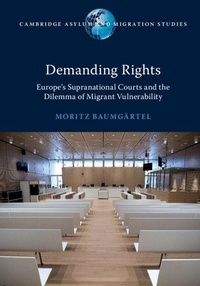
Demanding Rights
Europe's Supranational Courts and the Dilemma of Migrant Vulnerability
Published on 9. May 2019
Book
Hardback
206 pages
978-1-108-49649-0 (ISBN)
Description
While nominally protected across Europe, the human rights of vulnerable migrants often fail to deliver their promised benefits in practice. This socio-legal study explores both the concrete expressions and possible causes of this persistent deficit. For this purpose, it presents an innovative multifaceted evaluation of selected judgments of the European Court of Human Rights and the Court of Justice of the EU pertaining to such complex questions as the protection of persons fleeing from indiscriminate violence, homosexual asylum seekers, the Dublin Regulation, and the externalisation of border control. Highlighting the demanding character of migrant rights, the book also discusses some steps that could be taken to improve the effectiveness of Europe's supranational human rights system including changes in judicial and litigation practice as well as a reconceptualization of human rights as existential commitments.
Reviews / Votes
'With a rigorous methodology and laser-precise analysis, Baumgaertel shows the potential - if adequately prompted by rights defenders - for the European judiciary to steer migration policies towards a better protection of the human rights of migrants, despite the increasing nationalist populist pressure towards tighter 'securitisation' of the borders.' Francois Crepeau, Hans and Tamar Oppenheimer Professor in Public International Law, McGill University, Montreal 'Zooming in on one of the most contentious fields of contemporary human rights struggles - migrant rights - this excellent monograph investigates what can be expected of European supranational jurisdictions. The study of the impact and/or effectiveness of strategies is a crucial yet still underdeveloped aspect of human rights work. Baumgaertel has developed a method that allows him to assess the results of the work of the Strasbourg and Luxemburg courts. Admirably, this author resists the temptation of surfing on the wave of human rights skepticism. Instead, he chooses constructive engagement with human rights theory as well as with strategies of courts and litigators, aimed at optimizing effectiveness.' Eva Brems, Ghent University, Belgium '[T]his book is highly recommended. The strength of Baumgaertel's work lies in the clarity of his arguments despite the complexity of the subject; his clear guidance on how to unpack human rights adjudication; his convincing and novel approach of using a vast array of sociolegal sources, ranging from the empirical methods of case assessment to qualitative interviews; and his thorough and occasionally provocative assessment of prevailing shortcomings regarding the realization of vulnerable migrants' rights, combined with numerous constructive proposals to advance these rights. These qualities make Demanding Rights a valuable contribution to theoretical critical human rights scholarship and to the work of human rights defenders alike.' Lena Riemer, International Journal of Constitutional Law 'Moritz Baumgaertel's book ... offers remarkably clear insight into the impact of the European Court of Human Rights (ECtHR) and the Court of Justice of the European Union (CJEU) jurisprudence on the actual protection of the rights of vulnerable migrants ... Most importantly, he has included in the discussion the various stakeholders - courts, attorneys, state officials and, of course, migrants themselves. Adjusting remarkably well the theories of effectiveness to explain the perplexing and multi-dimensional causes and effects of European courts adjudication, Baumgaertel has created a book that is a valuable addition to the reading shelf both of a legal practitioner and a migrant rights advocate, introducing, simultaneously, a fresh set of ideas which could engage other researchers in fruitful discourse.' Dimitra Fragkou, Human Rights Law ReviewMore details
Series
Edition
Alternate
Language
English
Place of publication
Cambridge
United Kingdom
Edition type
Alternate
Illustrations
Worked examples or Exercises; 5 Tables, black and white; 6 Line drawings, black and white
Dimensions
Height: 250 mm
Width: 175 mm
Thickness: 16 mm
Weight
547 gr
ISBN-13
978-1-108-49649-0 (9781108496490)
Copyright in bibliographic data and cover images is held by Nielsen Book Services Limited or by the publishers or by their respective licensors: all rights reserved.
Schweitzer Classification
Other editions
Additional editions
Moritz Baumgaertel
Demanding Rights
Europe's Supranational Courts and the Dilemma of Migrant Vulnerability
E-Book
05/2019
Cambridge University Press
€35.49
Available for download
Moritz Baumgaertel
Demanding Rights
Europe's Supranational Courts and the Dilemma of Migrant Vulnerability
Book
05/2019
Cambridge University Press
€44.50
Article not available at the moment
Moritz Baumgartel
Demanding Rights
Europe's Supranational Courts and the Dilemma of Migrant Vulnerability
E-Book
05/2019
Cambridge University Press
€29.49
Available for download
Person
Moritz Baumgärtel is Assistant Professor at the Faculty of Law of Universiteit Utrecht, The Netherlands and at University College Roosevelt. He holds a Ph.D. from the Université libre de Bruxelles, an M.Phil. in International Relations from the University of Cambridge and an LL.M. in Public International Law from Universiteit Utrecht, The Netherlands. In recent years, he has been a lecturer at Tilburg Law School and has held visiting positions at the law schools of the University of Michigan, Duke University, and the University of Copenhagen. Baumgärtel's research concerns the human rights of vulnerable migrants such as refugees, asylum seekers and undocumented migrants.
Content
1. Introduction; Part I: 2. Expanding the rights to stay?; 3. Establishing responsibility; 4. Reaffirming jurisdiction; Part II: 5. From dilemmatic to strategic adjudication; 6. From strategic to consolidating litigation; 7. Migrant rights as existential commitments; 8. Demanding rights: some conclusions.