

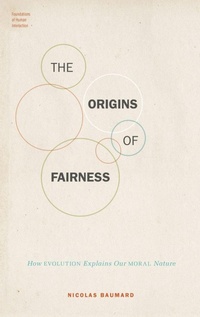
The Origins of Fairness
How Evolution Explains Our Moral Nature
Published on 1. April 2016
Book
Hardback
272 pages
978-0-19-021022-9 (ISBN)
Description
In order to describe the logic of morality, "contractualist " philosophers have studied how individuals behave when they choose to follow their moral intuitions. These individuals, contractualists note, often act as if they have bargained and thus reached an agreement with others about how to distribute the benefits and burdens of mutual cooperation. Using this observation, such philosophers argue that the purpose of morality is to maximize the benefits of human
interaction. The resulting "contract " analogy is both insightful and puzzling. On one hand, it captures the pattern of moral intuitions, thus answering questions about human cooperation: why do humans cooperate? Why should the distribution of benefits be proportionate to each person's contribution?
Why should the punishment be proportionate to the crime? Why should the rights be proportionate to the duties? On the other hand, the analogy provides a mere as-if explanation for human cooperation, saying that cooperation is "as if " people have passed a contract-but since they didn't, why should it be so?
To evolutionary thinkers, the puzzle of the missing contract is immediately reminiscent of the puzzle of the missing "designer " of life-forms, a puzzle that Darwin's theory of natural selection essentially resolved. Evolutionary and contractualist theory originally intersected at the work of philosophers John Rawls and David Gauthier, who argued that moral judgments are based on a sense of fairness that has been naturally selected.
In this book, Nicolas Baumard further explores the theory that morality was originally an adaptation to the biological market of cooperation, an arena in which individuals competed to be selected for cooperative interactions. In this environment, Baumard suggests, the best strategy was to treat others with impartiality and to share the costs and benefits of cooperation in a fair way, so that those who offered less than others were left out of cooperation while those who offered more were
exploited by their partners. It is with this evolutionary approach that Baumard ultimately accounts for the specific structure of human morality.
interaction. The resulting "contract " analogy is both insightful and puzzling. On one hand, it captures the pattern of moral intuitions, thus answering questions about human cooperation: why do humans cooperate? Why should the distribution of benefits be proportionate to each person's contribution?
Why should the punishment be proportionate to the crime? Why should the rights be proportionate to the duties? On the other hand, the analogy provides a mere as-if explanation for human cooperation, saying that cooperation is "as if " people have passed a contract-but since they didn't, why should it be so?
To evolutionary thinkers, the puzzle of the missing contract is immediately reminiscent of the puzzle of the missing "designer " of life-forms, a puzzle that Darwin's theory of natural selection essentially resolved. Evolutionary and contractualist theory originally intersected at the work of philosophers John Rawls and David Gauthier, who argued that moral judgments are based on a sense of fairness that has been naturally selected.
In this book, Nicolas Baumard further explores the theory that morality was originally an adaptation to the biological market of cooperation, an arena in which individuals competed to be selected for cooperative interactions. In this environment, Baumard suggests, the best strategy was to treat others with impartiality and to share the costs and benefits of cooperation in a fair way, so that those who offered less than others were left out of cooperation while those who offered more were
exploited by their partners. It is with this evolutionary approach that Baumard ultimately accounts for the specific structure of human morality.
Reviews / Votes
readers interested in contractualist normative theory might benefit from his exposition of the theory in the light of evolutionary theory. Baumard writes without using many technicalities and so the book should be accessible for the non-specialist reader, too. * Michael Klenk, Metapsychology Online Reviews * This book offers a compelling account of the origins of morality. It makes an important contribution to the growing body of literature in the field of evolutionary ethics ... and will be of interest to anyone in the fields of evolutionary ethics and contractualism, as well as to students of ethics broadly construed. * Jeff O'Connell, The Quarterly Review of Biology. *More details
Other editions
Additional editions
E-Book
04/2016
1st Edition
OUP eBook
€37.99
Available for download
E-Book
03/2016
1st Edition
OUP eBook
€53.49
Available for download
Person
Nicolas Baumard is Research Scholar in the Department of Cognitive Sciences at the Ecole Normale Supérieure in Paris.
Content
INTRODUCTION: Reconciling morality with the natural sciences; Naturalism: The moral sense; Contractualism: The social contract; A naturalistic and contractualist theory of morality; PART 1: THE MORAL SENSE; Chapter 1: A mental organ; 1. An autonomous disposition; Moral judgments and moral intuitions; Moral intuitions and moral ideas; 2. A domain-specific disposition; Morality, a passion among others; The sense of honor; 3. A universal disposition; Variability as a product of the diversity of situations and beliefs; Observed diversity and real diversity; 4. An innate disposition; 5. Non-intuitive moral judgments; Chapter 2: A functional disposition; 1. The competing passions; 2. The moral sense and non-naturalistic theories; The domain specificity of moral judgments; The innateness of moral judgments; 3. The moral sense as adaptation; Functionality and modularity; Efficient causes and final causes; PART 2: MORALITY AS FAIRNESS; Chapter 3: From cooperation to morality; 1. A naturalistic contractualism; 2. From the cooperation market to the sense of fairness; The cooperation market; Cooperation market theory vs. other mutualistic theories; Manipulation on the cooperation market; The cooperation market in the ancestral environment; 3. The sense of fairness; The example of reciprocity and justice; Moral rectitude, or fairness in general; Fairness and power relationships; Framing effects; Chapter 4: Moral principles and the sense of fairness; 1. Getting past principles; 2. The mutualistic logic of moral dilemmas; Actions and omissions; The trolley dilemma; A mutualistic analysis of the trolley problem; Utilitarian interpretations of the trolley problem; 3. Principles and justice; Chapter 5 A cognitive approach to the moral sense; 1. A contract without negotiations: Morality and theory of mind; The importance of others: Mental states vs. interests; Consent has no moral value; A mutualistic approach to responsibility; 2. The evaluation of individual interests; Intuitive axiology and the moral sense; Victimless crimes; Roles and statuses; Moral differences between the sexes; 3. The limits of the moral community; The proper and actual domains of the moral sense; The variability of the actual domain; 4. Disposition and micro-dispositions; PART 3: MORALITY AS SACRIFICE; Chapter 6 Mutualistic morality and utilitarian morality; 1. Utilitarian morality and group selection; 2. Utilitarian societies?; Observed utilitarianism and real utilitarianism; Collectivism and utilitarianism; Social institutions and moral interactions; 3. Utilitarian judgments?; Distributive justice; Retributive justice; Supererogatory actions; Moral dilemmas; 4. Economic games; The ecological validity of economic games; Economic games: moral situations; A mutualistic analysis of economic games; Chapter 7: Punishment: useless and uncertain; 1. A marginal practice in non-state societies; 2. Revenge, ostracism and self-defense: punishments?; 3. A simple question of duty; A mutualistic analysis of apparently punitive actions; Punishment in economic games; 4. Retributive justice and penal systems; PART 4: MORALITY AS EXCELLENCE; Chapter 8: Mutualistic morality and virtue morality; 1. Sympathy; The three faces of Adam Smith; Of sympathy and the other social sentiments; 2. The parental instinct; 3. Disgust; 4. The virtues; Chapter 9: On the state of nature; 1. Morality in animals; Morality: one disposition among many; Primate morality: reality or anthropomorphism?; 2. Morality and social cognition; Understanding others to communicate; Communicating to cooperate; CONCLUSION; 1. The steps in the argument; 2. The scientific implications of a mutualistic theory; 3. The practical implications of mutualistic theory; References