

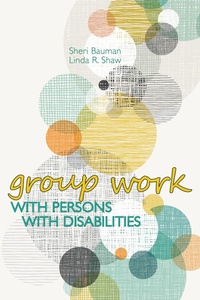
Group Work with Persons with Disabilities
Published on 19. May 2016
Book
Paperback/Softback
264 pages
978-1-55620-340-4 (ISBN)
Description
This one-of-a-kind manual provides direction for leading groups of people with disabilities or groups that have members with disabilities. Viewing disability as a single aspect of a multifaceted person, Drs. Bauman and Shaw share their insight and expertise and emphasize practical skill building and training for facilitating task, psychoeducational, counseling, family, and psychotherapy groups across various settings.
Topics examined in Part I include common themes in groups that focus on disability; various group formats, including groups using technological platforms; issues of diversity that exist simultaneously with ability; group composition; ethical concerns; and training considerations and logistical accommodations. Part II focuses on group counseling with clients experiencing sensory, psychiatric, cognitive, and physical disabilities as well as chronic medical conditions. A list of resources, support information, and group exercises completes the book.
Topics examined in Part I include common themes in groups that focus on disability; various group formats, including groups using technological platforms; issues of diversity that exist simultaneously with ability; group composition; ethical concerns; and training considerations and logistical accommodations. Part II focuses on group counseling with clients experiencing sensory, psychiatric, cognitive, and physical disabilities as well as chronic medical conditions. A list of resources, support information, and group exercises completes the book.
More details
Language
English
Place of publication
Alexandria, VA
United States
Target group
Professional and scholarly
Product notice
Paperback (trade)
Illustrations
Illustrations
Dimensions
Height: 226 mm
Width: 152 mm
Thickness: 15 mm
Weight
363 gr
ISBN-13
978-1-55620-340-4 (9781556203404)
Copyright in bibliographic data and cover images is held by Nielsen Book Services Limited or by the publishers or by their respective licensors: all rights reserved.
Schweitzer Classification
Other editions
Additional editions
Sheri Bauman | Linda R. Shaw
Group Work With Persons With Disabilities
E-Book
04/2016
Wiley
€44.99
Available for download
Sheri Bauman | Linda R. Shaw
Group Work With Persons With Disabilities
E-Book
04/2016
Wiley
€44.99
Available for download
Persons
Sheri Bauman, PhD, is a professor and director of the counseling graduate program in the Department of Disability and Psychoeducational Studies in the College of Education at the University of Arizona. Prior to earning her doctorate in 1999, she worked in public schools for 30 years, 18 of those as a school counselor. She is a licensed psychologist (currently inactive). Dr. Bauman conducts research on bullying, cyberbullying, peer victimization, and teacher responses to bullying. She also studies group work and is past editor of the Journal for Specialists in Group Work. She is a frequent presenter on these topics at local, state, national, and international conferences. She is the author of Special Topics for Helping Professionals and Cyberbullying: What Counselors Need to Know and is lead editor of Principles of Cyberbullying Research: Definition, Measures, and Methods. Her most recent book is Mental Health in the Digital Age, coauthored with Dr. Ian Rivers. Her vita includes over 50 publications in peer-reviewed scholarly journals, numerous book chapters, three training DVDs, and other publications for a general audience. She has been the recipient of two grants from the National Science Foundation and is now the principal investigator on the research team funded by a grant from the National Institute of Justice to investigate how School Resource Officers (SROs) affect school climate and safety and to test the added value of an enhanced model for training SROs.
Linda R. Shaw, PhD, is a professor and department head in the Department of Disability and Psychoeducational Studies at the University of Arizona. Prior to her current position, Dr. Shaw was the director of the Rehabilitation Counseling Program at the University of Florida. She has over 35 years of experience as a rehabilitation counselor, administrator, and educator. Her counseling and nonacademic administrative experience includes specializations in spinal cord injury rehabilitation, brain injury rehabilitation, and psychiatric disability. Dr. Shaw is a licensed mental health counselor and a certified rehabilitation counselor. Dr. Shaw currently chairs the Code of Ethics Revision Committee for the Commission on Rehabilitation Counselor Certification (CRCC) and was a member of the American Counseling Association (ACA) Ethics Revision Task Force, which completed the 2014 revision of the Counseling Code of Ethics. She is a past president of the Council on Rehabilitation Education, the national accreditation body for rehabilitation counseling programs, and a past president of the American Rehabilitation Counseling Association. She represented CORE on the 20/20 Visioning Group cosponsored by the American Association of State Counseling Boards and ACA. Dr. Shaw has served as Vice Chair of CRCC and has also served as Chair of the CRCC Ethics Committee, presiding over that committee throughout the process of a previous revision of the Code of Ethics for Professional Rehabilitation Counselors. Dr. Shaw has published and presented widely on issues related to disability-related job discrimination, the correlates of professional ethical behavior, professional issues in rehabilitation counseling, and neurological disability. She is the author of two coedited books and many publications and presentations. Currently, her research is focused on disability harassment in employment and on professional ethics.
Linda R. Shaw, PhD, is a professor and department head in the Department of Disability and Psychoeducational Studies at the University of Arizona. Prior to her current position, Dr. Shaw was the director of the Rehabilitation Counseling Program at the University of Florida. She has over 35 years of experience as a rehabilitation counselor, administrator, and educator. Her counseling and nonacademic administrative experience includes specializations in spinal cord injury rehabilitation, brain injury rehabilitation, and psychiatric disability. Dr. Shaw is a licensed mental health counselor and a certified rehabilitation counselor. Dr. Shaw currently chairs the Code of Ethics Revision Committee for the Commission on Rehabilitation Counselor Certification (CRCC) and was a member of the American Counseling Association (ACA) Ethics Revision Task Force, which completed the 2014 revision of the Counseling Code of Ethics. She is a past president of the Council on Rehabilitation Education, the national accreditation body for rehabilitation counseling programs, and a past president of the American Rehabilitation Counseling Association. She represented CORE on the 20/20 Visioning Group cosponsored by the American Association of State Counseling Boards and ACA. Dr. Shaw has served as Vice Chair of CRCC and has also served as Chair of the CRCC Ethics Committee, presiding over that committee throughout the process of a previous revision of the Code of Ethics for Professional Rehabilitation Counselors. Dr. Shaw has published and presented widely on issues related to disability-related job discrimination, the correlates of professional ethical behavior, professional issues in rehabilitation counseling, and neurological disability. She is the author of two coedited books and many publications and presentations. Currently, her research is focused on disability harassment in employment and on professional ethics.
Content
Part I. General principles. IntroductionCommon themes Types of groupsDiversity issuesGroup compositionEthical considerationsTraining considerations
Part II. Specific disabilities. Sensory disabilitiesPsychiatric disabilitiesCognitive disabilitiesPhysical disabilitiesChronic health conditions
Part III. Resources. Recap and conclusionsExercises and resources
Part II. Specific disabilities. Sensory disabilitiesPsychiatric disabilitiesCognitive disabilitiesPhysical disabilitiesChronic health conditions
Part III. Resources. Recap and conclusionsExercises and resources