

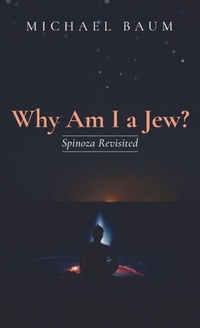
Why Am I a Jew?
Spinoza Revisited
Published on 6. January 2022
Book
Hardback
162 pages
978-1-6667-2302-1 (ISBN)
Description
The book starts by considering mankind's role in the complex ecological system of our planet and then considers the place of mankind in the cosmos while also looking inward at our own microcosm. It then explains how these scientific insights lead to the ontological search for God. The good, the bad, and the ugly sides of religious beliefs are considered and it is suggested that we are looking for ""God"" in the wrong place. The book then explains a justification for the author's apparent cognitive dissonance of retaining a Jewish identity whilst denying the existence of a God with the attributes of man. The author then argues that we should look for ""God"" in the infinitely small spaces within ourselves instead of the infinitely large spaces of the universe. His ""God"" would not mind whether individuals believed in ""him"" or not, so long as they practiced their life as the author practices his medicine: in a never-ending quest to improve the length and quality of the lives of his patients. This book should improve the reader's knowledge of the philosophers who wrote on the ontology of God. It also rediscovers that Baruch Spinoza had already reached the conclusions of modern-day thinkers more than 350 years ago.
More details
Language
English
Place of publication
United States
Product notice
sewn/stitched
Cloth over boards
With dust jacket
Dimensions
Height: 222 mm
Width: 145 mm
Thickness: 13 mm
Weight
343 gr
ISBN-13
978-1-6667-2302-1 (9781666723021)
Copyright in bibliographic data and cover images is held by Nielsen Book Services Limited or by the publishers or by their respective licensors: all rights reserved.
Schweitzer Classification
Other editions
Additional editions
E-Book
01/2022
Wipf and Stock Publishers
€18.49
Available for download
Person
Michael Baum qualified in medicine at Birmingham University in 1960. He held chairs of surgery at Kings College London, the Institute of Cancer Research, and University College London. On retiring as a professor of surgery at University College London in 2010, he spent the rest of his career teaching and promoting ""medical humanities"" including fine art, literature, and philosophy. He was a medical officer at the Masada dig and researched biblical archaeology at the Palestine Exploration Fund.