

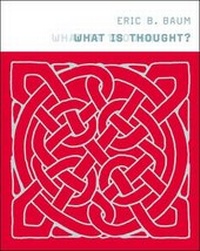
What is Thought?
Published on 19. December 2003
Book
Hardback
492 pages
978-0-262-02548-5 (ISBN)
Description
In What Is Thought? Eric Baum proposes a computational
explanation of thought. Just as Erwin Schrodinger in his classic 1944 work What Is Life?
argued ten years before the discovery of DNA that life must be explainable at a
fundamental level by physics and chemistry, Baum contends that the present-day inability of computer
science to explain thought and meaning is no reason to doubt there can be such an explanation. Baum
argues that the complexity of mind is the outcome of evolution, which has built thought processes
that act unlike the standard algorithms of computer science and that to understand the mind we need
to understand these thought processes and the evolutionary process that produced them in
computational terms.
Baum proposes that underlying mind is a complex but compact
program that corresponds to the underlying structure of the world. He argues further that the mind
is essentially programmed by DNA. We learn more rapidly than computer scientists have so far been
able to explain because the DNA code has programmed the mind to deal only with meaningful
possibilities. Thus the mind understands by exploiting semantics, or meaning, for the purposes of
computation; constraints are built in so that although there are myriad possibilities, only a few
make sense. Evolution discovered corresponding subroutines or shortcuts to speed up its processes
and to construct creatures whose survival depends on making the right choice quickly. Baum argues
that the structure and nature of thought, meaning, sensation, and consciousness therefore arise
naturally from the evolution of programs that exploit the compact structure of the world.
explanation of thought. Just as Erwin Schrodinger in his classic 1944 work What Is Life?
argued ten years before the discovery of DNA that life must be explainable at a
fundamental level by physics and chemistry, Baum contends that the present-day inability of computer
science to explain thought and meaning is no reason to doubt there can be such an explanation. Baum
argues that the complexity of mind is the outcome of evolution, which has built thought processes
that act unlike the standard algorithms of computer science and that to understand the mind we need
to understand these thought processes and the evolutionary process that produced them in
computational terms.
Baum proposes that underlying mind is a complex but compact
program that corresponds to the underlying structure of the world. He argues further that the mind
is essentially programmed by DNA. We learn more rapidly than computer scientists have so far been
able to explain because the DNA code has programmed the mind to deal only with meaningful
possibilities. Thus the mind understands by exploiting semantics, or meaning, for the purposes of
computation; constraints are built in so that although there are myriad possibilities, only a few
make sense. Evolution discovered corresponding subroutines or shortcuts to speed up its processes
and to construct creatures whose survival depends on making the right choice quickly. Baum argues
that the structure and nature of thought, meaning, sensation, and consciousness therefore arise
naturally from the evolution of programs that exploit the compact structure of the world.
More details
Series
Language
English
Place of publication
Massachusetts
United States
Publishing group
MIT Press Ltd
Target group
Professional and scholarly
Interest Age: From 18 years
Illustrations
34 illus.
Dimensions
Height: 229 mm
Width: 178 mm
Thickness: 25 mm
Weight
907 gr
ISBN-13
978-0-262-02548-5 (9780262025485)
Copyright in bibliographic data and cover images is held by Nielsen Book Services Limited or by the publishers or by their respective licensors: all rights reserved.
Schweitzer Classification
Person
Eric B. Baum has held positions at the University of California at Berkeley, Caltech, MIT, Princeton, and the NEC Research Institute. He is currently developing algorithms based on Machine Learning and Bayesian Reasoning to found a hedge fund.