

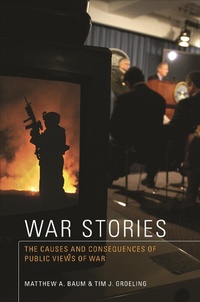
War Stories
The Causes and Consequences of Public Views of War
Published on 3. January 2010
Book
Paperback/Softback
368 pages
978-0-691-13859-6 (ISBN)
Description
How does the American public formulate its opinions about U.S. foreign policy and military engagement abroad? War Stories argues that the media systematically distort the information the public vitally needs to determine whether to support such initiatives, for reasons having more to do with journalists' professional interests than the merits of the policies, and that this has significant consequences for national security. Matthew Baum and Tim Groeling develop a "strategic bias" theory that explains the foreign-policy communication process as a three-way interaction among the press, political elites, and the public, each of which has distinct interests, biases, and incentives. Do media representations affect public support for the president and faithfully reflect events in times of diplomatic crisis and war? How do new media--especially Internet news and more partisan outlets--shape public opinion, and how will they alter future conflicts? In answering such questions, Baum and Groeling take an in-depth look at media coverage, elite rhetoric, and public opinion during the Iraq war and other U.S. conflicts abroad.
They trace how traditional and new media select stories, how elites frame and sometimes even distort events, and how these dynamics shape public opinion over the course of a conflict. Most of us learn virtually everything we know about foreign policy from media reporting of elite opinions. In War Stories, Baum and Groeling reveal precisely what this means for the future of American foreign policy.
They trace how traditional and new media select stories, how elites frame and sometimes even distort events, and how these dynamics shape public opinion over the course of a conflict. Most of us learn virtually everything we know about foreign policy from media reporting of elite opinions. In War Stories, Baum and Groeling reveal precisely what this means for the future of American foreign policy.
Reviews / Votes
"In this landmark study, Baum and Groeling reveal how foreign policy messages are conveyed and undermined."--Lawrence D. Freedman, Foreign Affairs "War Stories ... makes an invaluable contribution to several literatures--politician-journalist interactions, news production, public reactions to news, foreign policymaking, and the new media. That War Stories has so much to say about so many important topics is a remarkable achievement. I learned much from this thoughtful study. It changed my thinking about a number of topics, and I recommend it to those interested in news production, communications research, public opinion, and policymaking."--Jeffrey E. Cohen, Public Opinion Quarterly "If you're studying American foreign policy, or American media, this is an essential book that will only provide detailed arguments and information backed up by a wealth of evidence. I have no doubt that researchers will also find inspiration for further studies from some of these sections."--Stefan Fergus, Civilian Reader "[S]cientific, meticulous, and nuanced."--David L. Paletz, Perspectives on PoliticsMore details
Language
English
Place of publication
New Jersey
United States
Target group
College/higher education
Professional and scholarly
Product notice
Paperback (trade)
Illustrations
39 line illus. 30 tables.
Dimensions
Height: 231 mm
Width: 152 mm
Thickness: 23 mm
Weight
499 gr
ISBN-13
978-0-691-13859-6 (9780691138596)
Copyright in bibliographic data and cover images is held by Nielsen Book Services Limited or by the publishers or by their respective licensors: all rights reserved.
Schweitzer Classification
Other editions
Additional editions
Book
01/2010
Princeton University Press
€76.75
Article exhausted; check different version
E-Book
12/2009
1st Edition
Princeton University Press
€36.99
Available for download
Persons
Matthew A. Baum is the Marvin Kalb Professor of Global Communications and professor of public policy and government at Harvard University. Tim J. Groeling is associate professor of communication studies at the University of California, Los Angeles.
Content
List of Figures ix List of Tables xiii Preface xv Acknowledgments xvii Chapter One: News, Opinion, and Foreign Policy 1 Chapter Two: Politics across the Water's Edge 17 Chapter Three: Elite Rhetoric, Media Coverage, and Rallying'Round the Flag 46 Chapter Four: War Meets the Press: Strategic Media Bias and Elite Foreign Policy Evaluations 89 Chapter Five: Shot by the Messenger: An Experimental Examination of the Effects of Party Cues on Public Opinion Regarding National Security and War 114 Chapter Six: Tidings of Battle: Polarizing Media and Public Support for the Iraq War 149 Chapter Seven: "Reality Asserted Itself": The Elasticity of Reality and the War in Iraq 186 Chapter Eight: Barbarians inside the Gates: Partisan New Media and the Polarization of American Political Discourse 230 Chapter Nine: Back to the Future: Foreign Policy in the Second Era of the Partisan Press 284 References 297 Index 315