

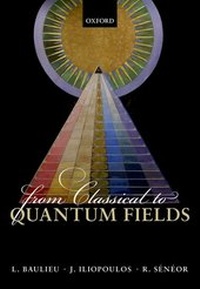
From Classical to Quantum Fields
Published on 2. February 2017
Book
Paperback/Softback
950 pages
978-0-19-878840-9 (ISBN)
Description
Quantum Field Theory has become the universal language of most modern theoretical physics. This introductory textbook shows how this beautiful theory offers the correct mathematical framework to describe and understand the fundamental interactions of elementary particles. The book begins with a brief reminder of basic classical field theories, electrodynamics and general relativity, as well as their symmetry properties, and proceeds with the principles of quantisation following Feynman's path integral approach. Special care is used at every step to illustrate the correct mathematical formulation of the underlying assumptions. Gauge theories and the problems encountered in their quantisation are discussed in detail. The last chapters contain a full description of the Standard Model of particle physics and the attempts to go beyond it, such as grand unified theories and supersymmetry. Written for advanced undergraduate and beginning graduate students in physics and mathematics, the book could also serve as a reference for active researchers in the field.
Reviews / Votes
From Classical to Quantum Fields makes for a fine companion for students and an excellent general reference for researchers in theoretical physics. * Francesca Vidotto, Physics Today * This monograph constitutes useful material for readers interested in updating their understanding of quantum theory. The presentation is very pleasant. * Francisco Marcell? an, Mathematical Reviews Clippings * I found this book to be unusually well-written and well-organised. There is a lot of material covered, and I expect to keep this book within easy reach to peruse as desired. This book is an amazing resource for anyone interested in learning QFT. * Andrew Resnick, Contemporary Physics * The presentation is at a level appropriate for graduate students and can be a resource for professionals...Recommended. * CHOICE * Everything is done in great detail, and the reader who stays with the discussion from beginning to end will obtain a fabulous education in modern physics, as well as a load of very solid ancillary mathematics. What a book! * Michael Berg, Mathematical Association of America * This is a book on field theory, carefully written by the top experts in the field (no pun intended). It will be very useful for students studying this fundamental and complicated subject. * A. Polyakov, Department of Physics, Princeton University * This is a major contribution to the literature. Starting out with very elementary considerations, it proceeds to reach some of the frontiers in the field. From Classical to Quantum Fields is a fantastic resource to learn quantum field theory. It was a pleasure to read. * Luis Alvarez-Gaume, Theoretical Physics Department, CERN, Switzerland *More details
Language
English
Place of publication
Oxford
United Kingdom
Target group
College/higher education
Product notice
Paperback (trade)
Unsewn / adhesive bound
Illustrations
118
Dimensions
Height: 251 mm
Width: 103 mm
Thickness: 66 mm
Weight
1758 gr
ISBN-13
978-0-19-878840-9 (9780198788409)
Copyright in bibliographic data and cover images is held by Nielsen Book Services Limited or by the publishers or by their respective licensors: all rights reserved.
Schweitzer Classification
Other editions
Additional editions
Laurent Baulieu | John Iliopoulos | Roland Sénéor
From Classical to Quantum Fields
E-Book
02/2017
1st Edition
OUP eBook
€68.49
Available for download
Laurent Baulieu | John Iliopoulos | Roland Seneor
From Classical to Quantum Fields
Book
02/2017
Oxford University Press
€169.00
Shipment within 15-20 days
Persons
Laurent Baulieu is currently CNRS Research Director at the University of Paris, where he has long been the head of the Theoretical Physics Department. His main field of research is Quantum Field Theory, the
Theory of Elementary Particles and Symmetries. He has been an organizer of many summer schools and workshops on various aspects of Quantum Field Theory, especially in les Houches and in the Cargese Institute in Corsica.
John Iliopoulos is Director of Research Emeritus at the Ecole Normale Superieure in Paris, where for many years he was the head of the Theoretical Physics Department. His research was centred around theoretical particle physics. In 1970, in collaboration with Sheldon Glashow and Luciano Maiani, he predicted the existence of the charm quark and proposed the GIM mechanism, an important step in the construction of the Standard Model. He has also contributed to the development of supersymmetry (with Bruno Zumino and Pierre Fayet). He has received many awards, such as the Ricard Prize of the French Physical Society, the Sakurai Prize of the American Physical Society, the High Energy Physics Prize of the European Physical Society and the Dirac Medal.
Roland Seneor is Director of Research Emeritus at the French CNRS. He spent most of his career at the Ecole Polytechnique, where he established and directed the Graduate School and was the Head of the Department for International Scientific Relations. His research centered on the mathematical foundations of QFT: the axiomatic formulation, the constructive approach, the summability of the perturbation expansion and the study of dynamic stochastic models. He has received various awards, including the Langevin Prize of the French Physical Society.
Theory of Elementary Particles and Symmetries. He has been an organizer of many summer schools and workshops on various aspects of Quantum Field Theory, especially in les Houches and in the Cargese Institute in Corsica.
John Iliopoulos is Director of Research Emeritus at the Ecole Normale Superieure in Paris, where for many years he was the head of the Theoretical Physics Department. His research was centred around theoretical particle physics. In 1970, in collaboration with Sheldon Glashow and Luciano Maiani, he predicted the existence of the charm quark and proposed the GIM mechanism, an important step in the construction of the Standard Model. He has also contributed to the development of supersymmetry (with Bruno Zumino and Pierre Fayet). He has received many awards, such as the Ricard Prize of the French Physical Society, the Sakurai Prize of the American Physical Society, the High Energy Physics Prize of the European Physical Society and the Dirac Medal.
Roland Seneor is Director of Research Emeritus at the French CNRS. He spent most of his career at the Ecole Polytechnique, where he established and directed the Graduate School and was the Head of the Department for International Scientific Relations. His research centered on the mathematical foundations of QFT: the axiomatic formulation, the constructive approach, the summability of the perturbation expansion and the study of dynamic stochastic models. He has received various awards, including the Langevin Prize of the French Physical Society.
Content
1: Introduction 2: Relativistic Invariance 3: The Electromagnetic Field 4: General relativity: A Field Theory of Gravitation 5: The Physical States 6: Relativistic Wave Equations 7: Towards a Relativistic Quantum Mechanics 8: Functional Integrals and Probabilistic Amplitudes 9: Functional Integrals and Quantum Mechanics: Formal Developments 10: The Euclidean Functional Integrals 11: Fermions and Functional Formalism 12: Relativistic Quantum Fields 13: Applications 14: Geometry and Quantum Dynamics 15: Broken Symmetries 16: Quantum Field Theory at Higher Orders 17: A First Glance at Renormalisation and Symmetry 18: Renormalisation of Yang-Mills Theory and BRST Symmetry 19: Some Consequences of the Renormalisation Group 20: Analyticity Properties of Feynman Diagrams 21: Infrared Singularities 22: Coherent States and Classical Limit of Quantum Electrodynamics 23: Quantum Field Theories with a Large Number of Fields 24: The Existence of Field Theories beyond the Perturbation Expansion 25: Fundamental Interactions 26: Beyond the Standard Model 27: Supersymmetry, or the Defense of Scalars Appendix A: Tensor Calculus Appendix B: Differential Calculus Appendix C: Groups and Lie Algebras Appendix D: A collection of Useful Formulae Appendix E: Extract from Maxwell's A Treatise on Electricity and Magnetism