

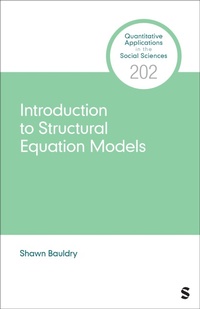
Introduction to Structural Equation Models
1st Edition
Will be published approx. on 14. December 2026
Book
Paperback/Softback
160 pages
979-8-3488-4688-6 (ISBN)
Description
Unlock the power of SEMs-learn to model complex social and behavioral relationships with clarity, hands-on examples, and practical tools for real research.
Reviews / Votes
Shawn Bauldry's Introduction to Structural Equation Models is a clear, comprehensible, and thoughtful guide to SEMs. With relatable examples, balanced coverage of theory and application, and attention to contemporary issues like mediation and categorical outcomes, this book will be invaluable for graduate students and instructors alike. -- John Hoffman This book is a game changer. Our program evaluation students need to understand SEM to excel, and this book will transform them from timid to eager. The quality of their projects will improve significantly because they will go beyond memorizing jargon to truly comprehending the purpose and process of SEM in applied settings. -- Rick SperlingMore details
Series
Language
English
Place of publication
Thousand Oaks
United States
Target group
College/higher education
Product notice
Paperback (trade)
Unsewn / adhesive bound
Dimensions
Height: 216 mm
Width: 140 mm
ISBN-13
979-8-3488-4688-6 (9798348846886)
Copyright in bibliographic data and cover images is held by Nielsen Book Services Limited or by the publishers or by their respective licensors: all rights reserved.
Schweitzer Classification
Person
Shawn Bauldry is a professor in the Department of Sociology at Purdue University. He is co-author, with J. Micah Roos, of Confirmatory Factor Analysis and has published methodological research in sociological and psychological methodology journals, including top-tier journals such as Sociological Methodology, Psychological Methods, and Structural Equation Modeling. His methodological research focuses on the development of structural equation models, particularly measurement models and models for longitudinal data. His substantive research focuses on demographic analyses of aging and health.
Content
About the Authors
Preface
Series Editor's Introduction
Acknowledgments
Chapter 1: Introduction
Latent and Observed Variables
Multiple Endogenous Variables
General Structural Equation Model
Statistical Software and Code
Outline of Book
Further Reading
Chapter 2: Model Specification
Measurement Model
Structural Model
*SEMs and DAGs
Conclusion
Chapter 3: Identification and Estimation
Model Identification
Estimators
Conclusion
Chapter 4: Model Evaluation and Modification
Overall Model Fit
Localized Model Fit
Comparative Model Fit
Model Modification
Conclusion
Chapter 5: Mediation Analysis
Classical Approach
*Counterfactual Approach
Sensitivity Analyses
Conclusion
Chapter 6: Categorical and Limited Endogenous Variables
Binary and Ordinal Variables
Estimators
Model Fit and Parameter Interpretation
Generalized Linear Model Framework
Conclusion
Chapter 7: FinalWords
Extensions
Pitfalls
Appendix: General SEM in Matrix Notation
References
Index
Preface
Series Editor's Introduction
Acknowledgments
Chapter 1: Introduction
Latent and Observed Variables
Multiple Endogenous Variables
General Structural Equation Model
Statistical Software and Code
Outline of Book
Further Reading
Chapter 2: Model Specification
Measurement Model
Structural Model
*SEMs and DAGs
Conclusion
Chapter 3: Identification and Estimation
Model Identification
Estimators
Conclusion
Chapter 4: Model Evaluation and Modification
Overall Model Fit
Localized Model Fit
Comparative Model Fit
Model Modification
Conclusion
Chapter 5: Mediation Analysis
Classical Approach
*Counterfactual Approach
Sensitivity Analyses
Conclusion
Chapter 6: Categorical and Limited Endogenous Variables
Binary and Ordinal Variables
Estimators
Model Fit and Parameter Interpretation
Generalized Linear Model Framework
Conclusion
Chapter 7: FinalWords
Extensions
Pitfalls
Appendix: General SEM in Matrix Notation
References
Index