

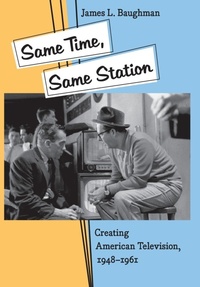
Same Time, Same Station
Creating American Television, 1948-1961
Published on 21. May 2007
Book
Hardback
460 pages
978-0-8018-7933-3 (ISBN)
Description
Ever wonder how American television came to be the much-derided, advertising-heavy home to reality programming, formulaic situation comedies, hapless men, and buxom, scantily clad women? Could it have been something different, focusing instead on culture, theater, and performing arts? In Same Time, Same Station, historian James L. Baughman takes readers behind the scenes of early broadcasting, examining corporate machinations that determined the future of television. Split into two camps-those who thought TV could meet and possibly raise the expectations of wealthier, better-educated post-war consumers and those who believed success meant mimicking the products of movie houses and radio-decision makers fought a battle of ideas that peaked in the 1950s, just as TV became a central facet of daily life for most Americans. Baughman's engagingly written account of the brief but contentious debate shows how the inner workings and outward actions of the major networks, advertisers, producers, writers, and entertainers ultimately made TV the primary forum for entertainment and information.
The tale of television's founding years reveals a series of decisions that favored commercial success over cultural aspiration.
The tale of television's founding years reveals a series of decisions that favored commercial success over cultural aspiration.
Reviews / Votes
Baughman's study is interesting from a policy point of view... it is also evocative as a spin through the index will show. History Wire 2007 Baughman tells a familiar story-commerce crushes cultural aspiration-but he adds fresh and fascinating details from behind the scenes at the television networks. And he avoid nostalgia for a 'golden age' of television that never was. Philadelphia Inquirer 2007 The period that Baughman covers is the 'golden age of television'-the much mourned era of dramas by Paddy Chayefsky and documentaries by Edward R. Murrow... Although Baughman is scrupulously respectful of the achievements of Weaver, Murrow, and other heroes of fifties television, he never misses a chance to offer up contrarian material. -- Nicholas Lemann New Yorker 2007 Though not the first study of this period, this is surely one of the more readable and insightful - and well documented. -- Chris Sterling Communication Booknotes Quarterly 2007 This book is full of interesting stories and facts. Summing Up: Essential. Choice 2007 College-level collections strong in media history will find this an attractive addition... accessible even to lay readers. Midwest Book Review 2008 The most thorough, well-researched, and broad-ranging history of television we have to date... Baughman's achievement is a major one. Business History Review 2007 Readers of Journalism History... are urged to read this book. -- Alexander Russo Journalism History 2008 A thought-provoking book... Does a masterful job of engaging the academic discourse and media theory. -- Andrew J. Falk Register of the Kentucky Historical Society 2007 Same Time, Same Station is a scholarly pleasure to explore and should be in every university library where media studies are taken seriously. -- Peter C. Rollins Journal of American History 2010More details
Language
English
Place of publication
Baltimore, MD
United States
Product notice
sewn/stitched
Paper over boards
With dust jacket
Illustrations
19 s/w Photographien bzw. Rasterbilder
19 Halftones, black and white
Dimensions
Height: 230 mm
Width: 163 mm
Thickness: 38 mm
Weight
767 gr
ISBN-13
978-0-8018-7933-3 (9780801879333)
DOI
10.1353/book.3381
Copyright in bibliographic data and cover images is held by Nielsen Book Services Limited or by the publishers or by their respective licensors: all rights reserved.
Schweitzer Classification
Other editions
Additional editions
E-Book
05/2007
Johns Hopkins University Press
€29.49
Available for download
Person
James L. Baughman is professor and director of the School of Journalism and Mass Communication at the University of Wisconsin-Madison and author of The Republic of Mass Culture: Journalism, Filmmaking, and Broadcasting in America since 1941 and Henry R. Luce and the Rise of the American News Media, both published by the Johns Hopkins University Press.
Content
Acknowledgments
Introduction
1. Opening Number
2. "The Mother of Television"
3. The Marionette and the Cross-Dresser
4. The Regulators
5. "Mr. Spectacular"
6. Paley's Choice
7. "We Just See That It Isn't Lousy"
8. The Patrons
9. "Informed without Being Ponderous"
10. Shooting the Wounded
11. Signing Off
Notes
Essay on Sources
Index
Introduction
1. Opening Number
2. "The Mother of Television"
3. The Marionette and the Cross-Dresser
4. The Regulators
5. "Mr. Spectacular"
6. Paley's Choice
7. "We Just See That It Isn't Lousy"
8. The Patrons
9. "Informed without Being Ponderous"
10. Shooting the Wounded
11. Signing Off
Notes
Essay on Sources
Index