

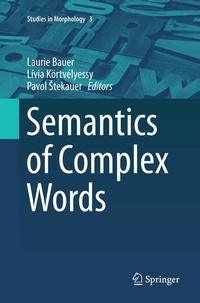
Semantics of Complex Words
Published on 9. October 2016
Book
Paperback/Softback
X, 319 pages
978-3-319-38152-7 (ISBN)
Description
This volume offers a valuable overview of recent research into the semantic aspects of complex words through different theoretical frameworks. Contributions by experts in the field, both morphologists and psycholinguists, identify crucial areas of research, present alternative and complementary approaches to their examination from the current level of knowledge, and indicate perspectives of research into the semantics of complex words by raising important questions that need to be investigated in order to get a more comprehensive picture of the field. Recent decades have seen both extensive and intensive development of various theories of word-formation, however, the semantic aspects of complex words have, with a few notable exceptions, been rather neglected. This volume fills that gap by offering articles written by leading experts in the field from various theoretical backgrounds.
More details
Series
Edition
Softcover reprint of the original 1st ed. 2015
Language
English
Place of publication
Cham
Switzerland
Publishing group
Springer International Publishing
Target group
Professional and scholarly
Illustrations
40 s/w Abbildungen, 2 farbige Abbildungen
X, 319 p. 42 illus., 2 illus. in color.
Dimensions
Height: 235 mm
Width: 155 mm
Thickness: 19 mm
Weight
505 gr
ISBN-13
978-3-319-38152-7 (9783319381527)
DOI
10.1007/978-3-319-14102-2
Schweitzer Classification
Other editions
Additional editions
Laurie Bauer | Lívia Körtvélyessy | Pavol Stekauer
Semantics of Complex Words
Book
03/2015
Springer
€106.99
Shipment within 10-15 days
Content
Introduction.- Semantics, Concepts, and Meta-Cognition: Attributing Properties and Meanings to Complex Concepts.- The Interface of Semantic Interpretation and Inflectional Realization.- The Role of Second Order Schemas in the Construction of Complex Words.- Sense Inheritance in English Word-Formation.- Word-Formation Strategies: Semantic Transparency vs. Formal Economy.- Lexeme Formation in a Conscious Approach to The Lexicon.- Remarks on Tautology in Word-Formation.- Form and Meaning of Bahuvrihi Compounds: Evidence from Modern Greek and its Dialects.- Transpositions and the Limits of Word Formation.- Structural Sensitivity as an Argument for Underspecification.- Stacking as a Reflex and Indicator of (Proto-)Typical Selectional Restrictions.- Thoughts on Morphology and Cultural Evolution.- Predicting the Semantics of English Nominalizations: A Frame-Based Analysis of -ment Suffixation.